UL 3700 Explained: What Plug-in Solar Certification Means and How to Check It
Shop for a plug-in solar kit and you will see phrases like “UL 3700 certified,” “UL 3700 compliant” and “UL listed.” They sound alike and mean different things. Several state laws now point to UL 3700 or to a “nationally recognized testing laboratory,” so the wording on a listing can matter for what you are allowed to plug in. This guide explains what UL 3700 is, what it checks, which states name it, how to read certification claims, and how to check one yourself.
- UL 3700 is UL Solutions’ evaluation document for plug-in solar. It is not a law, and no federal rule we found requires it. State laws decide.
- Vermont, Maine and New Jersey name UL 3700 in the text we read. Virginia, New Hampshire and Colorado ask for a nationally recognized testing laboratory (NRTL). Connecticut names UL 1741.
- “Certified,” “compliant” and “listed” are not interchangeable. Only a lab’s own database can confirm a certification.
- Reports about which products are certified conflict. Treat a seller’s claim as a claim until you have checked it.
- Certification does not tell you whether your wiring can take the power. See our guide to wattage limits and circuit safety.
What UL 3700 is
UL 3700 is titled the “Outline of Investigation for Interactive Plug-In Photovoltaic Equipment and Systems.” UL Solutions, the safety science company, announced a testing and certification program built on it on January 8, 2026. The program sets construction, performance and labeling criteria for plug-in (“balcony”) solar systems. pv magazine USA reports that the document was published in late 2025 and that products that pass are authorized to carry a UL 3700 mark.
It is worth being precise about what it is not. It is a document from a private company, not a statute, and it does not say where you may install a kit or how much power you may feed in. Those rules come from state laws, utilities and, for wiring, the electrical code.
What UL 3700 checks
UL Solutions says UL 3700 calls for features that:
- reduce accidental contact with hazardous live parts,
- support safe installation,
- protect against overloads, and
- prevent current from flowing backward into the grid.
UL’s white paper, as summarized by pv magazine USA in August 2026, names three hazards behind these requirements. Overcurrent: power fed back through an outlet can push the combined current on a circuit past what the wire can carry without tripping the breaker. Touch safety: grid-connected inverters were not evaluated for contact by users, so plug blades can be energized in sunlight. GFCI compatibility: today’s ground-fault standards assume current flows one way.
IEEE Spectrum reported in July 2026 that UL 3700 requires ground-fault devices built to handle current in both directions, along with wiring methods that add overcurrent protection and minimum insulation thickness. It also quoted a researcher at the Electric Power Research Institute (EPRI) saying a bidirectional GFCI disconnect of the kind some requirements call for was not yet commercially available, so some requirements may not be solvable at this time. UL’s public announcement does not list individual tests or numeric limits, so we do not either.
Is UL 3700 required?
Not by a national rule that we could find. Whether you need it depends on the state. This is what the enacted or enrolled text says, as read for our wattage limit guide:
| State | Certification wording we read | Source |
|---|---|---|
| Vermont | UL 3700 or equivalent | Act 149 |
| Maine | UL 3700 or a comparable standard | LD 1730 |
| New Jersey | UL 3700 or a comparable standard (third reprint of the bill) | S2368 |
| Virginia | Certified by an NRTL | HB 395 |
| New Hampshire | Certified by an NRTL | SB 540 |
| Colorado | Labeled and listed by an NRTL | HB26-1007 |
| Connecticut | UL or equivalent NRTL, and UL 1741 | Public Act 26-127 |
| Utah | UL or an equivalent NRTL | HB 340 |
An NRTL is a lab that the US Occupational Safety and Health Administration (OSHA) recognizes. Under 29 CFR 1910.7, an NRTL must have the facilities and procedures to test equipment, control its marks, inspect factory production and be independent of the manufacturers whose products it tests. So “NRTL” describes who did the testing. It does not name a standard. A product can carry an NRTL mark for a different standard than UL 3700.
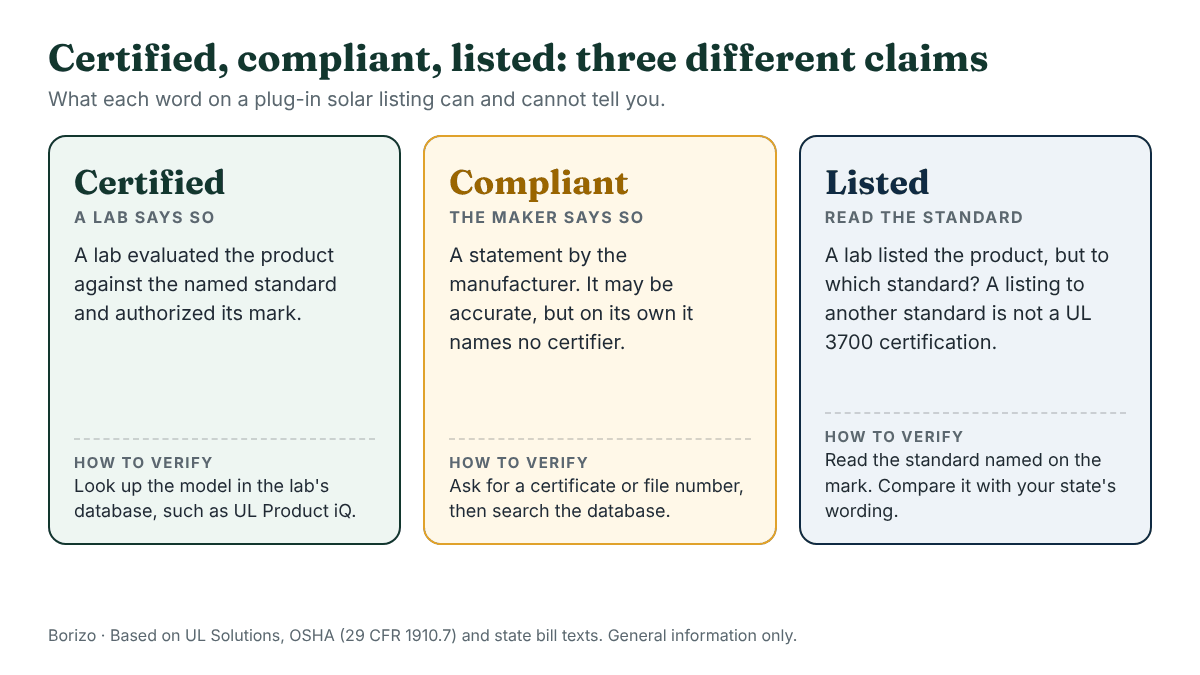
Certified, compliant, listed: reading the label
- Certified to UL 3700. A lab has evaluated the product against UL 3700 and authorized its mark. This is the claim you can verify in the lab’s database.
- Compliant with UL 3700. A statement by the maker. It may be true, and it may mean a certification is in progress, but on its own it does not tell you a lab has signed off. For example, Hoymiles’ July 15, 2026 announcement of its HiFlow Pro microinverter uses “compliant” and does not name a certifier, while other reports describe the product as certified. Wording differs between sources, so confirm it yourself.
- Listed. A lab has listed the product, but you have to read to which standard. A listing to another standard, such as UL 1741 for grid-connected inverters, is not a UL 3700 certification, even though it is a real safety mark.
What is actually certified today?
Sources disagree, which is a reason to check rather than assume.
- IEEE Spectrum (July 20, 2026) reported that no panels had met the standard yet, with an exception for one microinverter, and added a correction on July 21 saying it does meet UL 3700. The article does not name the product.
- pv magazine USA (July 15, 2026) reported the Hoymiles HiFlow Pro as “compliant.”
- A September 2026 article on solar.com says Hoymiles, APsystems and Mango Power have certified products. It cites the companies’ own websites, and solar.com also promotes rooftop solar quotes, so we treat it as a lead to check.
- Environment America said in a statement that no whole-system kit had received UL 3700 certification as of July 2026.
A product can be certified while the complete kit (panels, cables, mounting) is not, which may explain some of the differences. We have not been able to check UL’s own database from our research setup, so we do not endorse any product as certified. Our future kit comparisons will say which claims we have and have not confirmed.
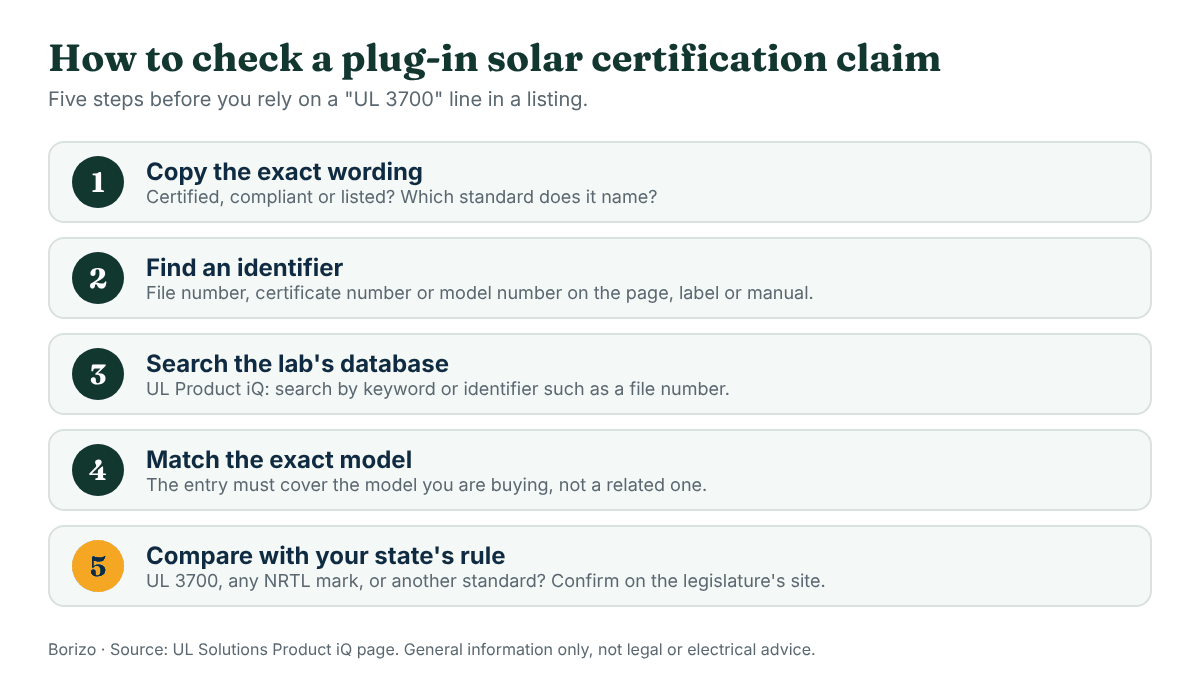
How to check a certification yourself
- Copy the exact words. Note whether the listing says certified, compliant or listed, and which standard it names.
- Find an identifier. Look for a file number, certificate number or model number on the product page, label or manual. A seller who cannot give one is a warning sign.
- Search UL’s database. UL Solutions says you can verify a certification in Product iQ, searching by keyword or by identifiers such as a file number. If the entry’s status is unclear, UL says its Customer Experience Center can confirm whether a certification is currently valid.
- Match the model. Check that the database entry covers the exact model you are buying, not a related one.
- Check your state’s wording. Your state may require UL 3700, any NRTL certification, or a specific other standard. Use the table above and the State Laws hub, then confirm on the legislature’s site.
What certification does not cover
A certification covers the product as tested. It does not cover your house. The same UL Solutions concern that led to UL 3700, branch-circuit overload, still depends on what else is on the circuit, the breaker rating and the age of the wiring. Stateline reported in September 2026 that UL’s current certification expects residents to modify their home circuits, though experts expect future products might handle this with built-in technology. The 2026 National Electrical Code does not specifically address plug-in solar, according to PV Tech. Read the circuit safety section of our wattage limit guide and ask a licensed electrician before you plug in.
Frequently asked questions
Is UL 3700 required by federal law?
We found no federal requirement. Some state laws name UL 3700 and others point to NRTL certification or a different standard, so the answer depends on where you live.
What is the difference between UL 3700 and UL 1741?
They are different UL documents. Connecticut’s law names UL 1741 in addition to a UL or equivalent NRTL listing, while Vermont, Maine and New Jersey name UL 3700 or a comparable standard. A product can hold one without the other, so read which standard a listing names.
Does “UL 3700 compliant” mean the same as certified?
Not necessarily. “Compliant” is usually the maker’s statement, while “certified” means a lab has evaluated the product and authorized its mark. Check the database before you rely on either.
Does a certified kit mean my circuit is safe?
No. Certification applies to the product. Whether your wiring can handle the combined current depends on your home, which is why electricians recommend checking the circuit.
Sources
- UL Solutions, “UL Solutions debuts testing and certification framework for safer plug-in solar,” January 8, 2026.
- “Ensuring safety of plug-in solar,” pv magazine USA, August 19, 2026.
- “Hoymiles introduces first UL 3700-compliant plug-in microinverter,” pv magazine USA, July 15, 2026.
- “Plug-in solar power,” IEEE Spectrum, July 20, 2026 (with July 21 correction).
- “UL 3700 certification: which plug-in solar products have this safety stamp?” solar.com, September 2026.
- Environment America statement on first national safety certification, 2026.
- Alex Brown, “States want balcony solar safety guidelines,” Stateline, September 30, 2026.
- OSHA, 29 CFR 1910.7, definition and requirements for NRTLs.
- UL Solutions, Product iQ databases.
- State laws: links in the table above.

Borizo is an independent guide to plug-in and balcony solar in the US. We track state laws, check certification claims against official sources, and compare kits using published specifications. Laws change often, so every state page shows a “last updated” date and links to its sources. We earn a commission when you buy through our Amazon links, at no extra cost to you. Our content is for information only and is not legal or electrical advice.