Plug-in Solar Wattage Limits and Circuit Safety, Explained
Almost every US plug-in solar law caps the system at 1,200 watts. That number is easy to repeat and easy to misread. It limits how much a kit may produce. It does not tell you whether your home’s wiring can handle that power, and it is not the same in every state. This guide explains what the limit is in each state we have checked, what safety experts say the real risk is, and what to confirm before you plug anything in.
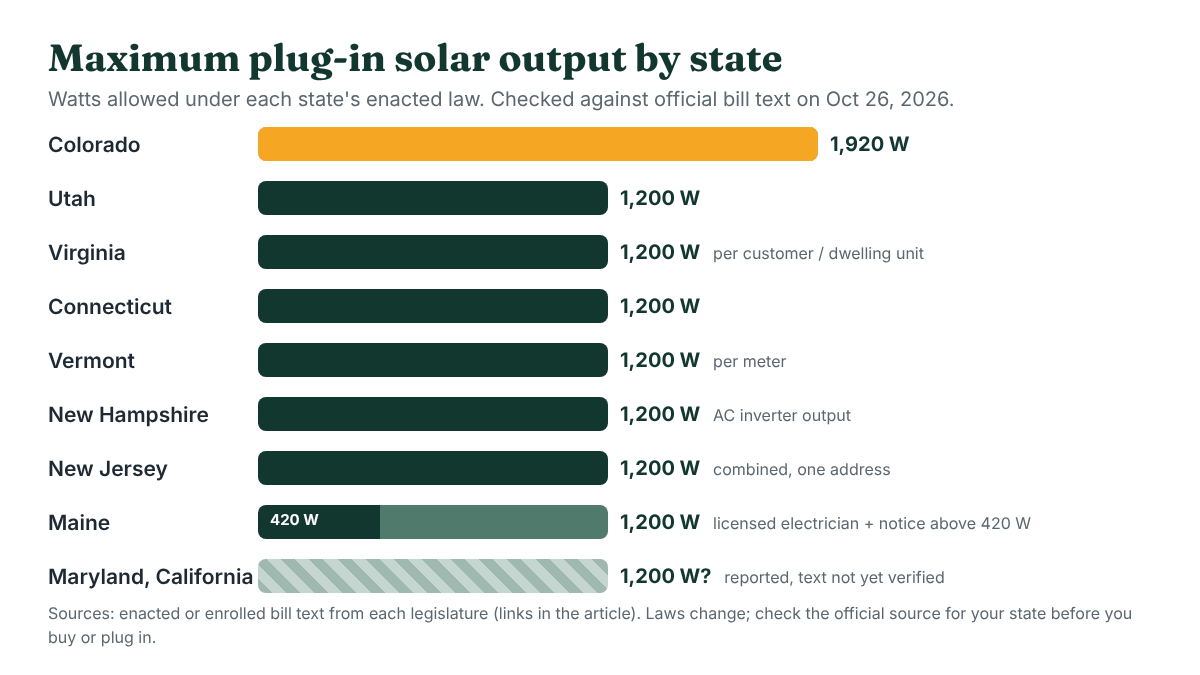
- Most states with a plug-in solar law cap output at 1,200 W. Colorado allows 1,920 W, and Maine splits the rule into two tiers at 420 W.
- Wording differs: per meter, per customer, per dwelling unit or per address. Check which one your state uses.
- UL Solutions and other experts point to branch-circuit overload as the main safety concern, not the wattage number on the box.
- This is general information, not legal or electrical advice. Ask a licensed electrician if you are unsure.
The limit, state by state
The chart and table below come from the enacted or enrolled bill text for each state, read on October 26, 2026. We link the official source for every row.
| State | Limit | Certification wording | Notify the utility? | Source |
|---|---|---|---|---|
| Colorado | 1,920 W; one device per wall outlet | Labeled and listed by a nationally recognized testing laboratory (NRTL) | Utility may require notice | HB26-1007 |
| Connecticut | 1,200 W; one device behind a meter | UL or equivalent NRTL, and UL 1741 | No | Public Act 26-127 |
| Maine | Up to 420 W without an electrician; up to 1,200 W with a licensed electrician and a dedicated circuit | UL 3700 or a comparable standard | Yes, within 30 days, for systems over 420 W | LD 1730 |
| New Hampshire | 1,200 W AC inverter output | Certified by an NRTL | Reporting is informational only | SB 540 |
| New Jersey | 1,200 W combined at one address | UL 3700 or a comparable standard (read in the third reprint of the bill) | No | S2368 |
| Utah | 1,200 W | UL or an equivalent NRTL | None found in the text | HB 340 |
| Vermont | 1,200 W per meter | UL 3700 or equivalent | No | Act 149 |
| Virginia | 1,200 W per customer, or per dwelling unit in multifamily housing | Certified by an NRTL | Yes, using a state form; the utility has 15 days to review | HB 395 |
What the 1,200 W number does not tell you
The limit is a cap on output. It says nothing about the wiring in your walls. We looked for the reason lawmakers settled on 1,200 W and did not find one stated in the sources we read. A Stateline report on balcony solar compares the figure to a hair dryer, and Utah’s law uses it as the point below which a utility contract is no longer required. Those are descriptions of the number, not a safety calculation.
The wording also matters. Virginia counts per customer or dwelling unit. Vermont counts per meter. New Jersey counts the combined output of all devices at one address and lets you exceed 1,200 W only with an interconnection agreement. Colorado allows 1,920 W but limits you to one device per wall outlet. Maine ties the number to who may install the system. If you rent, live in a multifamily building or have more than one kit, the wording decides what is allowed.
The real safety question: the circuit
Home branch circuits are designed for power that flows one way, from the breaker panel to whatever is plugged in. UL Solutions, the safety science company that wrote the plug-in solar standard, says this directly in a July 2026 column for the electrical inspectors’ magazine IAEI: “Branch circuits are designed for one-way power flow from the panelboard to the load.”
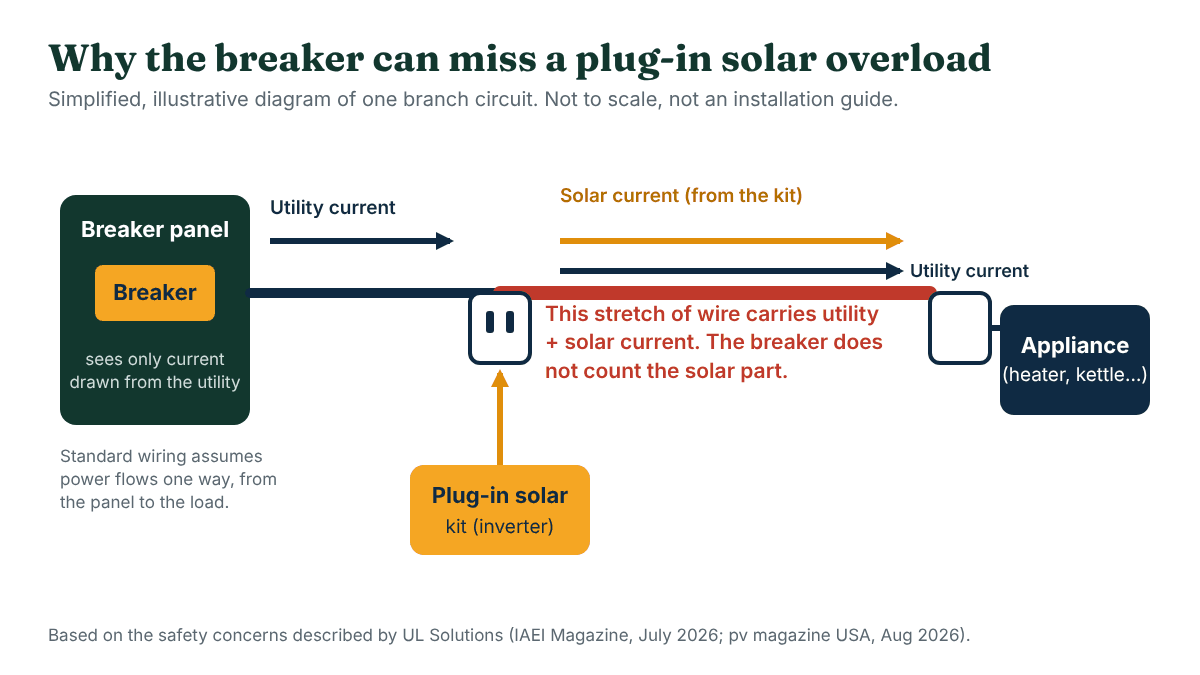
When a plug-in kit feeds power into an outlet, the current from the kit and the current from the utility can add up on the wire between the kit and a large load. Ken Boyce of UL Solutions told PV Tech that the kit injects current into the circuit “that the circuit breaker in the panel board is blind to.” The breaker only measures what comes from the utility, so wiring could carry more than its rating without the breaker tripping. UL’s white paper, summarized by pv magazine USA, warns that undetected overloads “pose risks of fire and electric shock.”
The ideas proposed to reduce this include dedicated circuits, outlets that only solar kits can use, overcurrent protection at the connection point, special plug designs and power-control systems that watch the total current. Stateline reports that UL’s current certification requires residents to modify their home circuits, though experts say future products might handle this with built-in technology.
Other hazards experts name
- Energized plug blades. UL says accessible plug blades can become energized when the panels are in sunlight, which creates a shock risk if the plug is touched.
- Unplugging. A standard plug has not been evaluated as a power source, and the anti-islanding function in inverters was not designed for frequent unplugging.
- GFCI protection. Ground-fault devices assume current flows one way. Current flowing both ways may leave them unable to do their job, especially outdoors.
- Power strips and extension cords. None of the sources we read discuss them. Follow your kit’s manual and ask a licensed electrician before using one.
Where UL 3700 and the electrical code fit
UL 3700 is UL Solutions’ “Outline of Investigation for Interactive Plug-In Photovoltaic Equipment and Systems.” pv magazine USA reports it was released in mid-December 2025, and Solar Builder reported UL’s testing and certification program in January 2026. It sets construction, performance and labeling criteria, including features that limit accidental contact with live parts, protect against overloads and prevent current flowing the wrong way.
Reports about certified products differ. PV Tech reported in late August 2026 that none of the market products UL had tested met the standard and that UL was working toward its first certification. A September 2026 solar.com article, which also promotes rooftop solar quotes, says several products have been certified. We have not confirmed either claim in UL’s own product database. Until we do, treat a “UL 3700 certified” line on a listing as the seller’s claim and check it yourself.
The 2026 National Electrical Code does not specifically address plug-in solar, according to PV Tech. The 2029 edition is being developed with many proposals on the topic. As Ken Boyce put it, until a model code is adopted by your jurisdiction, “it’s not enforceable.” Several states name UL 3700 in their laws (Vermont, Maine and New Jersey in the text we read) while others require certification by a nationally recognized lab or name UL 1741.
A checklist before you plug in
- Find your state’s rule. Check the table above or the State Laws hub, then confirm on the legislature’s site.
- Read the listing and manual closely. Note the exact certification wording, the inverter’s output in watts AC and what the maker says about outlets and circuits.
- Check whether the utility must be told. Virginia, Maine (above 420 W) and Colorado (if the utility asks) involve notice. Connecticut and Vermont do not.
- Know your circuit. Find out what else shares the outlet’s circuit and what the breaker rating is. A licensed electrician can check the wiring.
- Renting or in an HOA? Ask your landlord or association before installing. Some states add protections, but they differ.
- Estimate the payback. Use our savings and payback calculator and the kit size calculator before you buy.
Frequently asked questions
Is the 1,200 W limit per outlet, per home or per meter?
It depends on the state. Virginia counts per customer or dwelling unit, Vermont per meter, Connecticut per customer meter, and New Jersey the combined output at one service address. Colorado adds a limit of one device per wall outlet.
Can I install more than 1,200 W?
The plug-in rules we read treat 1,200 W as the cap, and what applies above it varies and is often not spelled out. New Jersey says exceeding 1,200 W at an address requires an interconnection agreement. Maine allows up to 1,200 W only with a licensed electrician and a dedicated circuit above 420 W. Colorado’s cap is 1,920 W.
Does a 1,200 W kit guarantee my circuit is safe?
No. The wattage limit is a legal cap on output. Safety experts say the question is whether combined current on the wiring stays within its rating, which the breaker cannot always detect for plug-in solar. Ask a licensed electrician about your home.
Do I have to tell my utility?
In some states, yes. Virginia uses a state form, and Maine requires notice for systems over 420 W. Colorado lets the utility require notice. In Connecticut and Vermont no notice is required, and New Hampshire’s reporting is informational. Check your utility too.
Sources
- State laws: links in the table above, all official bill or act text.
- UL Solutions, “Question Corner,” IAEI Magazine, July 1, 2026.
- Anne Fischer, “Ensuring safety of plug-in solar,” pv magazine USA, August 19, 2026.
- Shreeyashi Ojha, “US plug-in solar: questions remain over safety, certifications and regulation,” PV Tech, August 26, 2026.
- Alex Brown, “States want balcony solar safety guidelines,” Stateline, September 30, 2026.
- John Fitzgerald Weaver, “How to build a balcony solar kit to UL certification,” pv magazine USA, January 28, 2026.
- “UL Solutions debuts testing criteria for plug-in solar systems,” Solar Builder, January 12, 2026.

Borizo is an independent guide to plug-in and balcony solar in the US. We track state laws, check certification claims against official sources, and compare kits using published specifications. Laws change often, so every state page shows a “last updated” date and links to its sources. We earn a commission when you buy through our Amazon links, at no extra cost to you. Our content is for information only and is not legal or electrical advice.