How Long Do Plug-in Solar Panels Last?
A plug-in solar kit is a long-term purchase: it pays for itself slowly, a little each sunny day. So how long it keeps working matters as much as how much it costs. The panels themselves are among the most durable things you can buy for a home, with output that fades slowly over decades. The other parts, especially the microinverter, the cable and the mount, are a different story, and a balcony kit faces handling, wind and moves that rooftop panels never do. This guide explains how long solar panels typically last, how fast they lose output, what wears out first in a plug-in kit, how to make yours last longer and what to do at the end of its life. It is based on Department of Energy and NREL research. We have not tested any kit over time.
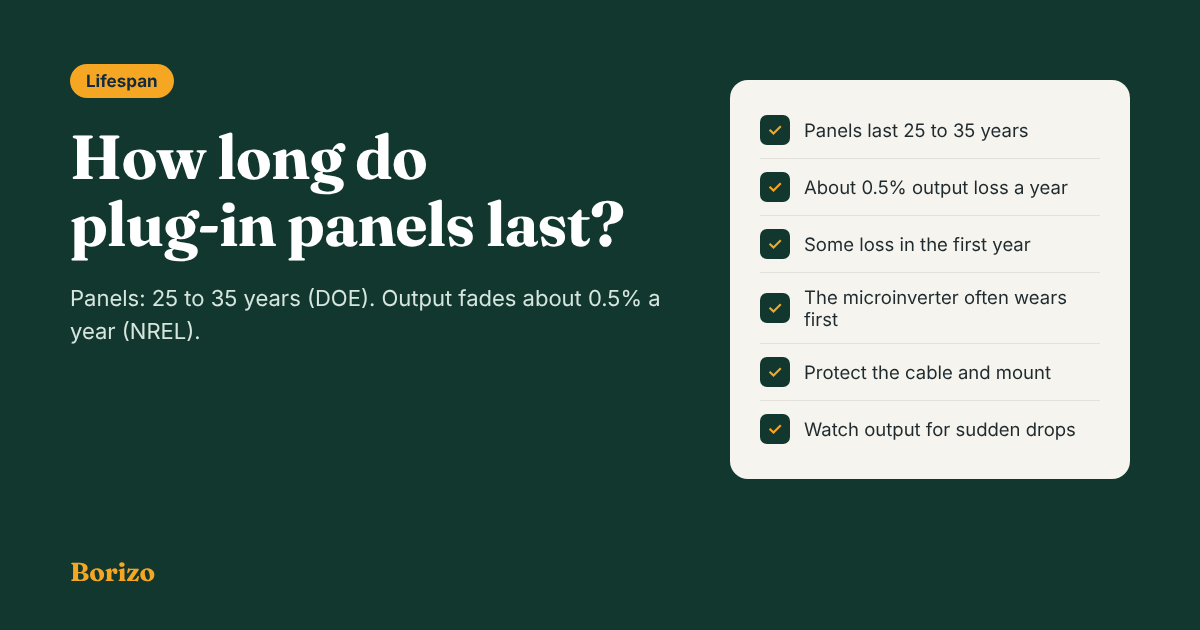
Solar panels typically last 25 to 35 years, according to the Department of Energy, and lose output slowly, about 0.5% a year for good-quality panels in NREL’s research. In a plug-in kit, the microinverter, cable, connectors and mount are more likely to need attention first. Buy certified parts, secure the mount, protect the cable and check the warranty terms for each part.
- Panel lifespan has grown. DOE says the average operational lifespan rose from around 20 years in 2007 to 25 to 35 years in 2025.
- Output fades slowly. NREL reports degradation is often less than 1% a year, with a median of 0.5% a year in its widely cited review, rising to 0.8% when lower-reliability products are included.
- Some loss happens early. NREL’s field data show a share of the loss in the first year, from effects such as light-induced degradation.
- Electronics and hardware wear first. The microinverter, cable, connectors and mount face heat, weather and handling.
- Recycling exists but costs more than landfill in the US today, DOE says.
How long do solar panels last?
The Department of Energy’s Solar Energy Technologies Office says “the average operational lifespan of a solar panel has increased from around 20 years in 2007 to 25-35 years in 2025.” It adds that most systems in the US are still early in their expected life, so the real-world record is still being written.
“Lifespan” here does not mean the panel suddenly stops. Panels keep producing past that point, just at lower output, and they reach end of life when damage, a fault or simple decline makes replacement worthwhile. DOE notes that weather damage and installation errors can bring that point forward, and that some owners replace working panels early to upgrade to better technology.
How fast do panels lose output?
NREL has studied this more than anyone. Its PV lifetime work says degradation is typically slow, “often less than 1% per year.” Its 2011 review of about 2,000 measured rates found a median of 0.5% a year, rising to 0.8% a year when lower-reliability products were included. A 2016 update with more than 11,000 data points found 0.5% a year for high-quality crystalline silicon in multi-measurement studies.
Here is what those rates mean for a panel’s output over time, as a share of its starting output:
| Years in use | At 0.5% a year | At 0.8% a year |
|---|---|---|
| 5 | about 97.5% | about 96.1% |
| 10 | about 95.1% | about 92.3% |
| 20 | about 90.5% | about 85.2% |
| 25 | about 88.2% | about 81.8% |
| 30 | about 86.0% | about 78.6% |
NREL’s 2021 field report shows how much individual products differ. Among the modules it measured at its Colorado site, median annual losses ranged from about 0.07% to about 1.09% a year, and for several models much of the loss happened in the first year. The two n-type modules it analyzed lost about 0.14% and 0.20% a year. In practice, a decent panel will still make most of its original output decades from now.
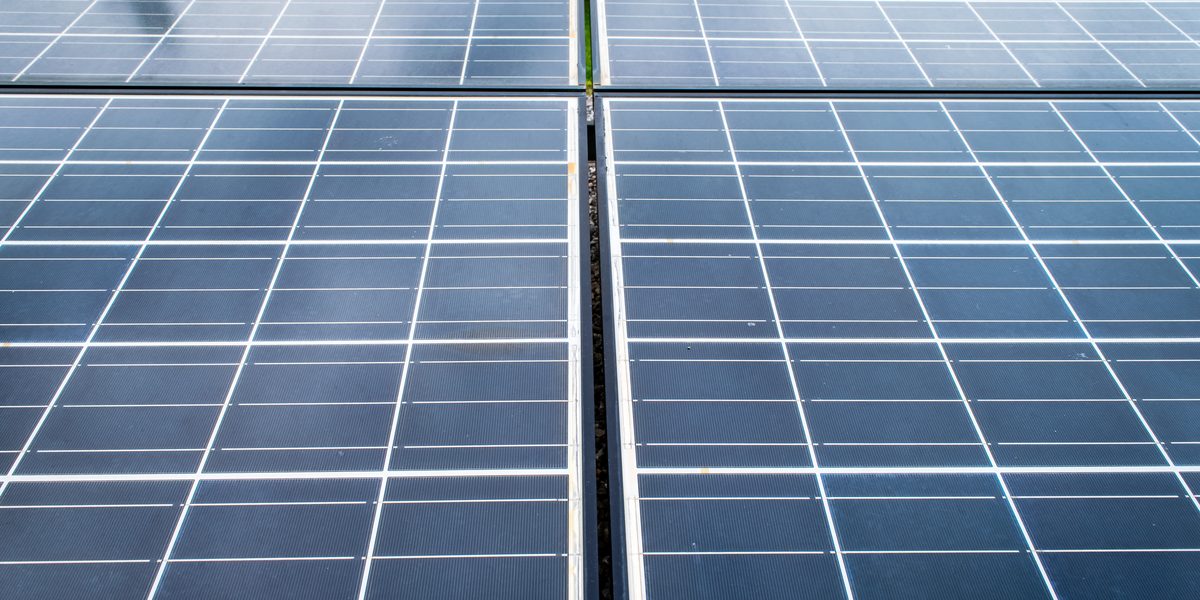
Stock photo (Freepik) for illustration only. It is not a Borizo installation, and we have not tested any product shown.
What wears out first in a plug-in kit
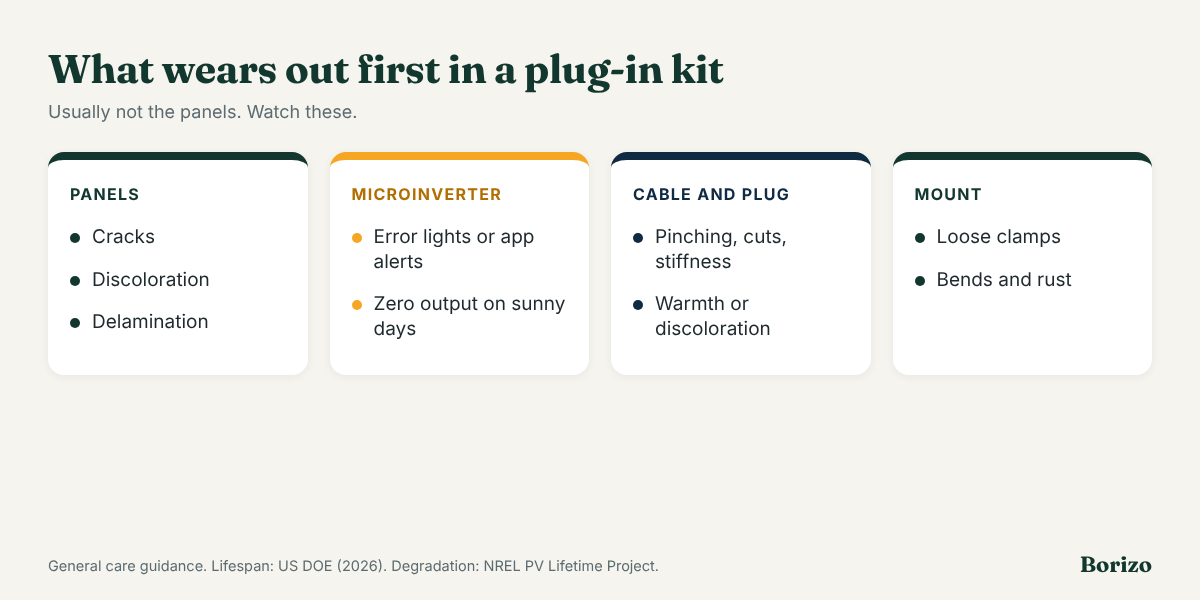
| Part | What wears it | What to watch |
|---|---|---|
| Panels | Sunlight, heat cycles, moisture, hail, impact | Cracks, discoloration, delamination, burn marks |
| Microinverter | Heat and electronics aging | Error lights or app alerts; output dropping to zero on sunny days |
| AC cable and plug | Pinching in doors and windows, UV, handling | Flattening, cuts, stiffness, discoloration, warmth |
| DC connectors | Water, dirt, repeated unplugging | Corrosion, looseness, cracked housings |
| Mount and clamps | Wind, vibration, rust | Loosening, bending, rust at fasteners |
The microinverter deserves a special mention. It does the hard electrical work of converting DC to grid-matched AC, often in a hot spot behind the panel. Our guide to what a microinverter does explains its jobs. Microinverter warranties are often shorter than panel performance warranties, so read both before you buy.
Why balcony kits face extra wear
- They get handled. Kits are taken down for storms, cleaning and moves. Each time, connectors, cables and frames take a little wear.
- Wind is closer. A railing panel flexes and vibrates more than a well-anchored rooftop array, which tests clamps and frames. See wind load and weight.
- Cables cross openings. A cable that crosses a door or window can be pinched daily, which wears it far faster than normal outdoor exposure.
- People and pets are near. Bumps, kicks and chewing are real risks on a small balcony.
How to make your kit last longer
- Buy certified parts and keep the documents. Our certification guide shows how to confirm a listing.
- Mount it securely with a mount rated for the panel and your wind, and retighten as the maker recommends. See no-drill mounting.
- Protect the cable where it crosses an opening, and keep connectors off the ground and out of standing water.
- Give the inverter air. Do not wrap or box it in unless the maker allows, and keep leaves from piling up around it.
- Clean gently and occasionally, without abrasives or pressure washers.
- Watch your output. A gradual decline is normal; a sudden drop means something is wrong. Our monitoring guide explains how to track it.
- Store it well if you take it down for a season: dry, flat or upright as the maker says, with connectors capped.
What it means for payback
Slow degradation barely changes a kit’s payback. If an 800 W kit makes roughly 960 kWh in its first year, as in our savings example, at 0.5% a year it would still make about 913 kWh in year 10. Most kits pay back well before the panels lose a meaningful share of output, so the parts that might fail early, such as the microinverter, matter more. A replacement inverter partway through can change the math, which is why its warranty is worth reading.
End of life and recycling
DOE says recycling processes exist for common panel types, but in the US “the total cost of recycling is still generally greater than the cost of disposing them in a landfill.” It expects many more panels to reach end of life in the coming decades. When your kit’s time comes, ask the maker or seller about take-back programs, check your state or city for electronics and solar recycling options, and treat the microinverter as electronic waste.
Frequently asked questions
How long do plug-in solar panels last?
The panels themselves typically last 25 to 35 years, according to the Department of Energy. The microinverter, cable, connectors and mount may need attention or replacement sooner, so check the warranty for each part.
How much efficiency do solar panels lose each year?
NREL’s research puts the median at about 0.5% a year, often less than 1%, with some loss concentrated in the first year. At 0.5% a year, a panel still makes about 88% of its original output after 25 years.
What usually fails first in a balcony solar kit?
Usually not the panels. The microinverter, cable, connectors and mount face heat, handling, wind and pinching, so they are more likely to need attention first. Watching your output helps catch problems early.
Can solar panels be recycled?
Yes, recycling processes exist, but DOE says recycling in the US generally costs more than landfill disposal today. Ask the maker about take-back programs and check local electronics recycling options.
Sources
- US Department of Energy, What Is End-of-Life Management for Photovoltaics? (lifespan from about 20 years in 2007 to 25 to 35 years in 2025; recycling cost vs landfill), last modified August 17, 2026.
- NREL, PV Lifetime Project (degradation often less than 1% per year; 2011 median 0.5%, 0.8% with lower-reliability products; 2016 update 0.5% for high-quality c-Si).
- Chris Deline, Dirk Jordan and others, NREL, PV Lifetime Project, 2021 Annual Report, September 2022 (module-by-module median losses; first-year losses).
- Photos: stock images from Freepik, used for illustration only.

Borizo is an independent guide to plug-in and balcony solar in the US. We track state laws, check certification claims against official sources, and compare kits using published specifications. Laws change often, so every state page shows a “last updated” date and links to its sources. We earn a commission when you buy through our Amazon links, at no extra cost to you. Our content is for information only and is not legal or electrical advice.