Balcony Solar Wind Load and Weight: What Your Railing Can Take
A solar panel on a balcony railing is a flat, stiff sheet held a few feet above the ground, often several stories up. On a calm day its weight is the only load. In a storm, the wind can push or pull on it with far more force than the panel weighs, and that force goes straight into the railing and the clamps. This guide explains, in plain numbers, how wind load works on a balcony panel, why it grows so fast with wind speed, what railings are designed to carry, how to read a mount’s ratings and what to do when a storm is coming. It is based on building code text, a state transportation agency’s wind-load method and Department of Energy guidance. It is general information, not an engineering assessment, and we have not tested any mount.
Wind, not weight, is what threatens a balcony panel. Wind force rises with the square of wind speed, so doubling the speed roughly quadruples the push. Use a mount rated for your panel size and local wind, keep the panel low and close to the railing, check the clamps after every storm, and take the panel down when severe wind is forecast if the maker recommends it.
- Wind pressure scales with speed squared. The ASCE 7 method, used in a Caltrans manual, starts from 0.00256 × V² (pounds per square foot, V in mph) before adjustment factors.
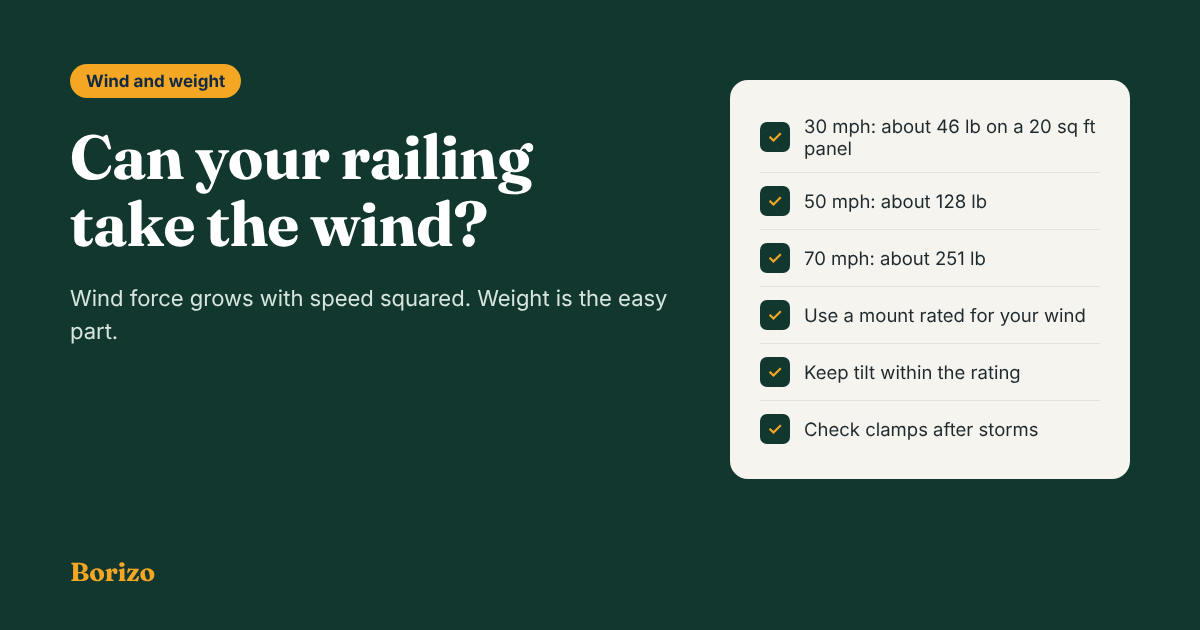
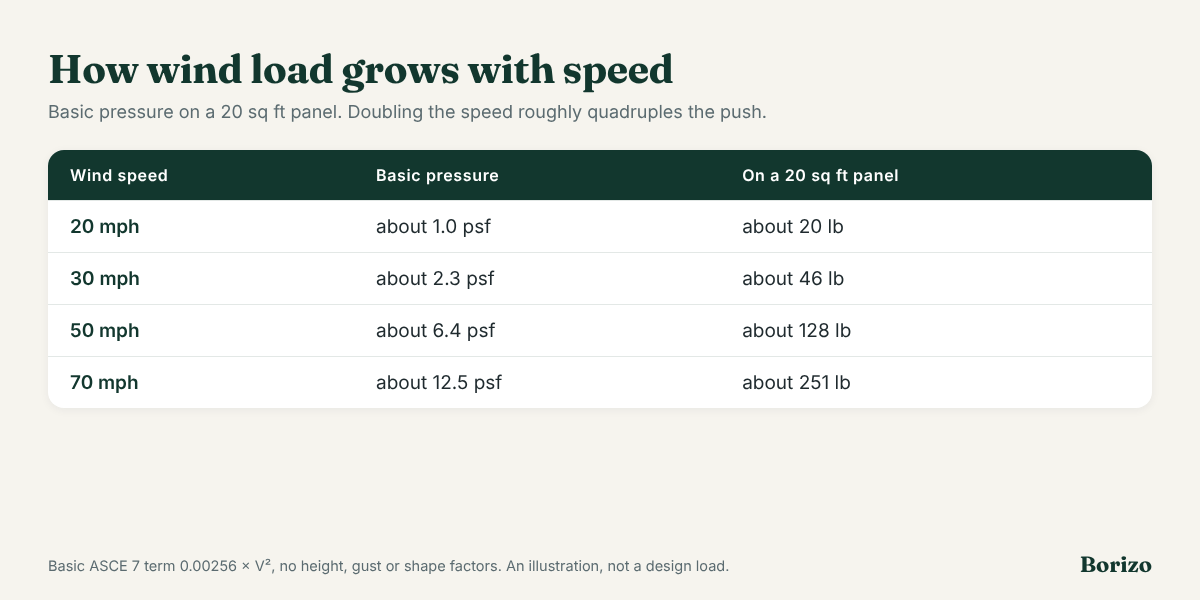
- A full-size panel can catch over 100 pounds of wind. Our simplified arithmetic for a 20 sq ft panel gives about 46 lb at 30 mph and about 128 lb at 50 mph, before gust and shape factors.
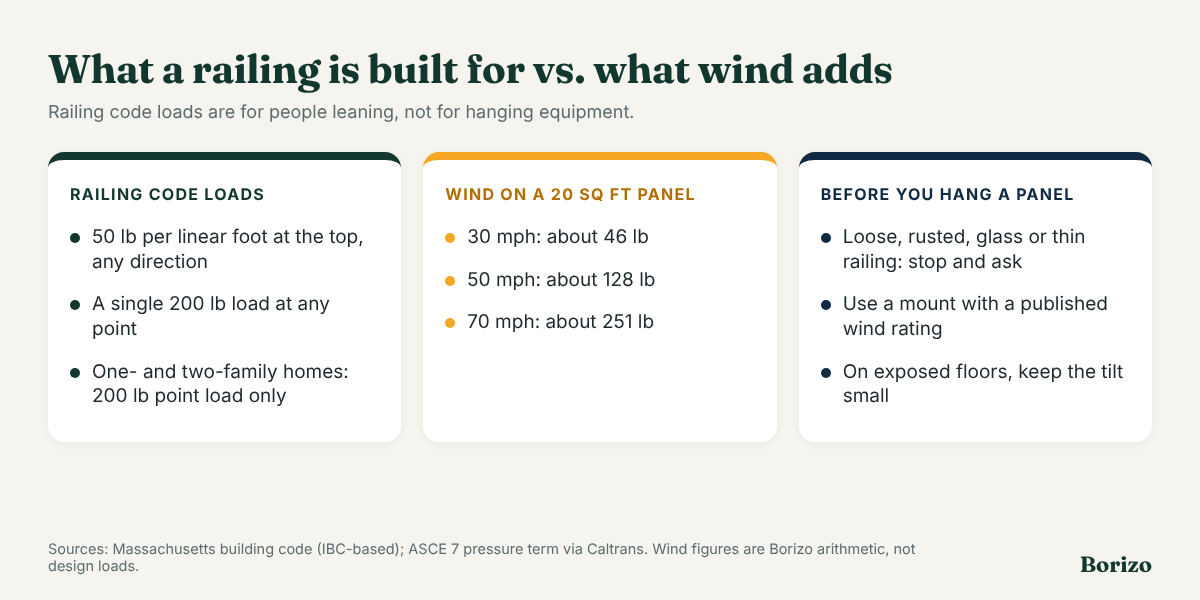
- Railings have design loads, not panel ratings. A building code section based on the IBC requires guards to resist 50 lb per foot and a 200 lb point load. That is for people leaning on them, not a rating for hanging equipment.
- Steeper tilt means more wind load. DOE notes steeper tilts shed snow better but increase wind load.
- Laws expect secure attachment. Vermont requires plug-in devices to be “temporarily but securely attached,” and Colorado lets associations require owners to secure them.
Why wind matters more than weight
A typical full-size residential panel weighs roughly as much as a heavy suitcase. Check your panel’s spec sheet for the exact figure, along with the mount’s weight. That load is steady and pulls straight down, which railings and clamps handle well.
Wind is different. It pushes on the whole face of the panel, it can also pull (suction on the back side), it changes direction and it comes in gusts. A panel tilted out from a railing acts like a sail or a wing. The force it feels depends on its area, its angle, how high it is and how exposed the site is, and it grows very fast as the wind picks up.
Wind load in plain numbers
Engineers in the US calculate wind loads with the ASCE 7 standard. Caltrans’ Temporary Structures Manual shows the ASCE 7 velocity pressure formula as qz = 0.00256 × Kz × Kzt × Kd × Ke × V², where V is the wind speed in miles per hour and the K factors adjust for height, terrain, direction and elevation. The 0.00256 × V² part is the basic pressure in pounds per square foot.
To show how quickly that grows, here is our simplified arithmetic for a panel of about 20 square feet, roughly the size of a common full-size panel, using only the basic term. Real design loads multiply this by height, gust and pressure coefficients, which can make the true load higher.
| Wind speed | Basic pressure (0.00256 × V²) | On a 20 sq ft panel |
|---|---|---|
| 20 mph | about 1.0 psf | about 20 lb |
| 30 mph | about 2.3 psf | about 46 lb |
| 50 mph | about 6.4 psf | about 128 lb |
| 70 mph | about 12.5 psf | about 251 lb |
The lesson is the shape of the curve. Going from 30 mph to 50 mph nearly triples the push, and 70 mph is more than five times the 30 mph figure. A clamp that holds fine in a breeze may not hold in a thunderstorm gust, and upper floors and corner balconies usually see stronger wind than sheltered ground-floor spots.
What a railing is designed to carry
Railings, which building codes call guards, are designed so people can lean on them without breaking through. Massachusetts’ building code, which is based on the International Building Code, requires handrails and guards to resist a load of 50 pounds per linear foot applied in any direction at the top, and a single 200-pound load at any point along the top. For one- and two-family dwellings, only the 200-pound point load applies. Your state or city may have adopted a different edition, so treat these as an example.
Two cautions follow. First, those numbers describe what a code-compliant railing should resist from people. They are not a rating for hanging equipment, and an older or damaged railing may not meet them at all. Second, wind on a tilted panel can push or pull the railing outward and twist its posts, which is a different kind of load from someone leaning on it. Hanging a panel adds to, rather than uses up, what the railing was built for. If the railing is loose, rusted, or made of glass or thin aluminum, ask the building owner or a professional before mounting anything on it.
How the angle changes the load
The Department of Energy’s Federal Energy Management Program notes that steeper tilts shed snow and hail better but increase wind load. On a balcony, the panel’s angle and how far it sticks out from the railing both matter. A panel hanging flat against the railing presents its face to wind from one side; a panel tilted out by 30° or more presents more of a wing shape and moves its load farther from the railing.
That is a real trade-off with output, because a tilted panel usually makes more energy than a vertical one. Our angle guide covers the output side. On windy, exposed balconies, a smaller tilt that stays within the mount’s rating is the safer choice.
Reading a mount’s ratings
A good mount comes with a spec sheet or manual. Look for these, and be wary of a listing that gives none of them:
- Supported panel size and weight. Compare with your panel’s dimensions and weight, not just its wattage.
- Railing type and size. Round or square tube, the range of diameters or widths the clamps fit, and whether glass or vertical-bar railings are allowed.
- Wind rating. Usually a maximum wind speed or pressure. Check whether it is for steady wind or gusts, and at what tilt.
- Fastener and torque instructions. Follow them exactly; too loose slips, too tight can crush tubing.
- Secondary safety. Some makers specify a safety cable or strap. Use one if allowed, especially above a walkway.
Our no-drill mounting guide compares clamp, hook and ballast options, and the ground-mount guide covers stands in a yard or patio.
What the laws say about attachment
- Vermont requires plug-in devices to be “temporarily but securely attached” to the ground or a structure.
- Colorado’s bill summary says that from January 1, 2027, an association may not prohibit the device but may require the owner to secure it reasonably, and the owner bears liability and costs.
- Maine says a customer installing on a structure they do not own must not weaken it or violate codes.
Even where no law speaks to it, a lease or association may ask how the panel is secured. See renters and HOAs for what to put in a written request.
Before and after a storm
- Know your forecast. If high winds are forecast and the maker recommends it, unplug the kit following the manual’s order and take the panel down or lay it flat and secured.
- Inspect after storms. Look for slipped clamps, bent brackets, cracked glass and a loosened railing. Do not lean over a railing to check; look from inside or from below.
- Retighten on a schedule. Temperature swings and vibration can loosen fasteners. Check them a few times a year and follow the maker’s torque values.
- Replace damage, do not patch it. A cracked panel or bent bracket should come down. Our installation checklist covers the rest of the setup.
Frequently asked questions
Can wind blow a solar panel off a balcony?
Yes, if the mount is not rated for the wind or is installed poorly. Wind force rises with the square of the wind speed, so a strong gust can put well over 100 pounds of force on a full-size panel. Use a rated mount and check it after storms.
How much weight can a balcony railing hold?
Codes based on the International Building Code typically require guards to resist 50 pounds per foot and a 200-pound point load at the top, designed for people leaning on them. That is not a rating for mounting equipment, and older railings may not meet it. Ask the building owner or a professional if you are unsure.
Is a flat or tilted panel safer in wind?
A panel close to and parallel with the railing generally catches less wind than one tilted far out. DOE notes that steeper tilts increase wind load. Stay within the mount’s rated tilt and wind speed.
Should I take my balcony panel down before a storm?
If severe wind is forecast and the manufacturer recommends it, yes. Unplug following the manual’s order before handling the panel, since plug blades can be energized in sunlight.
Sources
- California Department of Transportation, Temporary Structures Manual, Appendix A, Example 1: Wind Loads, September 2025 (ASCE 7-16 velocity pressure formula).
- Massachusetts State Building Code, 780 CMR, Section 1607.7, loads on handrails and guards (50 plf and 200 lb; one- and two-family exception), via Justia, current through September 27, 2024.
- US Department of Energy FEMP, Install and Commission a Photovoltaic System (steeper tilt increases wind load).
- State laws, read October 26, 2026: Vermont Act 149, Colorado HB26-1007 (summary), Maine LD 1730.
- UL Solutions, “Question Corner,” IAEI Magazine, July 1, 2026 (plug blades can be energized in sunlight).
- Photos: stock images from Freepik, used for illustration only.

Borizo is an independent guide to plug-in and balcony solar in the US. We track state laws, check certification claims against official sources, and compare kits using published specifications. Laws change often, so every state page shows a “last updated” date and links to its sources. We earn a commission when you buy through our Amazon links, at no extra cost to you. Our content is for information only and is not legal or electrical advice.