Plug-in Solar Installation Checklist: 12 Steps Before You Plug In
Plug-in solar is sold as “just plug it in,” and the plugging in really is the easy part. The steps that decide whether your kit is legal, safe and worth the money all happen before that: checking your state’s rule, confirming the certification, getting permission if you rent, telling the utility where the law requires it, and knowing what else is on the circuit. This checklist walks through those steps in order, with the official source for each legal point. It is based on state law text and manufacturer documents. We have not installed or tested any kit.
- Check your state first. Each law sets its own size cap, certification wording and notice rules. Most cap output at 1,200 W; Colorado allows 1,920 W, and Maine needs an electrician above 420 W.
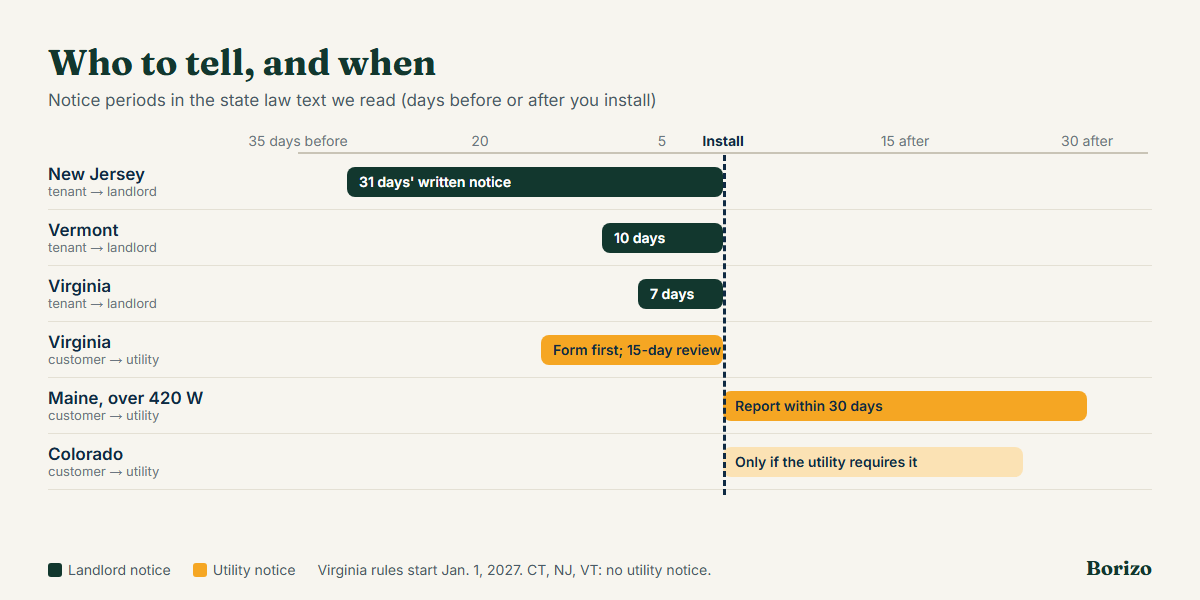
- Notice can be owed to two people: your utility (Virginia, Maine above 420 W, and Colorado if the utility asks) and your landlord (Virginia 7 days, Vermont 10 days, New Jersey 31 days in the bill text we read).
- Confirm the certification in the lab’s own directory, not just the product listing. Virginia’s utility form asks for the name of the lab that certified your device.
- Know your circuit. Safety experts say the main risk is overloading the wiring between the kit and a big appliance. Ask a licensed electrician if you are unsure.
- Secure the panels against wind, use one kit per outlet, and do not stack kits past your state’s cap.
Stage 1: Before you buy
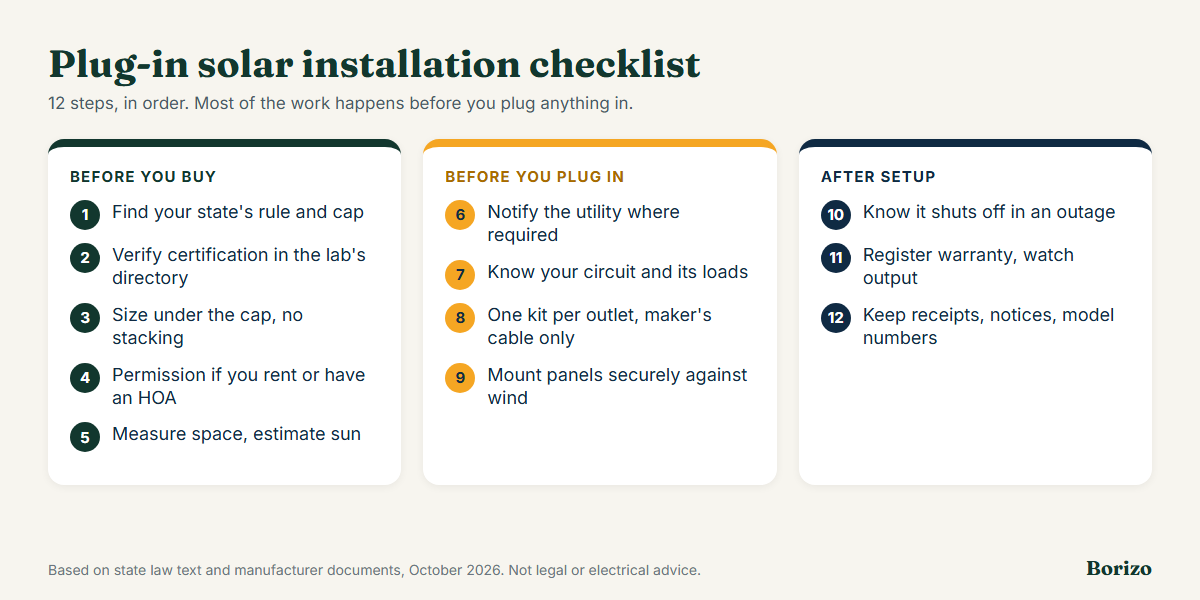
1. Find your state’s rule
Start with the law where you live, because it decides the size limit, the certification you need and whether anyone must be told. The table below covers the states whose enacted or enrolled text we have read. If your state is not listed, a plug-in kit may still need a standard utility interconnection agreement, so ask your utility before buying. See the State Laws hub for updates.
| State | Size cap | Tell the utility? | Tell the landlord? | Source |
|---|---|---|---|---|
| Virginia | 1,200 W per customer or dwelling unit | Yes, on the state form before installing; utility has 15 days to review | Yes, 7 days ahead, with documentation and location | § 56-596.8, HB 395 (effective Jan. 1, 2027) |
| Maine | 420 W without an electrician; up to 1,200 W with a licensed electrician and a dedicated circuit | Yes, within 30 days, for systems over 420 W | No landlord rule; do not weaken a structure you do not own | LD 1730 |
| Colorado | 1,920 W; one device per wall outlet | Only if the utility requires notice | Not addressed in the summary we read | HB26-1007 |
| New Jersey | 1,200 W combined at one address | No | Yes, written notice 31 days ahead (third reprint) | S2368 |
| Vermont | 1,200 W per meter | No | Yes, 10 days ahead; landlord has 10 days to reply | Act 149 |
| Connecticut | 1,200 W; one device behind a meter | No | None found | PA 26-127 |
| New Hampshire | 1,200 W AC | Reporting is informational only | None found | SB 540 |
| Utah | 1,200 W | None found in the text | None found | HB 340 |
2. Confirm the certification yourself
Every state law in the table requires some form of certification, but the wording differs: UL 3700 or a comparable standard (Vermont, Maine, New Jersey), certification by a nationally recognized testing laboratory (Virginia, New Hampshire, Utah, Colorado), or UL and UL 1741 (Connecticut). Nationally recognized testing laboratories are the labs OSHA recognizes under 29 CFR 1910.7; OSHA keeps the current list of NRTLs, which includes UL, CSA, Intertek and TÜV labs.
A line on a product listing is the seller’s claim. Note the exact inverter model number, then look it up in the certifying lab’s own directory, such as UL’s Product iQ. Keep a screenshot. In Virginia you will need the model number and the lab’s name for the utility form anyway. Our certification guide explains how to check a claim step by step.
3. Size the kit under your cap, and do not stack
Read the inverter’s AC output in watts, not the panels’ total DC rating. The law counts output, and the counting unit matters: per meter, per customer, per dwelling unit or per address. Some products are sold to be combined. APsystems, for example, says two of its EZ1 microinverters can be paired for up to 1,800 W, which is above the 1,200 W cap in most of the states listed. If you add a second kit later, add up both. For how many panels you actually need, see how many panels and our kit size calculator.
4. Get permission if you rent or live in an HOA
Where a state protects tenants, it usually still asks you to give notice first, and lets the landlord set reasonable limits on size, place and manner. Virginia’s tenant protection applies to landlords with more than four rental units, requires 7 days’ notice with documentation that the device meets the law and the proposed location, makes the tenant responsible for damage, and bars wiring or panel changes without the landlord’s written approval. Virginia’s law also does not override recorded covenants or condo and association documents. Rules differ a lot by state, so read plug-in solar for renters and HOAs before you order.
5. Check your space and sun
Measure the balcony, railing, wall or patio spot, and compare it with the panel dimensions on the spec sheet. Note which way it faces and what shades it during the day. Then estimate output for your exact address with NREL’s free PVWatts calculator, and plug that number into our savings and payback calculator. A shaded north-facing balcony can turn a reasonable payback into a very long one. In Virginia, local height, setback and historic-district rules can still apply to the device.
Stage 2: Before you plug in
6. Notify the utility where the law requires it
Virginia’s rule is the most detailed one we have read. From January 1, 2027, a customer must submit the State Corporation Commission’s form, online or by mail, before installing. The utility then has 15 days to review it for accuracy and completeness. If it does not respond within 15 days, you are treated as having met the requirement and may install. The utility cannot charge a fee or require its approval. The act says the form asks only for:
- your name, contact information and the address where the device will be installed;
- your electric provider, account number and meter number;
- the device’s model name and model number;
- the name of the national testing lab that certified the device.
The act also lets the utility install an automatic, locking disconnect switch where there is more than one device at a property or the distribution circuit requires it. In Maine, systems over 420 W must be reported within 30 days, and in Colorado the utility may require notice. Even where no notice is required, it costs little to check your utility’s website.
7. Know your circuit
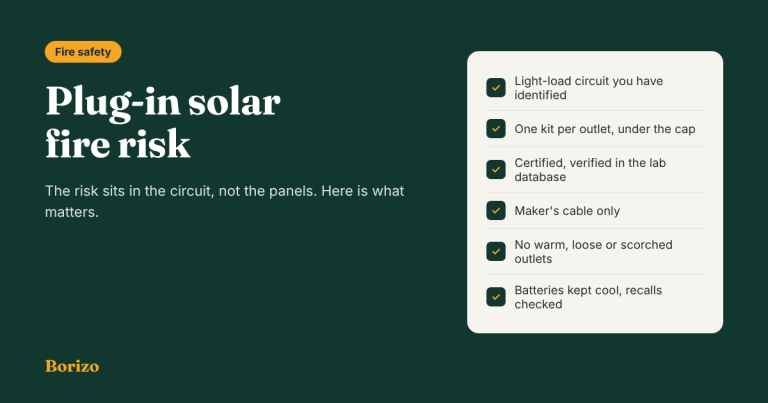
This is the step most guides skip. UL Solutions, which wrote the UL 3700 standard, explains that home branch circuits are built for power that flows one way, from the panel to the load. A plug-in kit adds current at the outlet, and the breaker in your panel only measures the current coming from the utility. On the wire between the kit and a large appliance on the same circuit, the two can add up past the wire’s rating without the breaker tripping. See wattage limits and circuit safety for the diagram.
- Find which breaker feeds the outlet you plan to use, its rating, and every other outlet and appliance on that circuit.
- Avoid circuits with heavy loads such as space heaters, window air conditioners or kitchen appliances.
- Maine requires a dedicated circuit and a licensed electrician for systems above 420 W. Virginia exempts devices of 391 W or less from product listing provisions that would require changes to wiring or panels, which suggests larger devices may need them.
- If you are unsure, pay a licensed electrician to look at the circuit before you plug in. It is a small cost next to the kit.
8. Use the right outlet and cord
- One kit per outlet. Colorado’s law says so directly, and it is a sensible rule everywhere.
- Power strips and extension cords: none of the official sources we read cover them. Use only the cable the maker supplies or approves, and follow the manual.
- Outdoor outlets: UL notes that ground-fault devices assume current flows one way and may not work as intended with a kit feeding power back. Ask an electrician about outdoor or GFCI-protected outlets.
- Plug blades can be live. UL warns that a kit’s plug blades can be energized when the panels are in sunlight. Follow the manual’s order for connecting and disconnecting, and never touch the plug’s prongs.
9. Mount the panels securely
A panel catching wind on a balcony can fall, and it can fall on someone. Use the maker’s mounting hardware, follow its wind and attachment instructions, and do not drill into a structure you do not own without permission. Vermont’s law describes devices that are “temporarily but securely attached,” and Maine’s says a customer installing on a structure they do not own must not weaken it or violate codes, and must restore it when the system is removed. APsystems’ guidance says to use the plug-in system where permitted and to follow its installation manuals and local requirements.
Stage 3: After setup
10. Know what happens in an outage
A plug-in kit is designed to shut off when grid power is lost, so it will not run your home in a blackout. Virginia’s law requires a feature that prevents the device from exporting power during an outage, and New Jersey’s bill requires the same. APsystems says its EZ1 restarts only after grid power has been stable for five minutes. If backup power is what you want, read plug-in solar vs a portable power station.
11. Register the warranty and watch the output
Many kits use an app to register the warranty and show production. APsystems, for example, says you register through its app to be eligible for the product warranty. Compare the first months of output with your PVWatts estimate. A large gap usually points to shade or panel angle.
12. Keep your records
Save the receipt, the model numbers, the certification screenshot, your landlord or utility notices and any replies, and the manual. If you move, sell the home or add a second kit, you will need them. Check the mounting and cables after storms and every few months.
Frequently asked questions
Do I need an electrician to install plug-in solar?
Not always. Most state laws let a qualifying kit plug into an existing outlet. Maine requires a licensed electrician and a dedicated circuit above 420 W, and Virginia bars tenants from wiring or panel changes without the landlord’s written approval. Because the main risk is circuit overload, having an electrician check the circuit is a good idea in any state.
Do I have to tell my utility before I plug in?
It depends on the state. Virginia requires the state form before installation, starting January 1, 2027, and the utility has 15 days to review it. Maine requires notice within 30 days for systems over 420 W, and Colorado lets the utility require notice. Connecticut, New Jersey and Vermont do not require it in the text we read.
Can I use an extension cord or power strip?
The official sources we read do not address this. Use only the cable that the manufacturer supplies or approves, follow the manual, and ask a licensed electrician before using anything else.
Can renters install plug-in solar?
In some states, yes, after giving notice. Virginia requires 7 days’ notice to landlords with more than four units, Vermont 10 days, and New Jersey 31 days in the bill text we read. Landlords can usually set reasonable limits on size and placement, and tenants are responsible for damage.
Sources
- Virginia, HB 395 enrolled text (device definition, 391 W exemption, tenant notice, utility form contents, effective January 1, 2027) and Code of Virginia § 56-596.8 (utility notice, 15-day review, disconnect switch).
- State laws for Maine, Colorado, New Jersey, Vermont, Connecticut, New Hampshire and Utah: linked in the table above, all official bill or act text.
- US Occupational Safety and Health Administration, Current List of NRTLs, and 29 CFR 1910.7.
- UL Solutions, “Question Corner,” IAEI Magazine, July 1, 2026 (one-way branch circuits, energized plug blades, GFCI).
- APsystems, EZ1 for consumers (pairing up to 1,800 W, five-minute restart, warranty registration, manuals), read October 26, 2026.
- NREL, PVWatts Calculator.
- Our guides on wattage limits, certification, renters and HOAs and the best kits.

Borizo is an independent guide to plug-in and balcony solar in the US. We track state laws, check certification claims against official sources, and compare kits using published specifications. Laws change often, so every state page shows a “last updated” date and links to its sources. We earn a commission when you buy through our Amazon links, at no extra cost to you. Our content is for information only and is not legal or electrical advice.