Snow on Balcony Solar Panels: Output Loss and Safe Clearing
Snow is the one weather event that can switch a solar panel almost completely off. A few inches on the glass block the light, and until it slides or melts away, the panel makes little or nothing. The good news for balcony owners is that a panel hanging steeply on a railing sheds snow far better than a flat rooftop array. The bad news is that the snow has to go somewhere, and on a balcony that can mean onto the floor below or onto people walking past. This guide explains how much snow really costs over a year, why tilt matters so much, whether and how to clear a panel safely, what to check about snow load, and how to prepare before winter. It is based on NREL’s snow-loss modeling and Department of Energy guidance. We have not tested any kit.
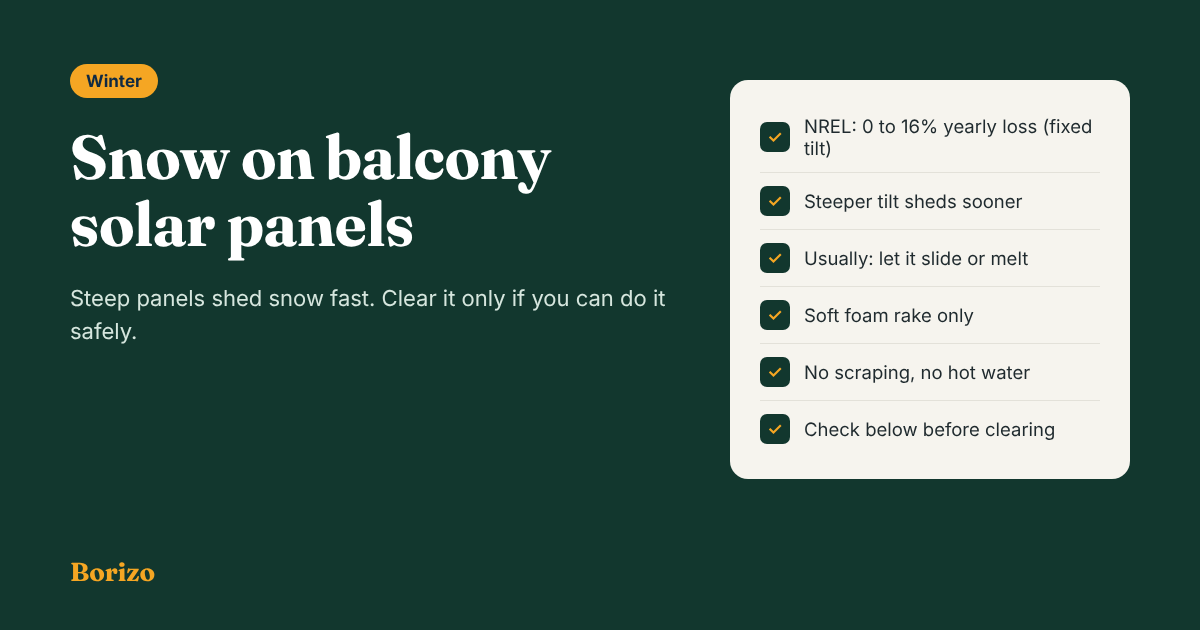
Snow costs a fixed solar panel anywhere from almost nothing to roughly 16% of its yearly output in the snowiest parts of the continental US, according to NREL modeling. Steep, balcony-style panels shed snow quickly, so the usual best move is to let it slide or melt. If you clear it, use a soft foam brush from a safe position, never scrape or pour hot water, and make sure sliding snow cannot fall on anyone below.
- Yearly losses are smaller than they feel. NREL modeled annual snow losses for fixed-tilt systems at 0% to 16% in the continental US, highest around Minnesota and Michigan.
- Steeper sheds faster. NREL found tilt-equals-latitude systems generally lose less to snow than 20° systems, because snow slides off steeper panels sooner.
- Sliding is the main way snow leaves. NREL’s model treats sliding, driven by temperature and sunlight, as the main removal process.
- Do not scrape, chip or use hot water. Those can scratch or crack the glass.
- Mind the drop. Snow sliding off a balcony panel can fall on people or property below.
How much does snow really cost?
NREL researchers built a snow-coverage model into the System Advisor Model (SAM) and ran it for sites across the country. Their 2017 report found that “PV snow coverage losses for fixed-tilt systems ranges from 0% to 16% in the continental United States.” The largest continental losses, about 16%, showed up in Minnesota and Michigan. Losses were generally highest from the Northeast across the Great Lakes and the Midwest into the northern Rockies, and some high-elevation spots, such as Flagstaff, Arizona, at 3% to 5%, lost more than nearby low-lying areas.
Two things keep that number lower than you might guess. First, snowy months are also the months with the least sunshine, so a panel loses less by being covered in December than it would in June. Second, snow usually does not stay long on a tilted panel. A week of coverage after a storm is a small slice of the year.
| Where you live | Snow losses NREL modeled (fixed tilt, annual) | What it means for a balcony kit |
|---|---|---|
| Little or no snow (much of the South and West Coast) | About 0% | Snow is not a factor |
| Occasional snow, or high elevation in mild regions | Low single digits (e.g., Flagstaff 3% to 5%) | A few covered days a year; let it melt |
| Northeast, Great Lakes, Midwest, northern Rockies | Higher, up to about 16% in Minnesota and Michigan | Worth a steep angle and safe, gentle clearing after big storms |
Why tilt matters so much
NREL’s model treats sliding as the main way snow leaves a panel: when the air is warm enough relative to the sunlight hitting the panel, snow slides off, and the share of the panel uncovered grows with the tilt angle. In its results, tilt-equals-latitude systems “generally” lost less than 20°-tilt systems across the continental US, which the authors put down to steeper tilts promoting faster snow removal.
The Department of Energy’s Federal Energy Management Program says the same thing from the design side: steeper tilts shed snow and hail better but increase wind load. A balcony panel hanging at 60° to 90° is much steeper than most rooftop arrays, so snow tends to slide off soon after a storm, especially once the sun warms the dark cells beneath it. Our angle guide covers the trade-off between winter shedding and summer output, and wind load explains why steeper is not free.
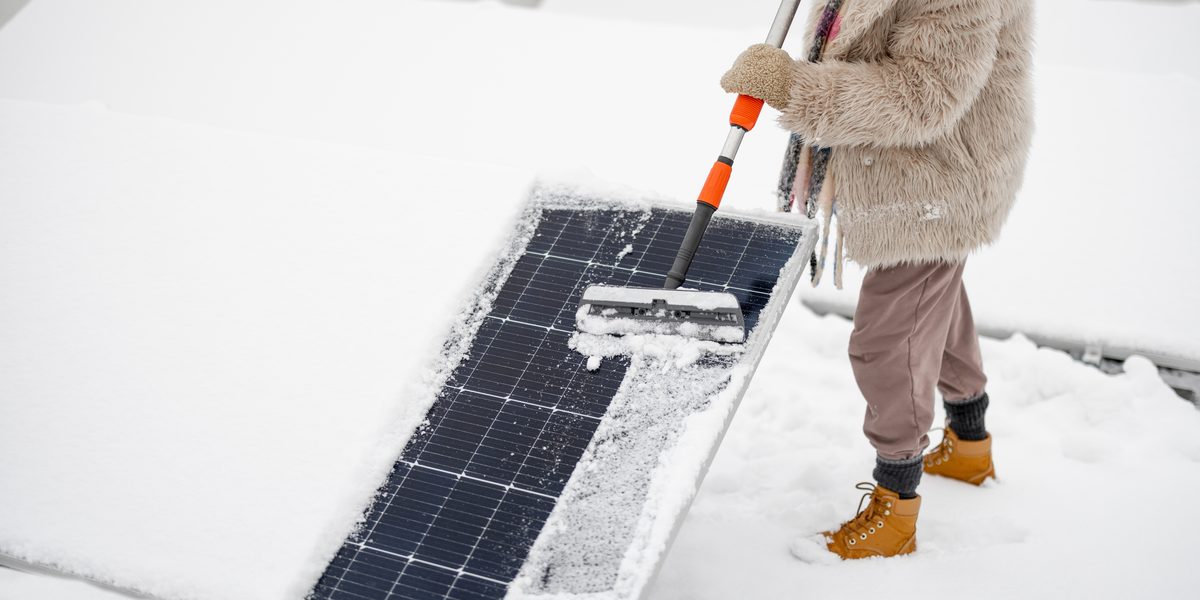
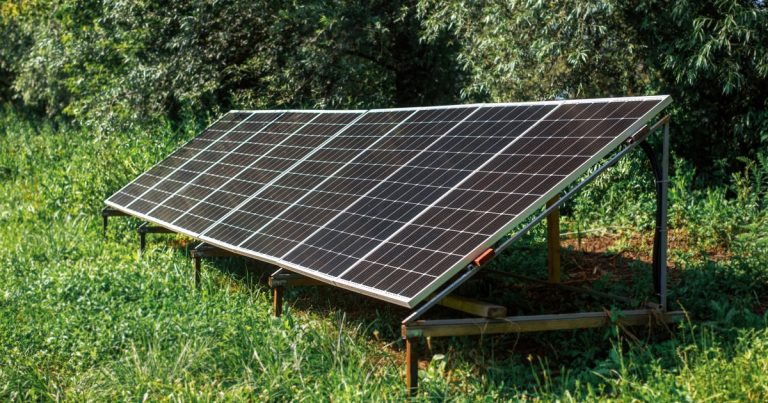
Stock photo (Freepik) for illustration only. It is not a Borizo installation, and we have not tested any product shown.
Should you clear snow off a balcony panel?
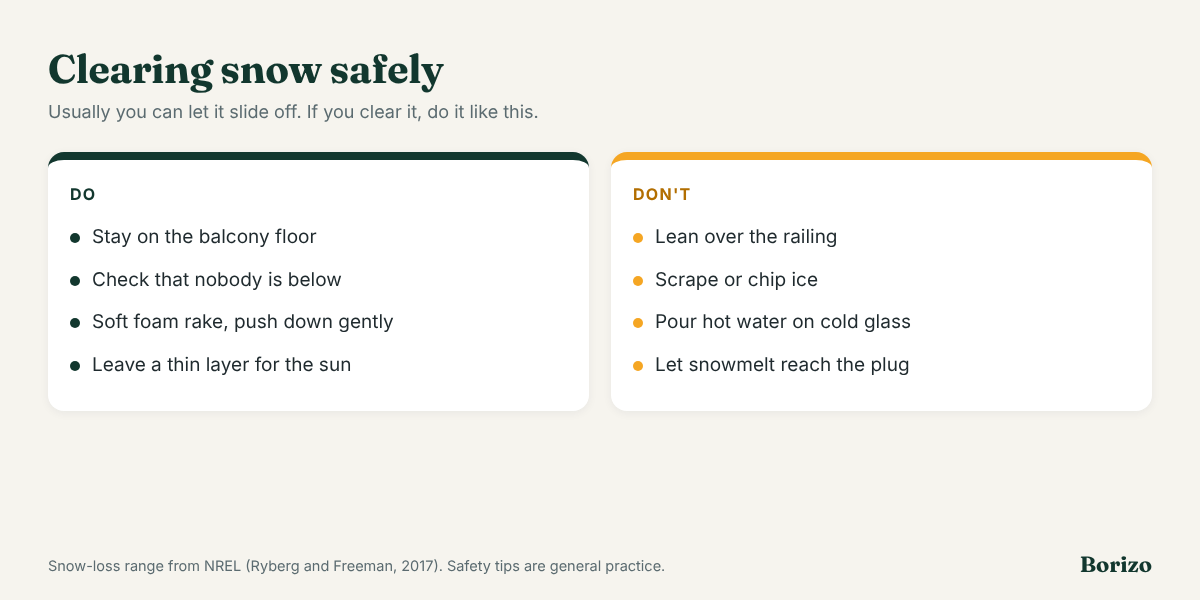
Usually, letting it slide or melt is fine. Clearing makes sense when heavy snow is forecast to sit for days in cold, cloudy weather and you can reach the panel safely from the balcony floor. If you do clear it:
- Stay safe. Never lean over the railing, stand on furniture or go onto a roof. If you cannot reach it with both feet on the balcony floor, leave it.
- Check below. Make sure nobody is walking, parking or sitting beneath you, and that snow will not land on a neighbor’s balcony.
- Use a soft tool. A foam snow rake or a soft brush made for cars, pushed gently downward. Leave a thin layer rather than touching the glass hard; the sun will finish the job.
- Do not scrape ice. Ice bonded to the glass will release on its own. Chipping can scratch the glass or crack a cell.
- No hot water. Pouring hot water on cold glass can crack it through thermal shock, and the water refreezes on the railing and floor.
- Keep the plug dry. Snowmelt can run along the cable. Check that the plug and outlet stay dry, and follow the manual if you need to shut the kit off.
Snow load on the panel and mount
Snow is heavy, especially when wet. A steep balcony panel rarely holds much for long, but a lower-angle panel on a ground stand or patio can collect a lot. Two things to check:
- The panel’s mechanical load rating. Panel datasheets list the load the panel is rated to carry on its face, often in pascals. Compare it with your area’s snow conditions if the panel will sit at a low angle.
- The mount’s rating. A stand or bracket rated for wind may not be rated for heavy snow at a low tilt. Check the spec sheet, and steepen the angle for winter if the mount allows.
If you use a ground stand, see our ground-mount guide for ballast and placement.
Getting ready for winter
- Steepen the tilt if your mount is adjustable and the maker allows it.
- Check clamps and cable before the first storm; frozen fasteners are harder to fix later.
- Think about where snow will land and move anything breakable, or anything a falling slab could hurt, out of the way.
- Clean leaves from behind the panel so meltwater can drain.
- Set expectations. Winter output is lower anyway because of short days and low sun. Our winter and cloudy days guide covers what to expect month by month.
Does snow ever help?
A little. Fresh snow on the ground reflects a lot of sunlight, and on a bright day after a storm, a clear panel can get extra light bounced up from below. Panels that collect light on both sides benefit most. And cold temperatures themselves are good for panel efficiency: solar cells produce slightly more power when they are cold. Neither makes up for a covered panel, but both help once the snow slides off.
Frequently asked questions
Do balcony solar panels work with snow on them?
Not well. A few inches of snow block most of the light, so output drops close to zero until it slides or melts off. Steep balcony panels usually shed snow quickly, often within a day or two of sun.
How much output do you lose to snow over a year?
NREL modeled annual snow losses for fixed-tilt systems at 0% to 16% in the continental US, with the highest losses around Minnesota and Michigan. Steeper panels generally lose less.
Is it safe to brush snow off solar panels?
Yes, if you can reach the panel from a safe position and use a soft foam rake or brush without scraping. Never lean over a balcony railing, pour hot water on the glass or chip at ice, and make sure falling snow cannot hit anyone below.
Will heavy snow damage my panel?
It can if the snow load exceeds the panel’s or mount’s rating, which is more likely on low-angle ground stands than steep balcony mounts. Check the datasheet’s load rating and steepen the angle for winter if your mount allows.
Sources
- David Severin Ryberg and Janine Freeman, NREL, Integration, Validation, and Application of a PV Snow Coverage Model in SAM, NREL/TP-6A20-68705, August 2017 (0% to 16% fixed-tilt losses; regional pattern; tilt and sliding).
- US Department of Energy FEMP, Install and Commission a Photovoltaic System (steeper tilts shed snow and hail but increase wind load).
- NREL, PVWatts Calculator.
- Photos: stock images from Freepik, used for illustration only.

Borizo is an independent guide to plug-in and balcony solar in the US. We track state laws, check certification claims against official sources, and compare kits using published specifications. Laws change often, so every state page shows a “last updated” date and links to its sources. We earn a commission when you buy through our Amazon links, at no extra cost to you. Our content is for information only and is not legal or electrical advice.