How Shade Affects Balcony Solar (and How to Check Your Spot)
Shade is the quiet killer of balcony solar. A panel that looks sunny at noon can sit behind a railing, an overhang or a neighbor’s building for half the day, and shade does more damage than the size of the shadow suggests. This guide explains how shade reduces output, why a small shadow can cost more than its share of the panel, which kinds of shade matter most on a balcony, how to survey your spot before you buy, and how to put a shade estimate into NREL’s free PVWatts calculator. It is based on NREL research, manufacturer information and our own arithmetic. We have not tested any kit, and the examples are illustrations, not measurements.
Shade can cut a panel’s output by far more than the percentage of its surface covered, because the cells in a panel are wired together. A balcony that is shaded for much of the day may not suit solar at all. Check your spot at several times of day and in more than one season, then test the result in PVWatts before you buy.
- Partial shade has a disproportionate effect. NREL research notes that partial shading of a PV installation can cost more power than the shaded area alone suggests.
- Hard shade hurts most (a railing bar, a pole, a branch). Light, diffuse shade hurts less.
- The sun’s path changes through the year. A spot that is clear in summer can be shaded in winter by the same building.
- PVWatts assumes only 3% shading loss by default, which is far too low for a shaded balcony. Change it.
- Two panels on separate trackers help: APsystems says its EZ1 tracks each connected panel independently.
Why shade costs more than its share
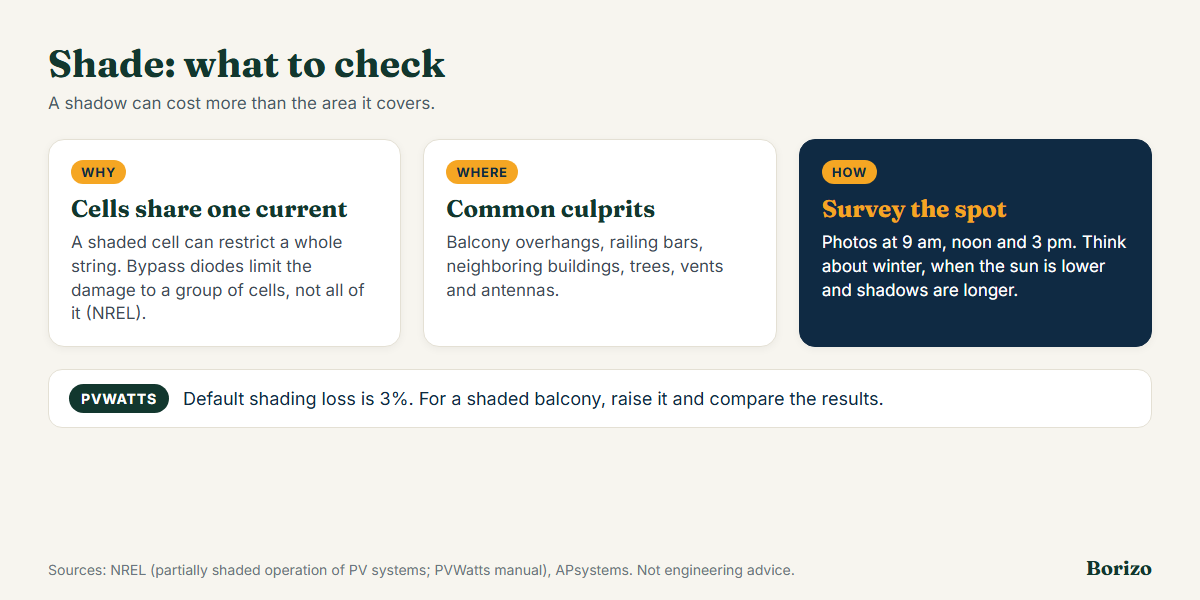
A solar panel is a string of cells wired in series. Current has to pass through every cell in the chain, so a shaded cell can restrict the whole string, much like a kinked section of a hose. Panels include bypass diodes to reduce this: an NREL paper on partially shaded operation of grid-tied PV systems describes how a diode lets current from the unshaded parts of a module go around the shaded part, which limits the effect of shading to the group of cells that diode protects. The same paper notes that partial shading has a disproportionate impact on a PV installation’s power production. In other words, bypass diodes help, but a shadow on one corner can still take out a whole section of the panel.
What this means in practice: a thin shadow from a railing bar that sweeps across a panel for two hours can cost more energy than “2 hours × the covered percentage” would predict. We do not have a measured loss figure for your railing, and we do not want to invent one. The point is to avoid shade where you can, not to calculate it to the decimal.
What shades a balcony
| Source of shade | When it hits | What to do |
|---|---|---|
| The balcony above (overhang) | Most of the day, and often most of the year, for a panel mounted under it | Mount outward or on the top rail if the rules and mount allow; otherwise this spot may not work |
| Your own railing or bars | Parts of the day, depending on panel position | Mount the panel above or outside the railing, not behind slats or bars |
| Neighboring buildings | Low-sun hours, especially winter mornings and evenings | Check a winter day if you can; the sun is lower, so shadows are longer |
| Trees | Changes with season; leaves can block light in summer | Check in leaf, not only in bare winter |
| Vents, chimneys, antennas | Moving thin shadows | Look for them on a sunny day |
| Dirt, snow and leaves | Constant until cleaned | Follow the maker’s cleaning guidance |
How to survey your spot
- Look at the same spot at several times. Take a photo from the panel’s location facing the sky at about 9 am, noon and 3 pm on a sunny day, and note any shadow that crosses the area.
- Remember the season. The sun is higher in summer and lower in winter, so a spot that is sunny in July can be shaded in December by a building or tree. If you are surveying in a different season from the one you care about most, adjust your expectations.
- Note the direction. Which way the balcony faces determines when the sun reaches it. See east, west and south-facing balcony solar.
- Mark the panel footprint. Use tape or a cardboard panel at the real position. The shadow of a pole across a cardboard panel shows the problem faster than a guess.
- Do not ignore morning and late afternoon, but remember the strongest sun is around midday, so shade at noon matters most.
How the kit’s electronics help or do not
Microinverters can reduce shading losses compared with one inverter serving a whole string, because each panel (or pair of panels) is handled separately. APsystems says its EZ1 takes one or two panels and tracks each independently, so shade on one panel need not drag down the other. A kit with one inverter for all panels in series does not have that benefit. When you compare products, read the specification sheet to see how many panels connect to each inverter and how they are tracked. Independent tracking limits the damage from shade, but it does not remove it: a shaded panel still produces less.
Put shade into PVWatts
NREL’s PVWatts calculator uses default system losses of 14%, which include a 3% allowance for shading and 2% for soiling. That is built for a typical unshaded roof array. For a balcony with real shade:
- Run PVWatts with the default losses for your address, tilt and direction. Note the yearly kWh.
- Estimate the share of the day that the panel is partly or fully shaded, and how strongly. Be honest and conservative.
- Raise the shading loss in the settings and run it again. For example, if you think shade removes a quarter of the output, set the shading loss to about 25%.
- Compare the two results in our savings and payback calculator.
| Assumed shading loss | 800 W kit yearly output | Value at 20¢/kWh |
|---|---|---|
| 3% (PVWatts default) | about 960 kWh | about $192 |
| 15% | about 840 kWh | about $168 |
| 30% | about 690 kWh | about $138 |
| 50% | about 495 kWh | about $99 |
These figures are our arithmetic from the 960 kWh example in our sizing guide and are illustrations, not measurements. They replace the default 3% shading allowance with the loss shown, so output is 960 kWh × (1 − loss) ÷ 0.97. They show why a heavily shaded spot can stretch payback by years: see is plug-in solar worth it.
Reduce the shade you can control
- Move the panel. A few feet up, out or along the railing can clear a bar or an overhang.
- Use the clear half. If only half of the balcony is clear, one panel may work better than two.
- Trim or move what you own. Plants, furniture and awnings on your own balcony are easy wins.
- Keep panels clean. Dirt acts like a thin permanent shade. Follow the manual for cleaning.
- Know when to give up. If the best spot is shaded for much of the day, a different location (a patio, a yard stand or a sunnier wall) or a different approach may be a better use of your money.
Frequently asked questions
How much does shade reduce balcony solar output?
It depends on how much of the panel is shaded, for how long, and how the panel and inverter are wired. NREL research notes the effect of partial shading can be disproportionate to the covered area, so we avoid a single number. Test your site with PVWatts using a higher shading loss.
Is a little shade okay?
Light, brief shade early or late in the day matters less than shade at midday. A shadow that sweeps across the panel at noon, even a thin one, can cost much more than its width suggests.
Do microinverters fix shade problems?
They limit them. A microinverter that tracks each panel independently, as APsystems says its EZ1 does, keeps one shaded panel from dragging down another. A shaded panel still produces less.
Should I check shade in winter?
Yes, if you can. The sun is lower in winter and shadows are longer, so a building or tree that does not bother you in summer may shade the panel for much of a winter day.
Sources
- NREL, Partially Shaded Operation of a Grid-Tied PV System (bypass diodes limit shading effects to a group of cells; partial shading has a disproportionate impact on power production).
- NREL, PVWatts Version 5 Manual and PVWatts Calculator (default losses of 14%, including 3% shading and 2% soiling).
- APsystems, EZ1 for consumers (one or two panels tracked independently), read October 26, 2026.

Borizo is an independent guide to plug-in and balcony solar in the US. We track state laws, check certification claims against official sources, and compare kits using published specifications. Laws change often, so every state page shows a “last updated” date and links to its sources. We earn a commission when you buy through our Amazon links, at no extra cost to you. Our content is for information only and is not legal or electrical advice.