East vs West vs South-Facing Balcony Solar: Which Direction Is Best?
Which way does your balcony face? For solar, the answer shapes both how much power you get and when you get it. In the Northern Hemisphere a south-facing panel catches the most sunlight over a year, but east and west balconies are far from useless, and they can fit how people actually use electricity. This guide compares south, east, west and north-facing balcony solar: how the day’s output curve changes, how to match it to your own use, what time-of-use rates can change, and a simple way to compare your options in NREL’s free PVWatts calculator. It is based on EIA and NREL sources. The comparisons are qualitative or our own arithmetic, and we have not tested any kit.
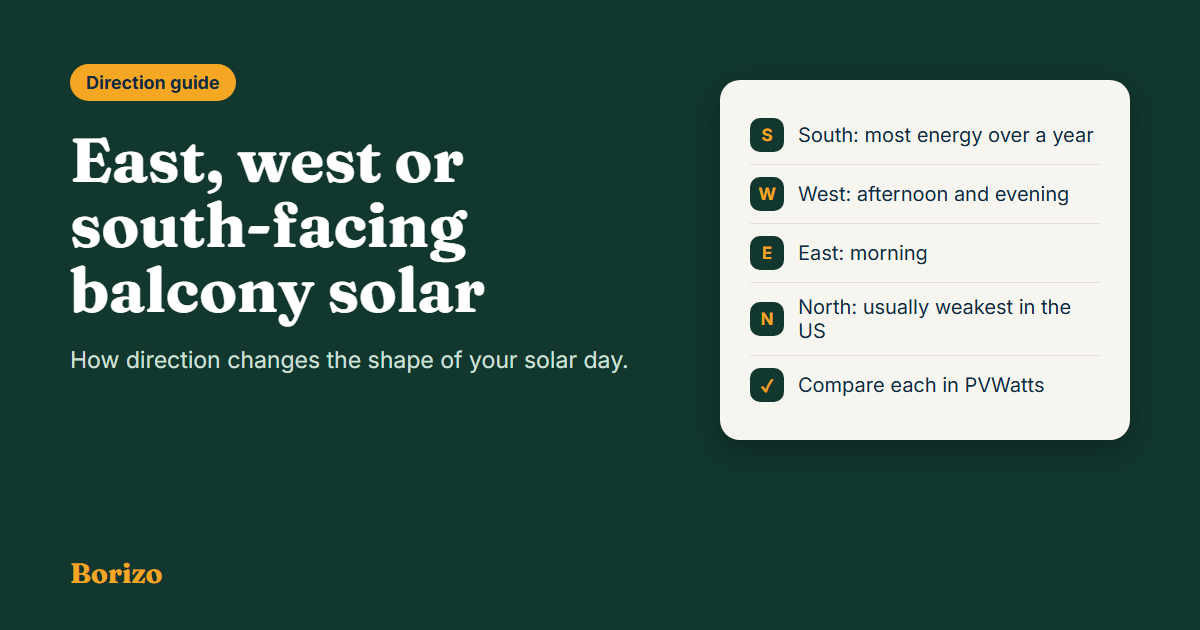
South-facing gives the most total energy over a year. West-facing shifts output toward the afternoon and early evening, when many homes use more power. East-facing shifts it to the morning. North-facing is usually the weakest in the US. The best way to know your own difference is to run each direction in PVWatts.
- EIA: the simplest way to maximize annual output of a fixed panel in the Northern Hemisphere is to tilt it south.
- West can beat south for timing. EIA notes west-facing panels point toward the setting sun, which can fit afternoon and evening demand.
- Timing only pays if your rates reward it. Customers on net metering generally do not gain from timing, but time-of-use rates change that.
- For plug-in solar, the power you use as it is made is what saves money, so match output to your own daytime use.
- Compare in PVWatts: use azimuth 180° for south, 90° for east, 270° for west and 0° for north.
What direction does to the day
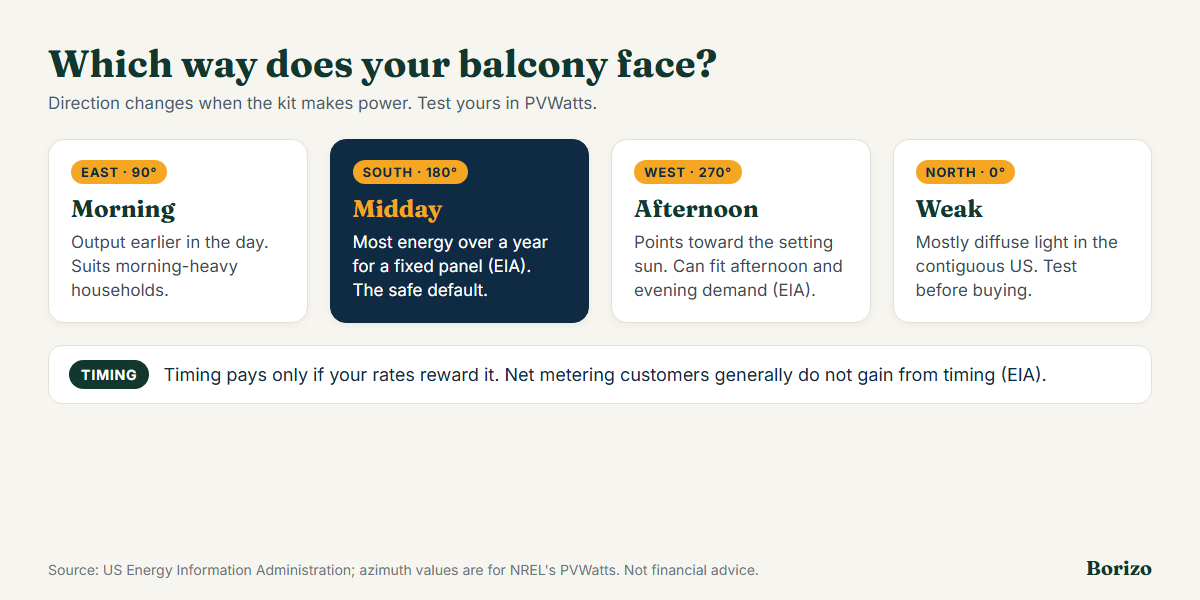
The sun rises in the east, crosses the southern sky and sets in the west. A panel gets the strongest light when it faces the sun, so the direction it faces decides when it makes the most power. We do not quote percentage losses here because they depend on your latitude and tilt; PVWatts will give you real numbers. The shape of the day looks like this:
| Direction | PVWatts azimuth | When it produces most | Total energy | Often suits |
|---|---|---|---|---|
| South | 180° | A broad peak around midday | Highest over a year for a fixed panel | Daytime use at home; the safe default |
| Southwest | 225° | Midday shifted to the afternoon | Close to south | Afternoon use with little give-up |
| West | 270° | Afternoon and early evening | Lower than south | Homes with afternoon and evening demand, or time-of-use rates with a late peak |
| Southeast | 135° | Morning to midday | Close to south | Morning use, early risers |
| East | 90° | Morning | Lower than south | Morning use; people out in the afternoon |
| North | 0° | Weak all day | Usually the lowest in the US | Rarely a good choice |
The “total energy” column is general direction, not measured for any particular product. Tilt matters too: see the best angle for a balcony panel. A panel flat against a vertical railing responds differently to direction than one tilted toward the sun.
South-facing: the default
EIA says the simplest way to maximize the total annual output of a fixed-tilt system in the Northern Hemisphere is to tilt the panels south. If you have a south-facing balcony without shade, you have the best-placed spot for annual energy. The peak is wide and sits around midday, which lines up with households that have someone home during the day or run a fridge, a dehumidifier or a home office.
West-facing: afternoon and evening
EIA notes that because demand often peaks in the afternoon or early evening, west-facing PV panels have an advantage over south-facing ones, as they are tilted toward the setting sun. That is a timing advantage, not extra energy. For a plug-in kit, timing matters because only the power you use as it is made saves you money; power you do not use goes to the grid, where it may earn little or nothing. A west balcony makes more of its power when more households are home and cooking, running air conditioning or watching TV. See how balcony solar works for what happens to the surplus.
East-facing: morning
East-facing panels produce earlier. If your house is busy in the morning and empty in the afternoon, that can suit you. If you are out until evening, an east panel’s power may go to the grid when you are away. An east-facing panel makes little power late in the day, so check what you use then.
North-facing
In the contiguous US the sun stays in the southern part of the sky, so a north-facing panel sees mostly diffuse light and little direct sun. It is rarely worth buying a kit for a north balcony. If a north balcony is your only space, test it in PVWatts first, or consider a patio, a wall or a ground stand in a sunnier spot, subject to your lease and your state’s rules.
Does timing change your savings?
EIA points out that customers on net metering generally do not gain from timing, because they are compensated per kilowatt-hour regardless of when it is generated. Time-of-use rates change that, since a kilowatt-hour in the late afternoon can cost more than one at midday. For plug-in solar the question is slightly different: what do you pay for the power you offset? If your plan charges more at 5 to 8 pm, a west-facing panel’s late-day output offsets more expensive power. Check your bill or your utility’s rate page, and see is plug-in solar worth it for how to find your price per kWh.
- Flat rate: total yearly energy matters most, so south usually wins.
- Time-of-use with an evening peak: west or southwest may be worth more than their energy total suggests.
- Net metering for exports: timing matters little, because exports are credited per kWh. We have not found a promise of export payment for plug-in kits in the state texts we read, so ask your utility.
Match the direction to your day
Before you decide, write down when your home actually uses power. Three quick profiles show how the choice can change:
| Your household | When you use power | Direction to test first |
|---|---|---|
| Works from home, fridge and router always on | Spread across daylight hours | South |
| Out at work, home from late afternoon | Evening peak: cooking, TV, air conditioning | West or southwest |
| Early risers, out by midday | Morning peak | East or southeast |
These are examples to guide what you test, not predictions. Your smart meter data or utility app may show an hourly usage curve you can compare with PVWatts’ monthly output. If the balcony faces only one direction, you do not have a choice, and the question becomes whether that direction is good enough to justify the kit.
Compare your directions in PVWatts
- Open PVWatts and enter your address and a system size, such as 0.8 kW.
- Set the tilt you can actually mount (see our angle guide).
- Run it with azimuth 180° (south), then your real direction, for example 270° for west.
- Compare the yearly kWh and the monthly bars. The difference is what your direction costs or saves.
- Think about when you use power, and put the yearly figure into the savings and payback calculator.
Also check shade for your direction: a west balcony that is shaded by a building at 4 pm loses its main advantage. See how shade affects balcony solar.
What if you have two balconies, or can aim panels two ways?
One idea is to put one panel on an east railing and one on a west railing to spread output across the day. Whether that works depends on the kit: both panels need to connect to the same microinverter or to separate ones, and your state’s cap counts the total output at your meter, customer, dwelling unit or address, not per balcony. See the wattage limit guide and check the product’s specifications for how many panels it accepts and how it tracks each one.
Frequently asked questions
Is south-facing best for balcony solar?
For total yearly energy, yes. EIA says tilting fixed panels south is the simplest way to maximize annual output in the Northern Hemisphere. Other directions can still make sense for timing.
Is west-facing solar better than south-facing?
Not for total energy, but it can fit afternoon and evening demand better. EIA notes west-facing panels point toward the setting sun, which can be an advantage where demand peaks later in the day.
Is east-facing balcony solar worth it?
It can be, if your use is concentrated in the morning, but it produces less than south over a year. Run it in PVWatts and compare it with your usage.
Does a north-facing balcony work for solar?
In the US it is usually the weakest direction. Test it in PVWatts before buying and consider a sunnier spot.
Sources
- US Energy Information Administration, Solar photovoltaic output depends on orientation, tilt, and tracking (south tilt maximizes annual output; west-facing advantage; net metering and time-of-use).
- NREL, PVWatts Calculator (compare orientation and tilt for your address).
- State laws on how output is counted: State Laws hub.

Borizo is an independent guide to plug-in and balcony solar in the US. We track state laws, check certification claims against official sources, and compare kits using published specifications. Laws change often, so every state page shows a “last updated” date and links to its sources. We earn a commission when you buy through our Amazon links, at no extra cost to you. Our content is for information only and is not legal or electrical advice.