Is Plug-in Solar Safe? Backfeeding Explained
“Backfeeding” sounds alarming, and in one sense it should: backfeeding your house from a generator through a homemade cable is dangerous. But the backfeed in a plug-in solar kit is a different thing, designed in and meant to be certified. The real questions are whether the design is safe for the wiring in your home and who has checked it. This guide explains what backfeed means for plug-in solar, what UL Solutions says the risks are, what protections exist and which do not, and what you can do to lower the risk. It is based on UL Solutions commentary, trade press coverage of UL’s research, NREL and state law text. We have not tested any kit, and this is general information, not electrical advice.
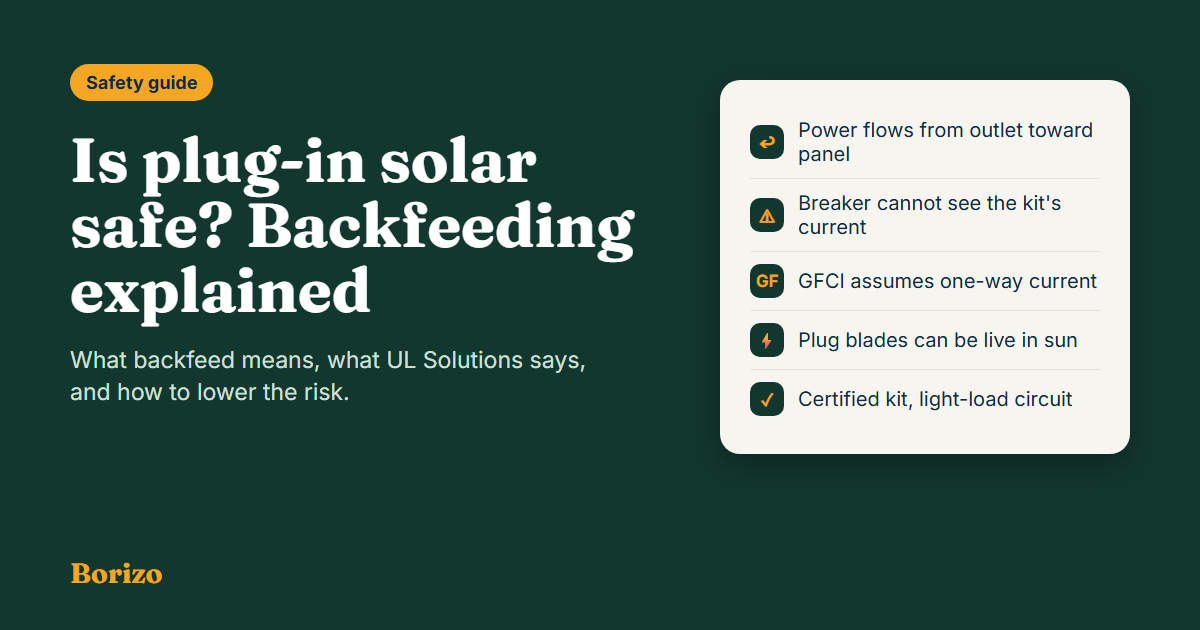
Plug-in solar deliberately feeds power backward into your home’s wiring through an outlet. Certified kits are designed to shut off in an outage, and state caps limit size, but UL Solutions says home circuits were built for one-way power flow, so the main remaining risk is an overloaded wire that the breaker cannot see. Choosing the circuit carefully matters.
- “Backfeed” here means power flowing from the outlet toward the panel, the opposite of the normal direction.
- Breakers measure only the utility side. UL says the combined current can exceed a wire’s rating without tripping the breaker.
- Plug blades can be live. UL warns they can be energized when panels are in sunlight.
- GFCI standards assume one-way current, so ground-fault protection may not behave as designed with a kit.
- You can reduce risk: certified kit, a light-load circuit, one kit per outlet, the maker’s cable, and an electrician’s check.
What backfeed means here
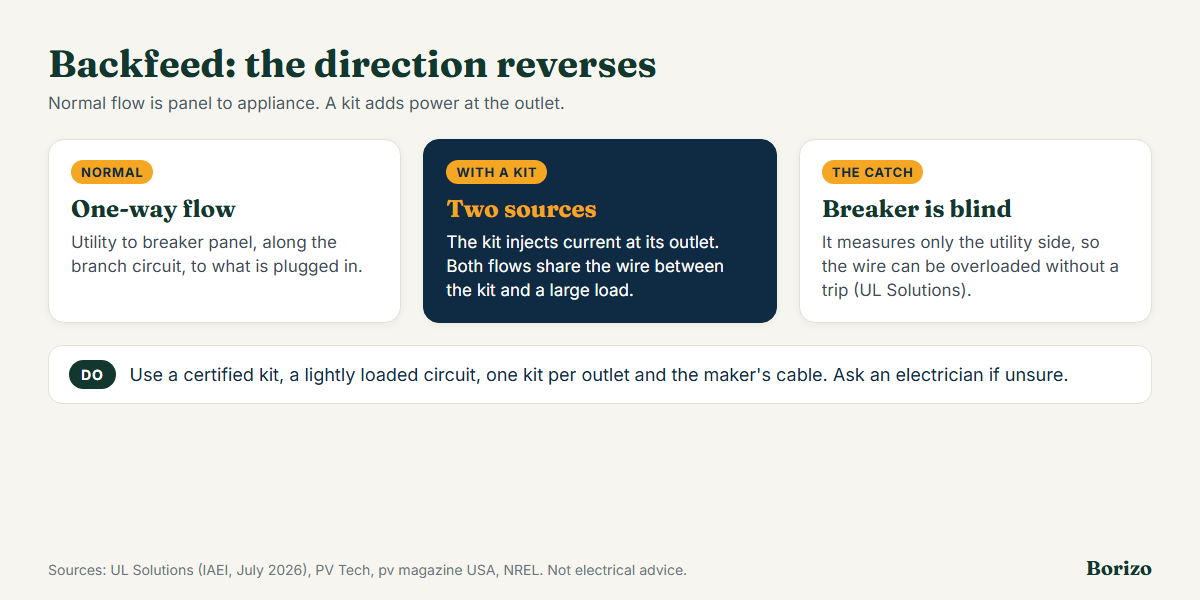
In a normal home, electricity flows one way: from the utility through the breaker panel, along a branch circuit and into whatever is plugged in. A plug-in kit reverses part of that. It injects power at an outlet, which flows along the same wires to other loads on that circuit and, if there is surplus, back toward the panel and the grid. UL Solutions describes plug-in PV units as backfeeding power into existing branch circuits through standard receptacles, and says that creates situations current electrical codes do not address. For the basics of how the power travels, see how balcony solar works.
That is different from the dangerous practice people call backfeeding a house from a generator. Never make or use a cable with plugs on both ends to push power into an outlet. A plug-in solar kit is a listed product with an inverter designed to meet a standard; an improvised cable has none of that.
What UL Solutions says the risks are
UL Solutions wrote the UL 3700 standard and has published both a magazine column and a white paper on how plug-in PV interacts with existing wiring protection. The points that matter to a homeowner:
- One-way design. “Branch circuits are designed for one-way power flow from the panelboard to the load,” UL says.
- Breaker blindness. When utility current and kit current add up on the wire between them, the combined current can overload a circuit without tripping the breaker. UL warns that undetected overloads pose fire and shock risks, often without the consumer’s awareness. Ken Boyce of UL Solutions told PV Tech that the kit injects current “that the circuit breaker in the panel board is blind to.”
- Ground-fault protection. UL says current GFCI standards assume current flows one way, and that two-way flow can leave GFCIs unable to protect the circuit as designed.
- Live plug blades. UL warns that accessible plug blades can become energized when the panels are in sunlight, and that grid-interactive inverters are not evaluated for this kind of user contact.
These are not reasons to panic. They are reasons to choose the outlet and the kit with care. The mechanism is the same one in our wattage limit and circuit safety guide, with a diagram.
What protects you, and what does not
| Protection | What it does | What it does not do |
|---|---|---|
| Anti-islanding in the inverter | Stops export when the grid fails, within about 2 seconds per the IEEE 1547-2018 standard summarized by NREL | Does not stop overload of a shared wire while the grid is up |
| Certification (UL 3700 or comparable) | Tests the device against a safety standard; state laws require it | A seller’s claim is not proof. Verify in the lab’s directory, and certification does not check your home’s wiring. See the UL 3700 guide |
| State size caps (mostly 1,200 W) | Limit the current a kit can add | Do not tell you what else is on your circuit |
| Dedicated circuit and electrician (Maine above 420 W) | Remove the shared-wire problem | Not required in most other states |
| One kit per outlet (Colorado) | Prevents stacking output at one point | Does not cover several outlets on one circuit |
| Your own choices | Light-load circuit, maker’s cable, an electrician’s check | Depend on you doing them |
A Stateline report from September 2026 carries the headline that states want balcony solar safety guidelines but they have not caught up. That is why a few extra minutes on your own circuit is worth it.
How to reduce the risk
- Buy a certified kit and look it up in the lab’s own directory.
- Find your breaker and its rating, and see what else is on that circuit. Avoid circuits that also feed a space heater, window air conditioner or kitchen appliances. See which outlet a kit can use.
- One kit per outlet and keep your total under your state’s cap.
- Use only the maker’s cable and no extension cords or power strips unless the manual allows them.
- Handle the plug with care. Follow the manual’s order for connecting and disconnecting, and never touch the prongs.
- Ask a licensed electrician to look at the circuit, especially for older wiring, outdoor outlets, GFCI outlets or any outlet that has been warm, loose or damaged. A dedicated circuit is the simplest fix.
- Know the signs. A warm outlet or plug, a burning smell, discoloration, a breaker that trips repeatedly or a GFCI that will not reset means unplug the kit and call an electrician.
Is it safe?
It is safer when the kit is certified, the circuit is known and lightly loaded, and the setup follows the manual. It is riskier when the device is uncertified, the circuit is shared with large loads, or cords and strips are improvised. As we read UL Solutions, the concern is that existing electrical codes did not address this interaction with a home’s wiring, so safeguards have to come from the product, the law and your own choices. We cannot judge your home’s wiring from here, and we have not tested any kit. Our installation checklist pulls these steps into one list, and plug-in solar in a power outage explains the shutdown side.
Frequently asked questions
What is backfeeding in plug-in solar?
Plug-in solar kits feed power from an outlet back into the home’s wiring, opposite to the normal flow from the panel to the load. Certified kits are designed for this, but UL Solutions says existing codes do not fully address it.
Can plug-in solar overload my wiring?
Possibly, on a shared circuit. UL says utility and kit current can add up on a wire without tripping the breaker. Choose a lightly loaded circuit, keep to one kit per outlet and ask an electrician if unsure.
Does backfeeding hurt utility workers?
Certified inverters are designed to stop within seconds of a grid outage, which protects line workers. NREL’s summary of IEEE 1547-2018 says the inverter must cease to energize and trip within 2 seconds after an island forms.
Is it the same as backfeeding from a generator?
No. A generator backfeed through a homemade cable is dangerous. A plug-in kit is a listed product with an inverter designed to shut off in an outage. Never use a cable with plugs on both ends.
Sources
- UL Solutions, “Question Corner,” IAEI Magazine, July 1, 2026 (backfeed into branch circuits, one-way design, breaker blindness, GFCI, energized plug blades, UL 3700).
- PV Tech, US plug-in solar: questions remain over safety, certifications and regulation (Ken Boyce, UL Solutions).
- pv magazine USA, Ensuring safety of plug-in solar (summary of UL’s white paper).
- Stateline, States want balcony solar safety guidelines, but they haven’t caught up, September 30, 2026.
- NREL, A Primer on the Unintentional Islanding Protection Requirements in IEEE 1547-2018.
- State laws: Colorado HB26-1007 (one device per wall outlet), Maine LD 1730 (dedicated circuit above 420 W); all states in the State Laws hub.

Borizo is an independent guide to plug-in and balcony solar in the US. We track state laws, check certification claims against official sources, and compare kits using published specifications. Laws change often, so every state page shows a “last updated” date and links to its sources. We earn a commission when you buy through our Amazon links, at no extra cost to you. Our content is for information only and is not legal or electrical advice.