Can Plug-in Solar Spin Your Meter Backward?
“Will it spin my meter backward?” is one of the most common questions about plug-in solar, and the honest answer is: probably not, and it would not matter much if it did. The image comes from old mechanical meters with a spinning disc, which really could turn in reverse when a home sent power out. Most US homes now have digital meters that count energy in each direction, or only one, rather than spinning at all. This guide explains what your meter actually does when a plug-in kit is running, how to tell which kind you have, what you might see on the display, why the answer matters for your bill, and what you should never do to a meter. It is based on Congressional Research Service and EIA material and an engineering report for the Vermont legislature. We have not tested any kit or meter.
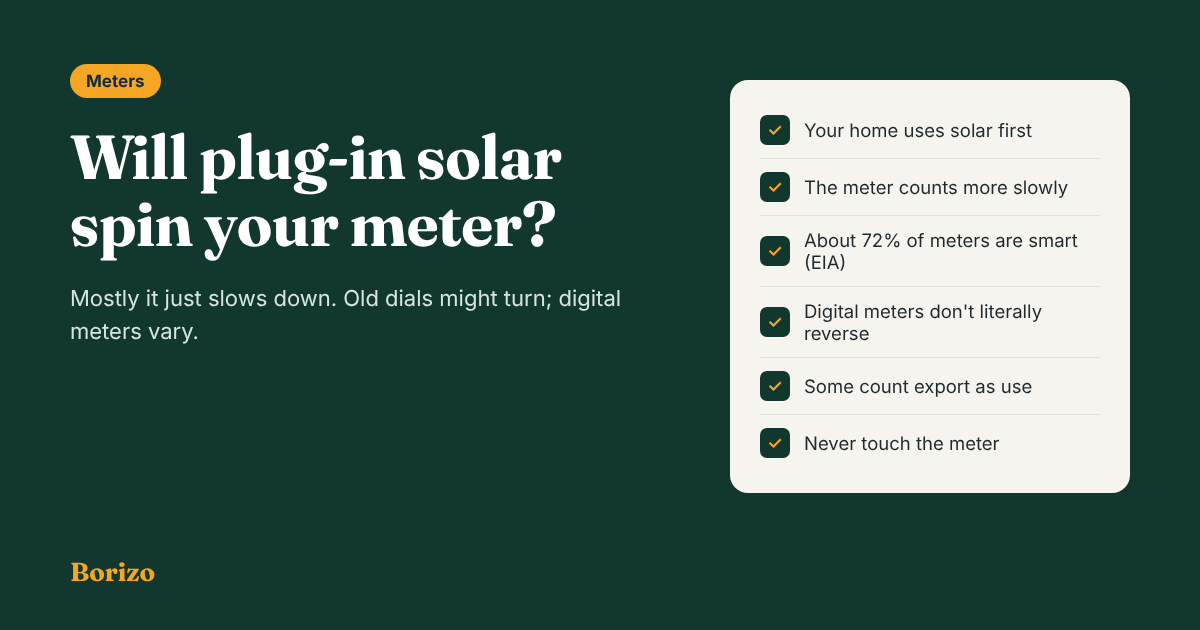
Most of the time, a plug-in kit just makes your meter count more slowly, because your home uses the solar power as it is made. On the rare occasions when the kit makes more than your home uses, an old mechanical meter might turn backward, while a digital meter records the export, ignores it or, with some meters, counts it as use. Which one you have decides whether exports help, do nothing or cost you a little. Ask your utility, and never open or tamper with the meter.
- “Running backward” is mostly a figure of speech now. The Congressional Research Service notes most meters installed today are digital and do not literally run in reverse.
- Smart meters are the majority. EIA counted about 119 million smart meter installations in 2022, about 72% of all electric meters.
- Meters handle export differently. An engineering report for the Vermont legislature says some meters record in one direction only, and others record flow in either direction as energy consumed.
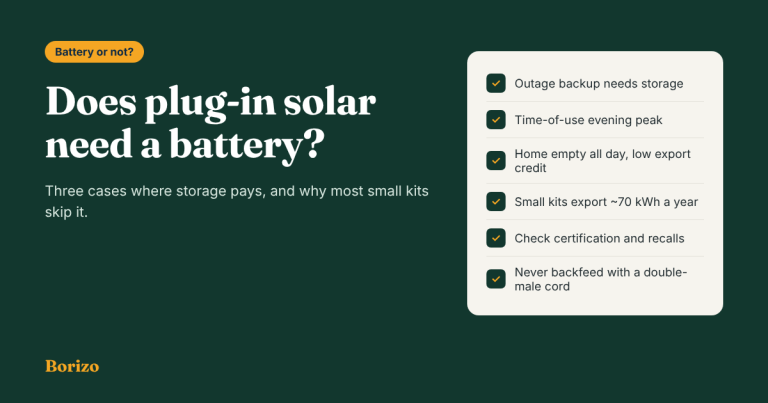
- A small kit rarely exports. The same report estimated at most about 70 kWh a year for a 1.2 kW system.
- Never touch the meter. Meters belong to the utility; tampering is dangerous and can be illegal.
What your meter does most of the time
When your kit is producing and your home is using more power than the kit makes, which is most of the time for a small kit, nothing unusual happens at the meter. Your home simply draws less from the grid, so the meter counts more slowly. On a sunny midday, you might see consumption drop to a fraction of what it is at night. That reduction is where nearly all of a plug-in kit’s savings come from, as our savings guide explains.
Only when the kit’s output exceeds everything your home is using at that moment does power flow out through the meter. Brooks Engineering, in a report for the Vermont legislature, found that happens only “from time to time” with plug-in systems, mostly in spring and fall, and estimated a 1.2 kW system could export about 70 kWh a year at most. For a sense of scale, EIA reports the average US residential customer used 865 kWh a month in 2024.
Which kind of meter do you have?
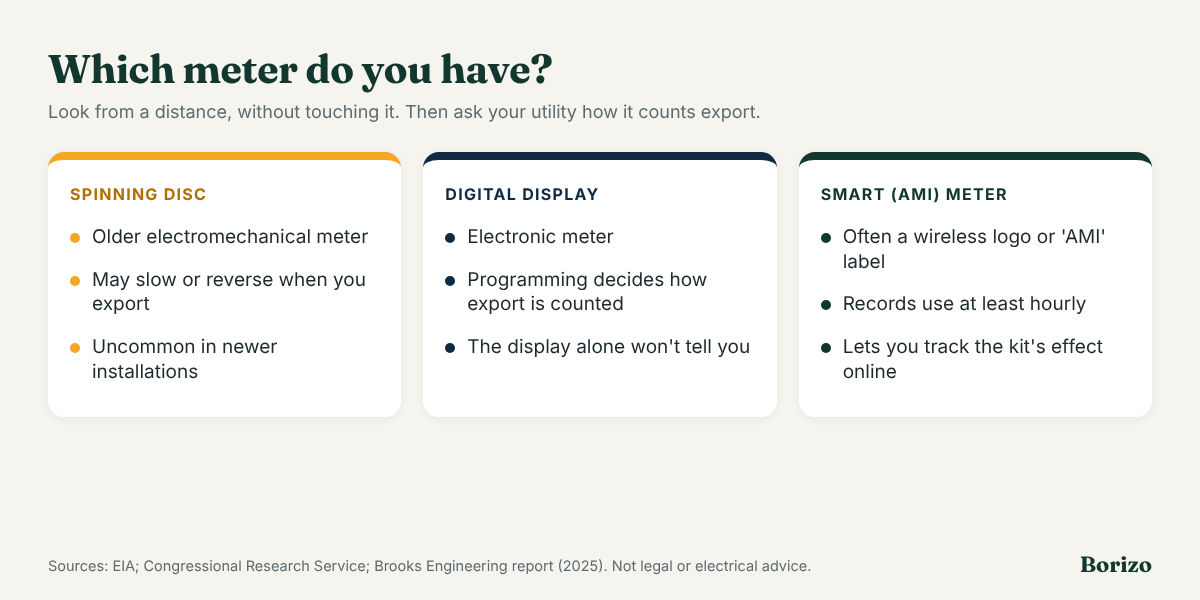
| Meter type | How it looks | What happens with export |
|---|---|---|
| Electromechanical (analog) | A glass dome with a spinning metal disc and dials or a counter | Many can turn backward when power flows out, subtracting from the count |
| Digital, net or bidirectional | An electronic display; may show separate “delivered” and “received” values | Records export, either netting it or on its own register |
| Digital, non-reversing | Electronic display | Records energy in one direction only; export is not counted |
| Digital, records either direction as use | Electronic display | Counts exported energy as if you used it |
Look at your meter from a distance without touching it. A spinning disc means an older electromechanical meter. A digital display, especially one with a utility’s wireless logo or a label like “AMI,” usually means a smart meter. EIA defines smart (AMI) meters as ones that “measure and record electricity usage at a minimum of hourly intervals” and share data with the utility and the customer at least daily. Our smart meter guide covers what that hourly data can show you.
Why it matters for your bill
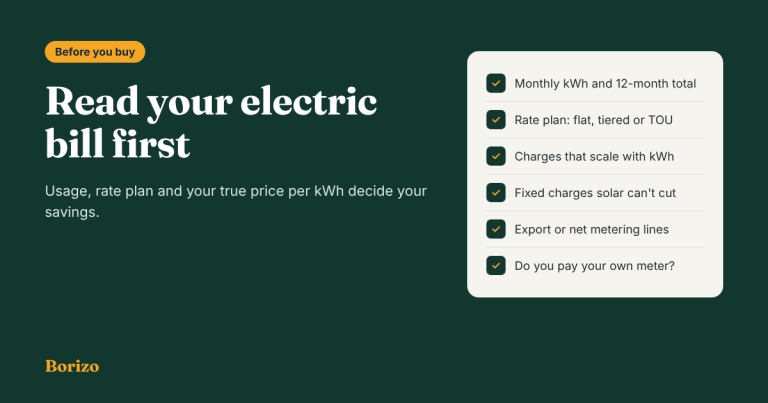
The Congressional Research Service describes net energy metering as electricity sent to the grid being credited one-to-one against electricity bought, commonly called “the meter running backward.” It also notes that most meters installed today are digital and do not literally run in reverse; the netting happens in the meter’s programming or the utility’s billing system.
For a plug-in kit, the four meter behaviors in the table lead to four outcomes for exported energy: a full credit, a credit at your utility’s export rate, nothing, or a small charge. The Vermont report estimated that for utilities that record produced energy as consumed, a 1.2 kW plug-in customer would lose about $14 a year, and described the meter issues as generally too small to have real impact. Small as it is, it is worth ruling out. Our guide to what happens to extra power covers export credits in more detail.
What to ask your utility
- What type of meter do I have, and does it record energy flowing back to the grid?
- If it does, how is that energy billed: netted, credited at a separate rate, or not credited?
- Could exported energy ever be counted as consumption on my meter?
- Do I need to notify you about a plug-in device under my state’s law? Virginia, Maine above 420 W, and Colorado if the utility asks, have notice rules; see our wattage limit guide.
- Can I see my hourly usage online so I can track the kit’s effect?
Ask in writing or note the date and name of the person you spoke with.
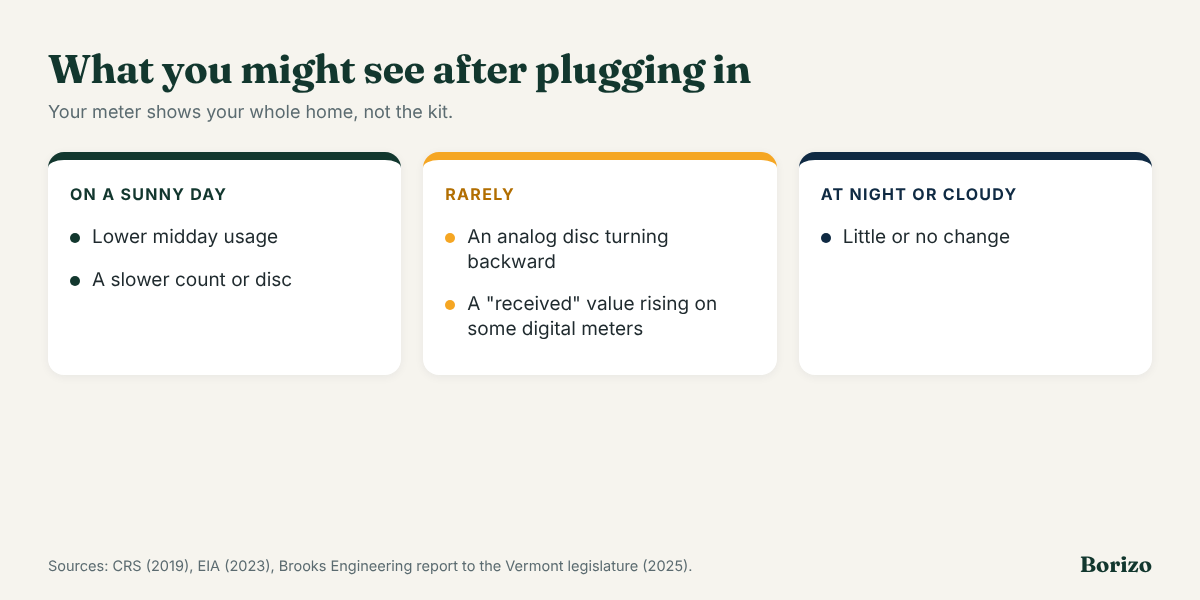
What you might notice after plugging in
- Lower midday usage in your utility’s hourly data on sunny days.
- A slower-moving disc on an analog meter while the sun is out, or very rarely a disc turning the other way.
- A “received” or export value creeping up on some digital meters on sunny weekends, if the meter records export separately.
- Little change on cloudy days and at night, when the kit produces little or nothing.
To measure the kit itself rather than the whole home, use its app or a plug-in energy monitor, as our monitoring guide explains.
What you should never do
Meters belong to the utility and carry high-energy service connections. Do not open, unseal, move, bypass or try to reprogram a meter, and do not try to make it run backward on purpose. Tampering is dangerous, can cause fires or electrocution, and can be treated as theft of service. If you think your meter is recording solar exports incorrectly, ask the utility to check it.
Frequently asked questions
Will plug-in solar make my electric meter run backward?
Usually not. Most of the time your home uses all the solar power, so the meter just counts more slowly. Only an older mechanical meter might turn backward during the rare times the kit exports, and most meters today are digital and do not literally run in reverse.
Does a smart meter record power from my balcony solar?
It records your home’s net flow at the meter, not the kit’s output directly. Depending on how it is set up, a digital meter may record exports, ignore them or count them as use. Ask your utility how yours works.
Can my meter charge me for solar I send to the grid?
With some meters, yes. An engineering report for the Vermont legislature notes that some meters record energy flowing in either direction as consumed. It estimated the cost at about $14 a year for a 1.2 kW system. Ask your utility to confirm your meter’s behavior.
Will the utility know I have plug-in solar?
It may see lower midday use or occasional exports in your meter data. Some states require you to notify the utility, including Virginia and, above 420 W, Maine. Follow your state’s rule.
Sources
- Ashley J. Lawson, Congressional Research Service, Net Metering: In Brief, R46010, November 14, 2019 (NEM one-to-one; “meter running backward”; digital meters do not literally reverse).
- US Energy Information Administration, How many smart meters are installed in the United States?, updated October 20, 2023 (about 119 million AMI installations in 2022; about 72% of meters; AMI definition).
- US Energy Information Administration, Today in Energy, May 12, 2025 (865 kWh a month per residential customer in 2024).
- Brooks Engineering for Bright Saver, Plug-In Solar Utility Impact in the United States, December 3, 2025 (meter behaviors; about 70 kWh a year of export; $14 example).
- Photos: stock images from Freepik, used for illustration only.

Borizo is an independent guide to plug-in and balcony solar in the US. We track state laws, check certification claims against official sources, and compare kits using published specifications. Laws change often, so every state page shows a “last updated” date and links to its sources. We earn a commission when you buy through our Amazon links, at no extra cost to you. Our content is for information only and is not legal or electrical advice.