Plug-in Solar With a Battery: When It Makes Sense
A plug-in solar kit makes power only while the sun is up, and most homes use the most electricity in the evening. A battery looks like the obvious fix: store the midday sunshine and use it at night, or keep the lights on in a blackout. Sometimes that is worth the money. Often it is not, because a small kit’s output is mostly used the moment it is made. This guide explains what a battery adds to plug-in solar, the three situations where it pays off, the ones where it does not, the product types on the market and the safety points to check. It is based on Department of Energy, state regulator and engineering sources. We have not tested any battery or kit.
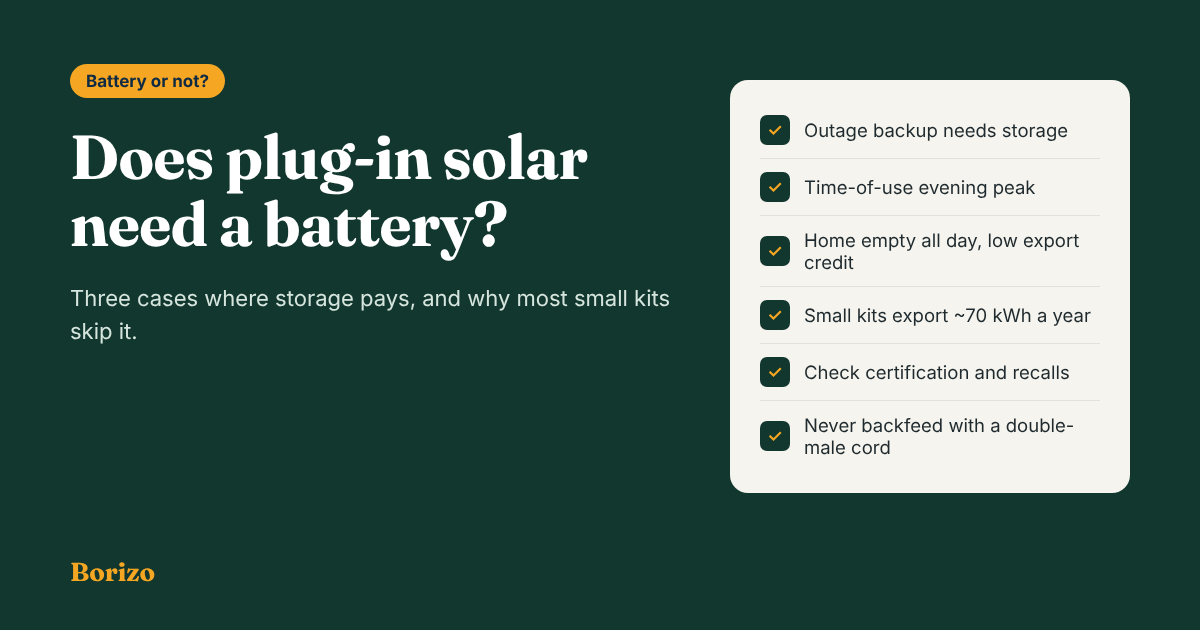
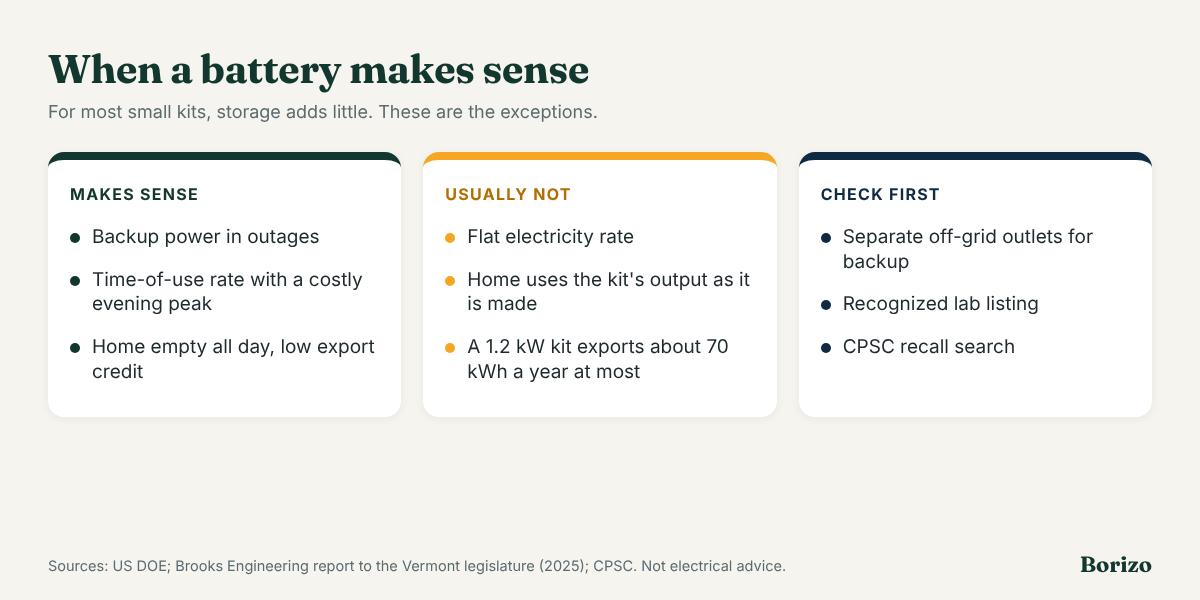
A battery makes sense with plug-in solar if you want backup power in an outage, if you are on a time-of-use rate with expensive evening hours, or if your home uses so little during the day that a lot of your solar flows out to the grid for little credit. If none of those apply, a plain kit usually pays back faster, and the money for a battery is better spent elsewhere.
- A grid-tied kit alone shuts off in an outage. The Department of Energy says grid-connected solar is designed to switch off when grid power cuts out. Backup needs storage that can run on its own.
- Small kits export little. An engineering report for the Vermont legislature estimated a 1.2 kW plug-in system exports only about 70 kWh a year at most, mostly in spring and fall.
- Time-of-use rates change the math. On Xcel Energy’s Colorado time-of-use rate, on-peak power costs 2.7 times the off-peak price, so moving solar into the evening is worth more.
- “Battery” covers three different things: a portable power station, a balcony battery with a built-in grid-tied inverter, and a home battery wired in by an electrician.
- Check certification and recalls. Lithium batteries can catch fire. Look for a recognized lab listing and search CPSC recalls before you buy.
What a battery changes
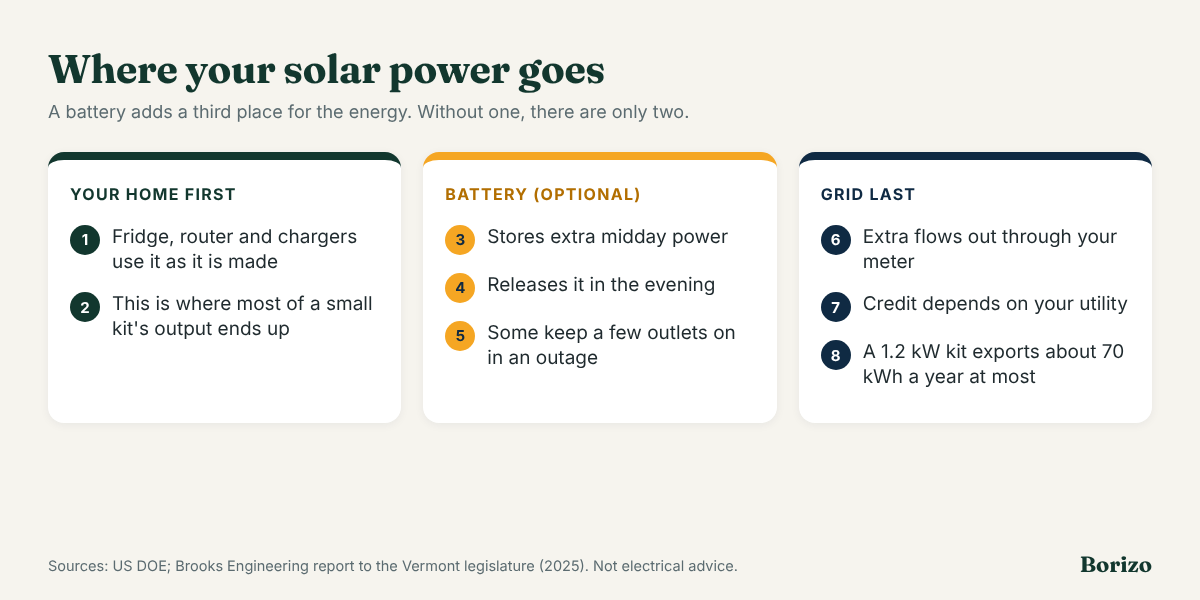
Without a battery, a plug-in kit feeds the circuit it is plugged into. Whatever your home is using at that moment, such as the fridge, router or a laptop charger, takes the solar power first. If the kit makes more than the home uses, the extra flows back out through your meter to the grid. Our guide to how balcony solar works covers that path in detail.
A battery adds a third place for the energy to go. Instead of exporting extra midday power, the system stores it and releases it later, usually in the evening. Some batteries can also keep a few outlets running when the grid goes down. Those two jobs, shifting energy in time and backup, are the whole case for a battery. Everything else is a question of how much each one is worth to you.
Why most small kits do not need a battery
The argument against a battery is simple: a small kit rarely makes more than your home is already using. In a report submitted to the Vermont legislature, Brooks Engineering looked at how much a plug-in system could export. It found that export happens only “from time to time,” typically in spring and fall, and that a 1.2 kW system “can only generate an excess of 0.76 kWh on the days when the home is at its lowest consumption.” Over a year, it estimated about 70 kWh of excess energy at best.
That number frames the battery question. If your kit exports around 70 kWh a year, a battery could save at most the difference between what you pay for power and what you are credited for exports, on those 70 kWh. The same report used an illustrative $0.20 retail price and $0.05 export credit, which works out to about $10.50 a year. No battery pays for itself on $10.50 a year.
Two caveats. First, that estimate assumes an ordinary household with a fridge, electronics and other loads running all day. A home that is empty and nearly switched off during the day will export more. Second, the figure is for a 1.2 kW system. A smaller 400 W or 800 W kit will export even less. To see what your kit is likely to produce, use our daily output guide.
When a battery does make sense
1. You want backup power in an outage
This is the clearest case. The US Department of Energy explains that grid-connected solar systems “generally depend on the electrical grid to produce power” and, “for safety reasons, they’re designed to switch off if the grid power cuts out.” To keep running during an outage, a system needs storage and an inverter that can run in “islanded” mode, separate from the grid. A plain plug-in kit cannot do this, as we explain in does plug-in solar work during a power outage.
If backup is your goal, what matters is not the solar kit but the battery’s own outlets: how many watts they deliver, how many watt-hours the battery holds, and whether it can recharge from solar while the grid is down. Read the manual carefully, because a battery’s grid-tied output must still stop during an outage. Only separate off-grid outlets keep working.
2. You pay time-of-use rates with an expensive evening peak
On a time-of-use plan, the price of electricity depends on the hour. Colorado’s Public Utilities Commission lists Xcel Energy’s on-peak hours as 5 p.m. to 9 p.m. on non-holiday weekdays, with on-peak power costing 2.7 times the off-peak price. Its table shows summer rates of about $0.213 per kWh on-peak and $0.079 off-peak.
On a rate like that, solar used at noon offsets cheap off-peak power, while the same energy used at 6 p.m. offsets expensive peak power. A battery that moves midday solar into the evening earns the difference. Our arithmetic, using those summer prices: shifting 1 kWh a day into the peak window is worth about $0.13 a day, or roughly $49 over a year if every day were a summer weekday, before battery losses. Real savings will be lower once you account for weekends, the cheaper non-summer rates and the energy a battery loses in charging and discharging. See savings and payback for the basic method.
3. Your exports earn little and you use little during the day
If your home is empty most of the day and your utility credits exported power at a low rate, or not at all, more of your solar is wasted. A battery keeps that energy for your own use. This is the case where the Vermont report’s estimate understates the value, so measure first. A plug-in energy monitor or your utility’s hourly data shows how much you use during sunny hours. Our monitoring guide explains the options.
The three kinds of “battery”
| Type | How it connects | Shifts solar to evening? | Outage backup? | Watch out for |
|---|---|---|---|---|
| Portable power station | Not connected to home wiring. Devices plug into it. Charges from the wall or its own solar panels | Only if you charge it from solar and plug devices into it | Yes, for what is plugged in | Never connect it to a wall outlet with a double-male cord |
| Balcony battery with grid-tied inverter | Sits between the panels and the outlet; stores extra solar and feeds the home later | Yes, automatically | Only if it has separate off-grid outlets | State certification rules and output caps still apply |
| Home battery system | Wired into the home’s panel by a licensed electrician, usually with a permit | Yes | Yes, for backed-up circuits | Cost, permits and utility interconnection rules |
Balcony batteries are the newest category in the US. Solar Builder described EcoFlow’s STREAM Ultra, launched first in Utah, as “a 1.92 kWh solar battery with a built-in grid-tied microinverter” that sends up to 1,200 W to the home. We mention it as an example of the category, not a recommendation, and we have not tested it. For portable power stations, our plug-in solar vs power station comparison covers sizing and the backfeeding warning.
A quick way to decide
- Write down your goal. Backup, bill savings, or both. If it is only backup, a power station sized to your devices may be all you need.
- Check your rate plan. Look on your bill for “time-of-use” or “TOU” and note the peak hours and prices. A flat rate makes bill-saving storage hard to justify.
- Estimate your exports. Compare your kit’s likely midday output with what your home uses at midday. If you almost never export, storage adds little.
- Price the shift. Multiply the kWh you could move each day by the price gap between peak and off-peak, then subtract roughly 10% to 15% for losses as a cautious placeholder. Compare that yearly figure with the battery’s cost and warranty length.
- Check the rules. Your state’s plug-in solar law may cap total output and name a certification, whether or not a battery is involved. See wattage limits.
The loss figure in step 4 is our cautious placeholder, not a measured value. Use the round-trip efficiency on the product’s spec sheet if it lists one.
Safety points for any battery
- Battery fires are real. In August 2024 the CPSC announced a recall of about 5,740 HALO 1000 portable power stations after four fire reports and one death. In September 2025 it warned consumers to stop using Aeiusny 400 W and 500 W power stations sold on Amazon after 24 reports of fires and explosions. Search CPSC recalls for any model before buying.
- Look for a recognized lab listing. UL 2743 covers portable power packs. For grid-tied balcony batteries, check what certification your state’s law requires and confirm it in the lab’s own database, as our certification guide explains.
- Never backfeed. The CPSC warns that powering house wiring by plugging a generator into a wall outlet “presents an electrocution risk to utility workers.” The same danger applies to any battery connected with a double-male cord.
- Place it sensibly. Keep batteries out of direct sun and away from heat, and follow the maker’s temperature limits. Do not block exits or leave a battery where children can reach the connectors.
Frequently asked questions
Do I need a battery for plug-in solar?
No. A plug-in kit works without one by feeding the circuit it is plugged into. A battery only helps if you want outage backup, you pay time-of-use rates with an expensive evening peak, or your home exports a lot of solar for little credit.
Will a battery let my plug-in solar run during a blackout?
Only if the battery has its own off-grid outlets designed to keep working when the grid is down. The grid-tied part of any system must stop exporting during an outage. Check the manual before you count on backup.
Is a balcony battery worth it on a flat electricity rate?
Usually not. On a flat rate, power used in the evening costs the same as power used at noon, so storing solar only helps with the small amount you would otherwise export. An engineering estimate for the Vermont legislature put that at about 70 kWh a year for a 1.2 kW system.
Can I charge a portable power station from my plug-in kit?
Not directly. The kit feeds your home circuit, not a battery. You can plug the station into a wall outlet while the sun shines, and part of that charging power is covered by your kit, or charge the station from its own portable panels.
Sources
- US Department of Energy, Solar and Resilience Basics (grid-connected solar switches off when grid power cuts out; storage and islanded mode).
- Brooks Engineering for Bright Saver, Plug-In Solar Utility Impact in the United States, December 3, 2025, submitted to the Vermont legislature (incidental export; 0.76 kWh daily maximum; about 70 kWh a year; $0.20/$0.05 example).
- Colorado Public Utilities Commission, Time of Use Rates (Xcel Energy on-peak 5 to 9 p.m. weekdays; on-peak 2.7 times off-peak; rate table), read October 26, 2026.
- Solar Builder, EcoFlow launches STREAM series to bring balcony solar to the U.S., May 7, 2025.
- CPSC, HALO 1000 recall, August 29, 2024; Aeiusny warning, September 4, 2025; Portable Generator Hazards alert (backfeeding).
- Standards Council of Canada, ANSI/CAN/UL 2743, Portable Power Packs.

Borizo is an independent guide to plug-in and balcony solar in the US. We track state laws, check certification claims against official sources, and compare kits using published specifications. Laws change often, so every state page shows a “last updated” date and links to its sources. We earn a commission when you buy through our Amazon links, at no extra cost to you. Our content is for information only and is not legal or electrical advice.