Does Plug-in Solar Work During a Power Outage?
When the power goes out on a sunny afternoon, it is natural to wonder whether the solar panels on your balcony will keep the fridge running. For a standard plug-in solar kit, the answer is no, and that is by design. The same feature that stops the kit from working in a blackout is the one that protects utility crews and your neighbors. This guide explains why a grid-tied kit shuts off, how quickly, when it starts again, what the law says, and what to buy instead if backup power is what you want. It is based on NREL research, state law text, UL Solutions and manufacturer documents. We have not tested any kit.
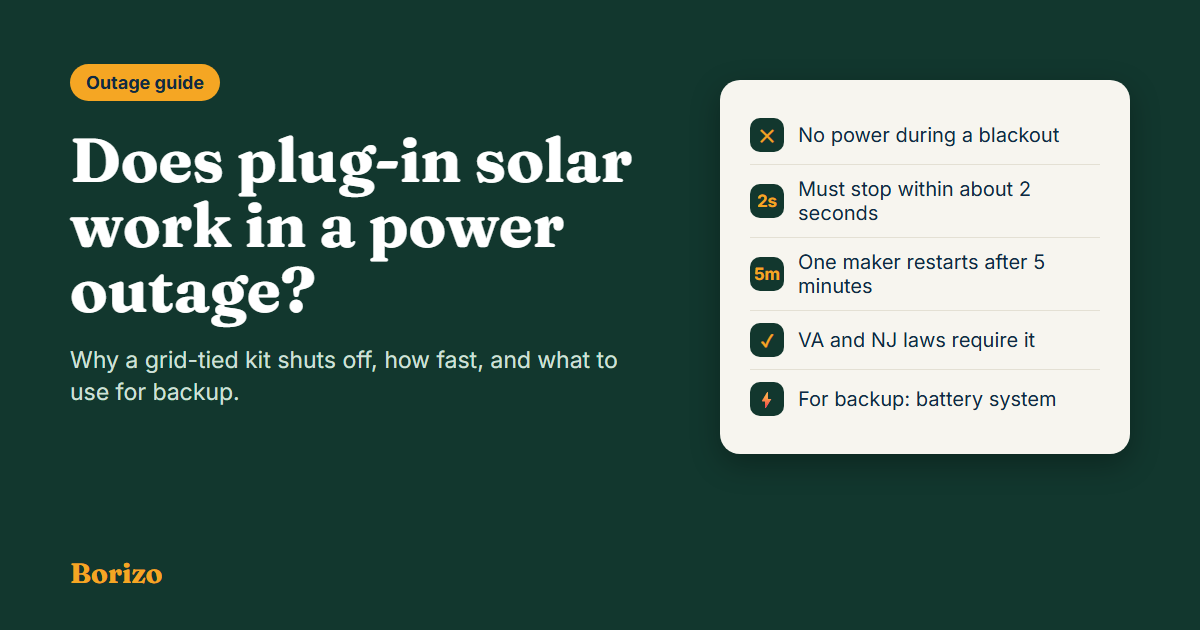
No. A standard plug-in solar kit is grid-tied: its microinverter needs a live grid to follow and must stop sending power within seconds when the grid fails. It will not run your home, or even one appliance, during a blackout. For backup power you need a battery system designed for it.
- Sunshine is not enough. A grid-tied inverter only works while it senses normal grid voltage and frequency.
- The shutdown is a safety feature, not a flaw. NREL says the standard requires inverters to cease to energize and trip within 2 seconds after an island forms.
- The kit restarts on its own after the grid has been stable for a while. APsystems says its EZ1 waits five minutes.
- State laws require it. Virginia’s law and New Jersey’s bill both require a feature that prevents export during an outage.
- For backup, look at a portable power station or a battery system built for backup, and read its manual carefully.
Why a plug-in kit stops when the grid goes down
The inverter follows the grid
A plug-in kit uses a grid-tied microinverter. As we explain in how balcony solar works, its job is to turn the panels’ DC power into AC power that matches the grid’s voltage and timing. It does that by following the grid’s signal. If the signal disappears, the inverter has nothing to follow, and a standard grid-tied inverter is not built to create its own.
Islanding is the danger
Even if an inverter could keep producing power, it should not. Engineers call the unsafe case an unintentional island: a part of the grid that is cut off from the utility but stays energized by local generators, including rooftop and balcony solar. That is dangerous for line workers who assume a repaired line is dead, and it can damage equipment when the utility reconnects. NREL’s primer on the IEEE 1547-2018 interconnection standard says an inverter must cease to energize and trip within 2 seconds after an island forms, and that this clearing time can be adjusted between 2 and 5 seconds by agreement between the utility and the equipment owner.
Safety standards test for it
State laws point to UL 3700 or a comparable standard for plug-in kits, and manufacturers cite UL 1741 for anti-islanding protection. APsystems, for example, says built-in anti-islanding protection automatically shuts its EZ1 down during an outage, and that the unit is certified to UL 3700 and meets UL 1741 SB requirements. See our UL 3700 guide for how to check a certification claim.
What you will see during an outage
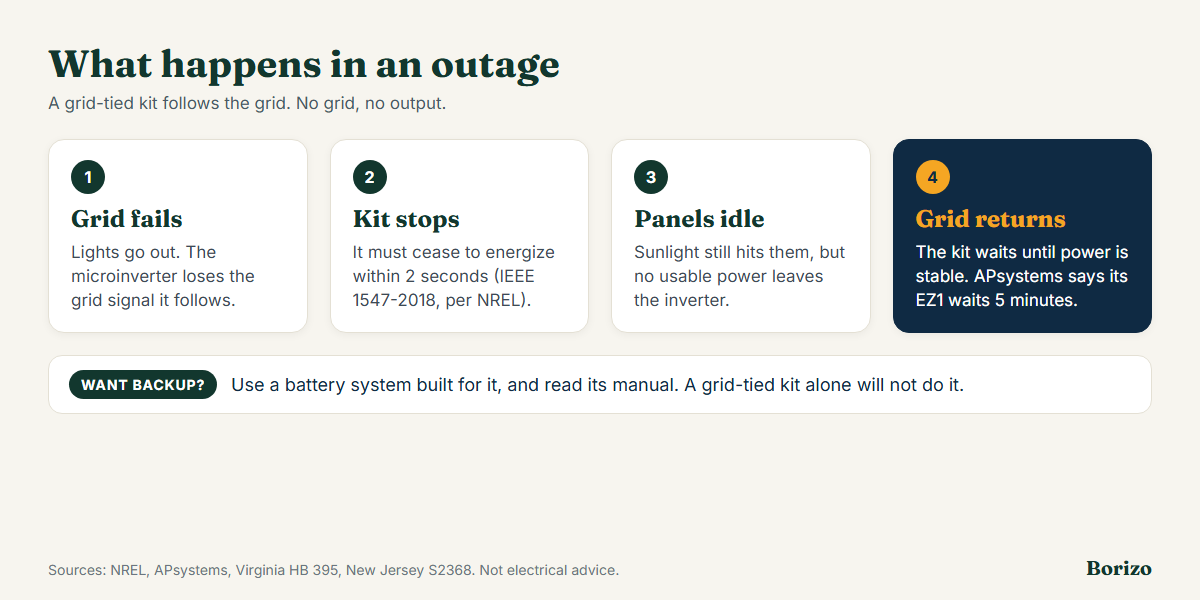
- The grid fails. Your lights go out and the inverter senses the loss of grid voltage.
- The kit stops within seconds. Depending on the product, an indicator light or the app may show an error or “grid off” state.
- The panels sit idle. Sunlight still reaches them, but no usable power leaves the inverter. Do not try to bypass it.
- Power returns and the kit waits. It does not restart the instant the lights come on. APsystems says the EZ1 restarts only after grid power has been stable for five minutes. Other products may use different delays, so check the manual.
- Output resumes. If the sun is still up, the kit starts producing again on its own.
We found nothing in the sources we read that says an outage harms the kit. If the outage is long, or storms are coming, follow the manual’s steps for disconnecting, and remember that UL Solutions warns the plug’s blades can be energized when the panels are in sunlight. Never touch the prongs, and use the order of connecting and disconnecting the manufacturer gives.
What the law says
| State | What the text we read says about outages | Source |
|---|---|---|
| Virginia | The device must have a feature that prevents it from exporting power during an outage | HB 395 |
| New Jersey | The bill requires the same: no export during a grid outage | S2368 (third reprint) |
| Other states with plug-in laws | Rely on the required certification (UL 3700 or a comparable standard, or NRTL listing) rather than a separate outage rule in the text we read | See the State Laws hub |
If you want power during a blackout
A grid-tied plug-in kit is the wrong tool for backup. These are the usual alternatives:
| Option | How it works | What to know |
|---|---|---|
| Portable power station | A battery with its own inverter that you plug devices into | You charge it from the wall or, with some models, from solar panels. See plug-in solar vs a power station. |
| Home battery system | A larger battery installed on your home’s wiring | Usually installed by an electrician and treated as a different kind of project from a plug-in kit |
| Plug-in kit with a battery | Some products pair panels, an inverter and a battery | Whether it can supply power in an outage depends on its design. Do not assume it can; read the manual |
| Small generator | Fuel-powered backup | Not solar, and it has its own safety rules |
Never plug a kit’s output into a generator or a backup power station’s outlet to “make it work” unless the manufacturer explicitly says you can. Mixing power sources without the right equipment is a safety risk. If you are unsure, ask a licensed electrician.
Before the next outage: a short plan
- Read the manual’s outage section. Note what the indicator or app shows when the grid is down and how long the restart delay is, so a blinking light does not worry you.
- Do not rely on the kit for essentials. If you need power for medical equipment, refrigerated medicine or a sump pump, plan separate backup power and keep it charged.
- Check the system after a storm. Look at the mounting, the cable and the plug for damage before the kit goes back to work. If anything looks wrong, unplug it following the manual and ask the maker or an electrician.
- Do not assume power is off. A neighbor’s or utility’s equipment may still be energized, and UL warns that a plug’s blades can be live in sunlight. Treat every plug as live.
- Tell your landlord or HOA what to expect, if you rent: a kit that stops in an outage by design is a safety feature worth mentioning when you ask permission. See our renters and HOA guide.
Does an outage change anything about buying?
If outages are rare where you live, a plug-in kit can still make sense for daytime savings. If they are frequent or you rely on medical equipment, treat backup power as a separate decision and do not count on solar to cover it. Check your own numbers with the savings and payback calculator, and see what plug-in solar is if you are just starting out.
Frequently asked questions
Will my balcony solar panels power my fridge during a blackout?
No. A standard grid-tied kit shuts down within seconds of losing grid power and does not run any appliance until the grid is back and stable. For a fridge in an outage you need a battery backup designed for that.
Is it safe to leave the kit plugged in during an outage?
The inverter is designed to stop sending power when the grid fails, which is why it is safe for utility crews. Still, follow the manual, do not touch the plug’s prongs, and disconnect in the maker’s order if storms or damage are a concern.
How long until it starts working again?
It depends on the product. APsystems says its EZ1 restarts only after grid power has been stable for five minutes. Check your kit’s manual for its delay.
Can I add a battery to keep it running in an outage?
Only if the product is designed for that. Some batteries store extra daytime power for the evening without providing backup, so read the specifications and the manual before you buy.
Sources
- NREL, A Primer on the Unintentional Islanding Protection Requirements in IEEE 1547-2018 (cease to energize and trip within 2 seconds; 2 to 5 second adjustment by agreement).
- APsystems, EZ1 for consumers (automatic anti-islanding shutdown, five-minute restart, UL 3700 and UL 1741 SB), read October 26, 2026.
- UL Solutions, “Question Corner,” IAEI Magazine, July 1, 2026 (energized plug blades).
- State laws: Virginia HB 395 and New Jersey S2368, read October 26, 2026. All states: State Laws hub.

Borizo is an independent guide to plug-in and balcony solar in the US. We track state laws, check certification claims against official sources, and compare kits using published specifications. Laws change often, so every state page shows a “last updated” date and links to its sources. We earn a commission when you buy through our Amazon links, at no extra cost to you. Our content is for information only and is not legal or electrical advice.