Watts vs Watt-Hours for Solar, Explained Simply
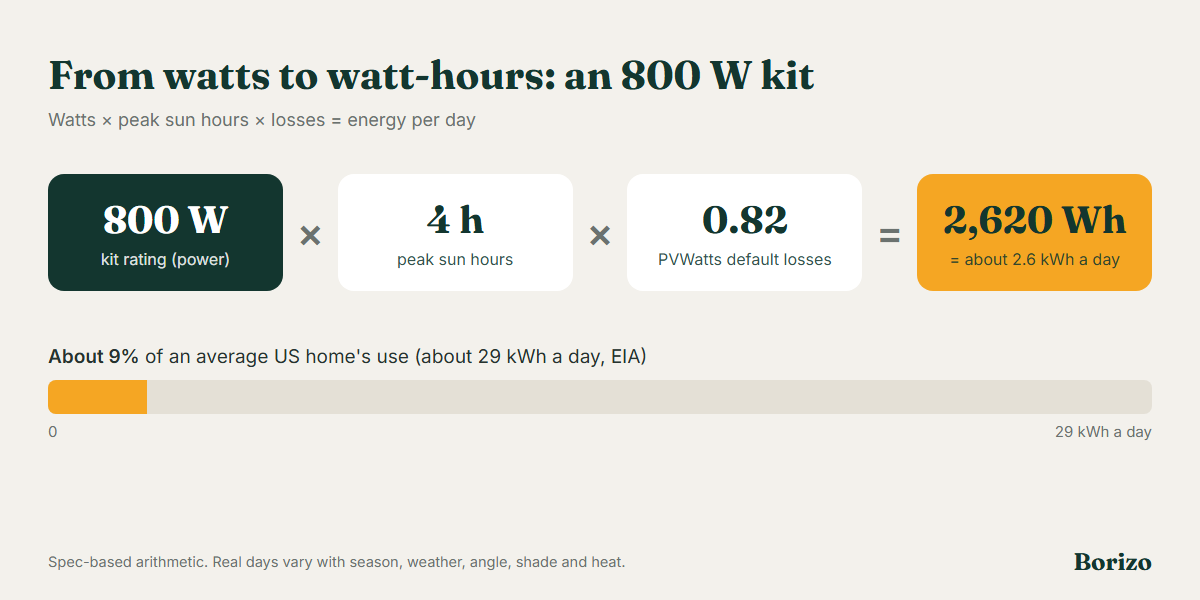
Watts measure power at one moment; watt-hours measure energy over time. For plug-in solar, the watt rating tells you how big a kit is, and the watt-hours tell you how much electricity it actually makes in a day. An 800 W kit does not make 800 watt-hours every hour; on an average day with 4 peak sun hours it makes about 2,600 watt-hours, or 2.6 kWh. The examples here are spec-based arithmetic, not hands-on tests.
Watts × hours = watt-hours. Divide by 1,000 to get kilowatt-hours (kWh), the unit on your electric bill. Use the hours an appliance actually runs, and for solar, use peak sun hours and allow for losses, not the hours of daylight.
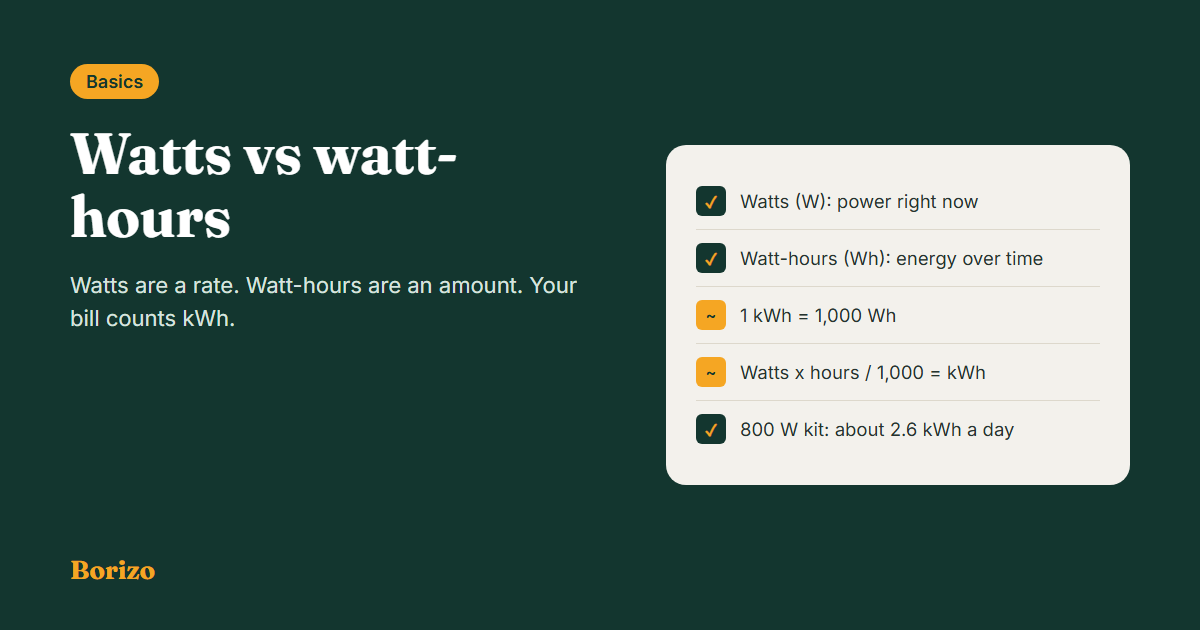
- Watts are a rate. Like miles per hour: how fast energy is used or made right now.
- Watt-hours are an amount. Like miles driven: how much energy over a stretch of time.
- Your bill counts kWh. 1 kWh = 1,000 watt-hours.
- A kit’s watts are a peak. Real daily energy depends on sun hours, angle, shade, heat and losses.
Watts vs watt-hours in plain English
Think of a car. Speed (miles per hour) tells you how fast you are going at this instant. Distance (miles) tells you how far you went. Watts are the speed of electricity; watt-hours are the distance.
A 10 W LED bulb uses energy slowly. A 1,000 W microwave uses it fast, but only while it runs. Leave the bulb on for 10 hours and it uses 100 watt-hours. Run the microwave for 6 minutes (0.1 hour) and it also uses 100 watt-hours. Different watts, same energy, because time is part of the answer.
Kilowatts and kilowatt-hours
A kilowatt (kW) is 1,000 watts, and a kilowatt-hour (kWh) is 1,000 watt-hours. A 1,200 W plug-in kit is a 1.2 kW kit. Utilities bill in kWh, so converting everything to kWh lets you compare an appliance, a solar kit and your bill in the same unit. The US Energy Information Administration says the average US household uses about 10,500 kWh a year, roughly 875 kWh a month or 29 kWh a day.
The one formula you need
Watts × hours ÷ 1,000 = kWh.
A 100 W device that runs for 5 hours uses 100 × 5 = 500 watt-hours, which is 0.5 kWh. To go the other way, multiply kWh by 1,000: 2 kWh is 2,000 watt-hours. This is the same method the Virginia Cooperative Extension uses in its guide to estimating appliance energy use.
Count the hours a device actually runs, not the hours it is plugged in. A TV plugged in all day but watched for 3 hours counts as 3 hours of its on-power (plus a little standby).
Worked examples: appliances
These use typical nameplate watts. Your model may differ, so check its label.
| Appliance | Watts | Hours used per day | Watt-hours per day | kWh per day |
|---|---|---|---|---|
| LED bulb | 10 W | 5 | 50 Wh | 0.05 |
| Laptop | 60 W | 4 | 240 Wh | 0.24 |
| Box fan | 50 W | 8 | 400 Wh | 0.40 |
| LED TV | 120 W | 3 | 360 Wh | 0.36 |
| Microwave | 1,000 W | 0.5 | 500 Wh | 0.50 |
| Total | 1,550 Wh | 1.55 |
The microwave has the most watts but runs for only 30 minutes, so it uses 0.5 kWh. The 50 W fan runs for 8 hours and uses 0.4 kWh, nearly as much. A low-watt device that runs all day can matter as much as a high-watt device used briefly.
Appliances that cycle, like a refrigerator, are harder to estimate from watts. Their compressor turns on and off, so multiplying the label watts by 24 hours overstates use. New refrigerators carry a yellow EnergyGuide label with an estimated yearly kWh figure, required under the Federal Trade Commission’s Energy Labeling Rule (16 CFR Part 305). Divide the yearly figure by 365 for a daily estimate.
Worked examples: a plug-in kit’s watts to daily watt-hours
For solar, the “hours” in the formula are peak sun hours: the day’s sunlight expressed as hours at full strength. A day can have 12 hours of daylight but only 4 peak sun hours. Then allow for losses. We use 0.82, from the PVWatts defaults of 14% system losses and a 96%-efficient inverter, the same factor as our daily output guide.
| Kit size | Peak sun hours | Watts × hours × 0.82 | kWh per day | kWh per 30 days |
|---|---|---|---|---|
| 400 W | 4 | About 1,310 Wh | About 1.3 | About 39 |
| 800 W | 4 | About 2,620 Wh | About 2.6 | About 79 |
| 1,200 W | 4 | About 3,940 Wh | About 3.9 | About 118 |
Doubling the watts doubles the daily energy only if the sun and setup stay the same. A 1,200 W kit on a shaded railing can make less than an 800 W kit in full sun.
Using watt-hours to size a plug-in kit
- Find your kWh on your bill. Divide the month’s kWh by 30 for a daily average. 875 kWh a month is about 29 kWh a day. Our bill reading guide shows where to look.
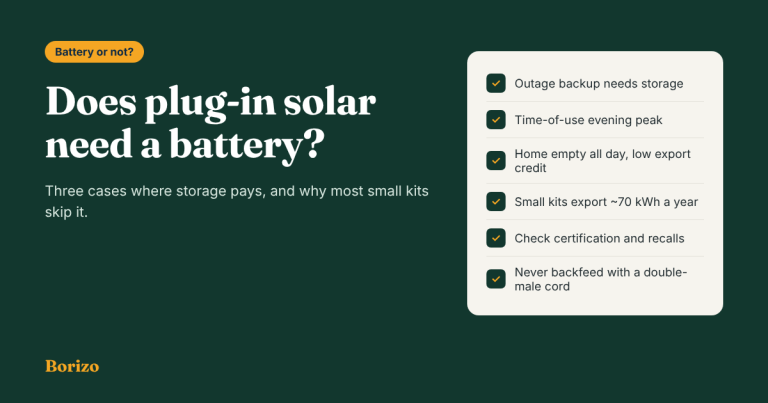
- Focus on daytime use. A kit without a battery helps only while the sun is up.
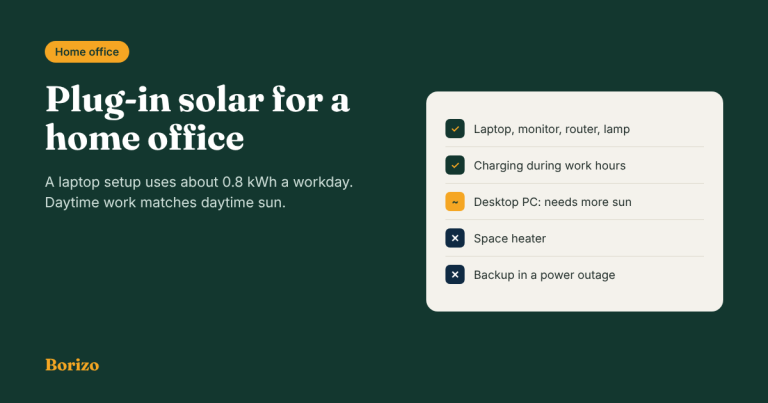
- Add up daytime watt-hours. List what runs between about 9 a.m. and 4 p.m. and use watts × hours.
- Compare with the kit table. An 800 W kit’s 2.6 kWh is about 9% of a 29 kWh day. If your daytime use is close to or above the kit’s output, most of what it makes gets used at home.
- Check instant watts too. A kit can only supply up to its output at that moment. A 1,500 W kettle draws more than any plug-in kit makes, so the grid covers the difference.
Our kit size calculator runs these steps for you, and what appliances can plug-in solar run lists typical watts.
Common mistakes
- Treating watts and watt-hours as the same. A 1,200 W kit does not make 1,200 kWh, or 1,200 watt-hours every hour.
- Using daylight hours. Twelve hours of daylight is not twelve hours at full power.
- Skipping losses. Wiring, inverter, heat and dust take a share. Without the 0.82 factor, an 800 W kit looks like 3.2 kWh a day instead of about 2.6.
- Counting cycling appliances at full watts for 24 hours. Use the EnergyGuide yearly kWh instead.
- Adding watts to kWh. Convert everything to the same unit first.
- Ignoring timing. Solar made at noon does not cover an evening load unless you have storage.
Check your state before you buy
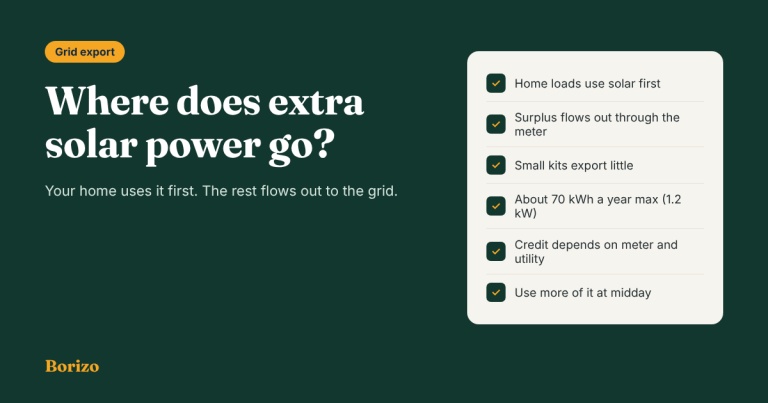
In the US, plug-in solar is generally limited to about 1,200 watts and is clearly allowed only in some states. Check our state laws hub or the state rule checker, then your utility and, if you rent, your landlord. Choose a certified kit with anti-islanding protection.
Frequently asked questions
What is the difference between watts and watt-hours in solar?
Watts are power at a moment; watt-hours are energy over time. An 800 W kit can produce up to about 800 watts in full sun. Over an average day with 4 peak sun hours and normal losses, it makes about 2,600 watt-hours, or 2.6 kWh.
How do I convert watts to kWh?
Multiply watts by hours of use, then divide by 1,000. A 120 W TV used for 3 hours uses 360 watt-hours, or 0.36 kWh.
How many watt-hours does a 1,200 W plug-in kit make per day?
About 3,900 watt-hours (3.9 kWh) on an average day with 4 peak sun hours, using the PVWatts default losses. In our PVWatts runs, daily averages ranged from about 3.6 kWh in Seattle to about 5.8 kWh in Phoenix.
Why is my kit’s watt reading lower than its rating?
The rating is measured in lab conditions. Morning or evening sun, clouds, shade, a poor angle and hot panels all lower the reading. It is normal to see well under the rating for most of the day.
Can a plug-in kit power my whole home?
No. Even a 1,200 W kit makes about 3.9 kWh on an average day, while the average US home uses about 29 kWh a day, according to EIA. A kit offsets part of your daytime use.
Sources
- US Energy Information Administration, Electricity use in homes (average household about 10,500 kWh a year), read October 27, 2026.
- Virginia Cooperative Extension, Estimating Appliance and Home Electronic Energy Use (watts × hours ÷ 1,000 = kWh).
- Federal Trade Commission, Energy Labeling Rule, 16 CFR Part 305 (EnergyGuide labels on refrigerators and other appliances).
- PVWatts Calculator, pvwatts.nlr.gov (default 14% system losses and 96% inverter efficiency).

Borizo is an independent guide to plug-in and balcony solar in the US. We track state laws, check certification claims against official sources, and compare kits using published specifications. Laws change often, so every state page shows a “last updated” date and links to its sources. We earn a commission when you buy through our Amazon links, at no extra cost to you. Our content is for information only and is not legal or electrical advice.