Plug-in Solar for a Home Office: Sizing, Savings and Setup
Plug-in solar can help power a home office, but as a partial daytime offset, not a full power supply or backup. A small kit that plugs into a standard 120-volt outlet can cut the grid electricity used by a laptop, monitor, router and lamp while the sun is shining. A daytime home office is one of the best matches for plug-in solar, because the work hours line up with the sun. In the US, plug-in solar is generally limited to about 1,200 watts and is clearly allowed only in some states, so check your state, utility and lease or HOA rules first. This guide is spec-based: it uses published specifications and public guidance, not hands-on tests.
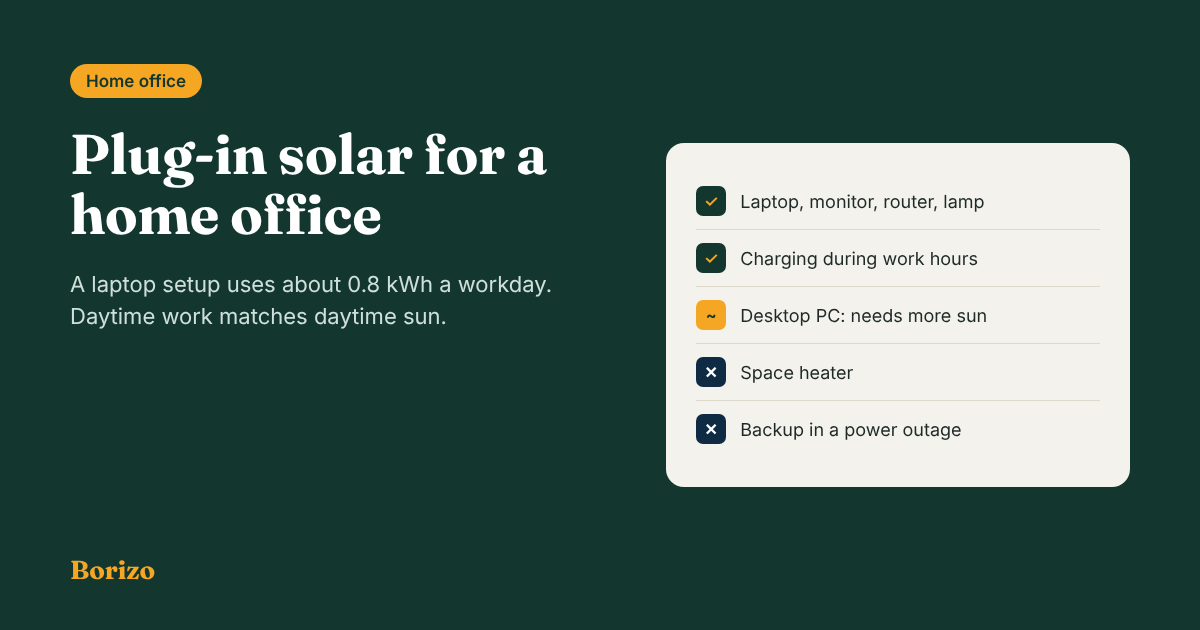
A laptop-based office uses roughly 0.8 kWh in an eight-hour workday, and a 400 to 800 W kit in good sun can cover most of it while the sun is up. The office alone is worth only about $35 a year in power (about 200 kWh at the 2025 US average price), but the kit also covers your fridge and other daytime loads, so a well-used kit is often worth $100 or more a year. It will not keep you online in a power outage.
- Watts x hours / 1,000 = kWh. Use that to total your office’s daily use.
- A light office draws about 100 watts at a time, far below a kit’s midday output.
- The kit helps all daytime loads, so the fridge and router use the spare output too.
- Space heaters are the exception: at 750 to 1,500 watts they swamp a small kit.
- No outage backup. A grid-tied kit shuts off when the grid does.
What plug-in solar for a home office means
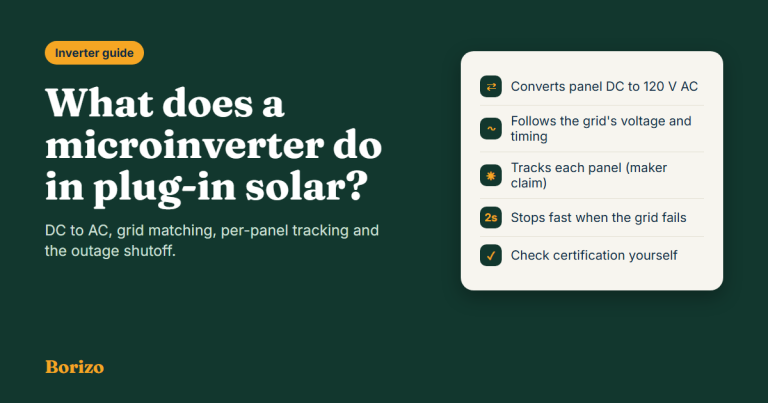
Plug-in solar, often called balcony solar, is a small kit with one or two panels, a microinverter, mounting hardware and a cable that plugs into a household outlet. The panels make direct current, the microinverter turns it into household alternating current, and whatever is running, including your office equipment, uses that power first and draws less from the grid.
- Sunlight hits the panels and they produce direct current.
- The microinverter converts it to household alternating current.
- It enters your home through a standard outlet and circuit.
- Running equipment uses it before drawing the rest from the grid.
- Any extra may flow out to the grid, depending on state and utility rules. Do not assume you will be paid for it.
A kit fits light, steady daytime loads: a laptop, monitor, router, phone charger and LED desk lamp. It is not a way to run a space heater, a large air conditioner or high-power tools on solar alone. It also does not keep your office running in a power outage: a grid-connected inverter shuts off when grid power is lost, a safety feature called anti-islanding. See does plug-in solar work during a power outage.
Is plug-in solar legal in your state? Check first
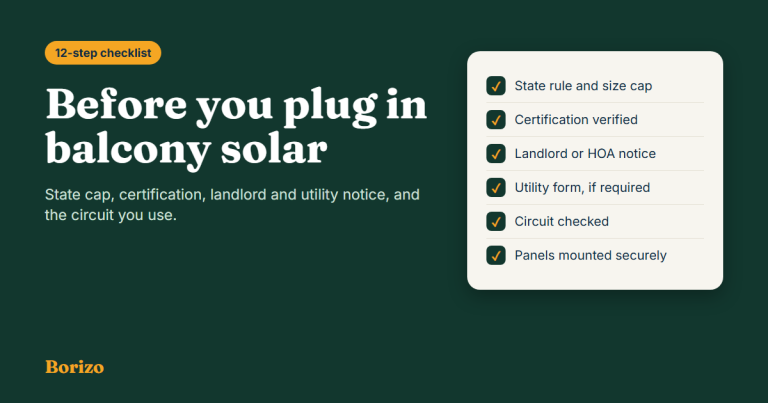
Do this before comparing kits. The US has no single national rule for plug-in solar. Some states have passed specific laws, some are considering bills, and elsewhere the older utility interconnection process may still apply. A kit sold online is not proof it is allowed in your state or building.
Utah is one example: its 2025 law, H.B. 340, created a category for portable solar devices of up to 1,200 watts. Even in a state with a clear law, your lease, building and HOA rules can still matter. Check our wattage limit guide and state laws hub, and get written permission where required. This is general information, not legal advice.
How much power does a home office use?
Start with your own equipment, not the kit size. The simple method: multiply each device’s watts by the hours it runs each day, then divide by 1,000 to get kWh. The Virginia Cooperative Extension factsheet Estimating Appliance and Home Electronic Energy Use explains it and lists typical wattages, including about 50 watts for a laptop. Check your own nameplates, because a gaming desktop or space heater uses far more than a basic laptop setup.
| Office item | Assumed watts | Hours per workday | Daily use (kWh) |
|---|---|---|---|
| Laptop | 50 | 8 | 0.40 |
| External monitor | 25 | 8 | 0.20 |
| Router and modem | 12 | 8 | 0.10 |
| LED desk lamp | 10 | 8 | 0.08 |
| Phone charger | 5 | 2 | 0.01 |
| Total | About 100 at once | About 0.79 |
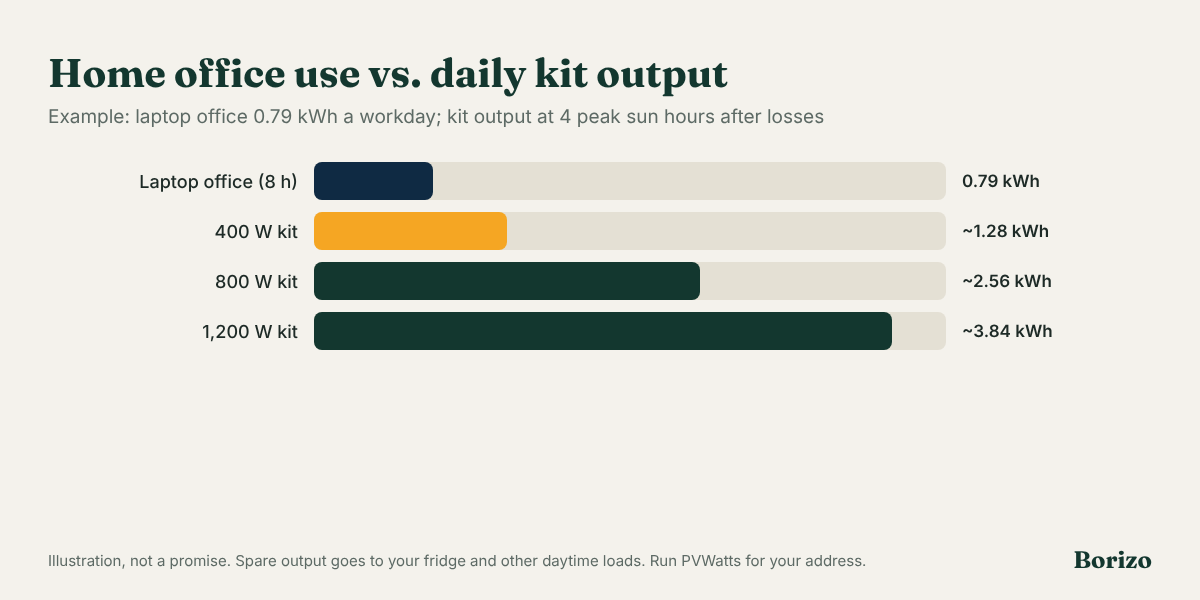
This office uses about 0.79 kWh in an eight-hour workday. Timing matters as much as the total: output after you finish work helps less than output during working hours. By contrast, the same factsheet lists a portable heater at 750 to 1,500 watts, which can exceed a small kit’s output at any moment. For other loads, see what appliances plug-in solar can run.
How much can a small plug-in kit make?
Solar output is often described in peak sun hours: the equivalent number of hours at full sun intensity in a day, not hours of daylight. For a rough estimate, multiply kit size in kilowatts by peak sun hours, then allow for losses from heat, wiring, inverter efficiency, shade and angle. At four peak sun hours and a simple 0.80 factor for losses, a 400 W kit makes about 1.28 kWh a day, an 800 W kit about 2.56 kWh and a 1,200 W kit about 3.84 kWh. These are illustrations, not a promise for your balcony.
For a site-specific estimate, use the PVWatts Calculator. Enter your location, kit size, direction, tilt and shade, and look at the monthly pattern, not just the yearly total. Direction and shade often matter more than a small difference in panel wattage: an east-facing balcony suits morning work, and a west-facing one suits afternoon work. See east vs west vs south facing balcony solar.
What the savings could look like
Savings depend on how much solar you use yourself, not how much the kit makes. Exported power without credit may not lower your bill. As an example, using 60 kWh of your own solar in a month is worth about $10.38 at 17.30 cents per kWh, the EIA’s 2025 average US residential price (EIA). Over a year that is about $125. Use the energy rate on your own bill, and do not count export credits unless your utility confirms them. Our savings and payback calculator does the math.
Choosing a kit: a spec-based checklist
- AC output, not just panel watts. Some kits list a high panel total while the inverter limits output. For a 1,200 W limit, output is what counts.
- Certification and safety. Look for an inverter certified by a nationally recognized testing laboratory, typically to UL 1741 (see UL Solutions), with anti-islanding protection.
- Mounting and weight. A railing, wall, deck or ground mount must hold the panels in wind and bad weather. Check whether your building allows drilling, clamping or freestanding frames.
- Outdoor rating and cable length. Measure the distance to your outlet and follow the manufacturer’s cable instructions.
- Monitoring and warranty. An app or meter helps you spot shade, dirt or a connection problem; see how to monitor plug-in solar output. Compare panel, inverter and mount warranties separately.
- Battery or not. A battery stores midday power for later but adds cost and weight, and you may not need one if you work in daylight. See plug-in solar with a battery.
A practical setup for a home office
Start with permission and placement, not the largest kit. Confirm state, utility, landlord and HOA rules (our renters and HOA guide helps), measure your space, check shade through the day, and list your office loads and hours.
Once the kit is up, shift flexible work to sunny hours where you can. Charge laptop batteries, phones and power banks at midday rather than at night. Keep heavy loads like a space heater out of your solar expectations.
Common mistakes
- Buying before checking state and building rules. A landlord or HOA may restrict balcony mounting even where state law allows plug-in solar.
- Treating it as backup power. Do not plan deadlines or important equipment around it in an outage.
- Confusing panel watts with usable output. Inverter output, direction, shade, heat and time of day decide what you get.
- Expecting the whole bill to disappear. A small kit offsets part of the office and some daytime loads, not heating, cooling, cooking or night use.
- Ignoring shade and direction. A spot sunny at noon may be shaded at 9 a.m. or 4 p.m.
- Oversizing past the state limit. Adding a panel or inverter can push a kit over 1,200 watts.
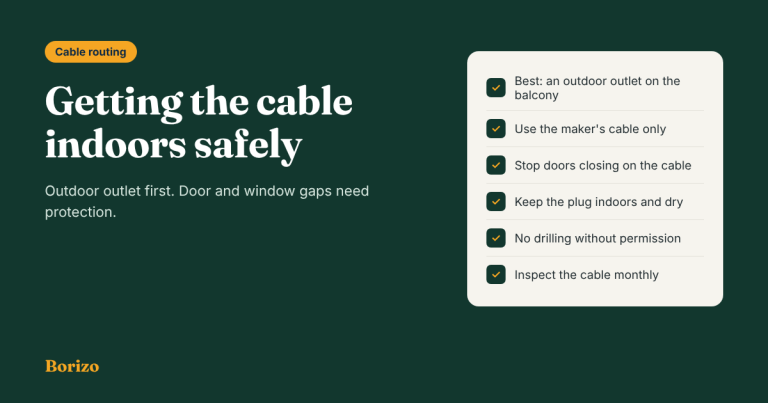
- Improvised wiring. Use the supplied cables and follow the manual; ask a qualified electrician if unsure.
- Forgetting winter. A kit that covers a bright summer workday covers less in January. See plug-in solar in winter and cloudy days.
Costs, payback and realistic expectations
Kit prices vary by panel size, inverter, mounting, battery options, shipping and warranty, and a cheap kit may need extra hardware to meet your state limit. To test payback, divide total upfront cost by the yearly value of solar you expect to use yourself. A hypothetical $1,200 kit saving $125 a year would take about 9.6 years to pay back on energy savings alone. That is an illustration, not a prediction. Do not count a rebate or tax credit until an official program page confirms it applies to your product, state and installation type; some incentives are designed for permanent rooftop systems.
Frequently asked questions
Is plug-in solar legal everywhere in the United States?
No. It is clearly allowed only in some states, and limits and utility steps differ. Utah, for example, created a category for portable devices of up to 1,200 watts under H.B. 340. Check your state law, utility and lease or HOA rules before you buy.
Will plug-in solar power my home office during a power outage?
Normally, no. A standard grid-connected inverter shuts off when grid power is lost, for safety. If backup matters, look for a battery system designed for backup use.
How many panels do I need for a home office?
It depends on your loads and hours. A light laptop office using about 0.8 kWh in an eight-hour day can often be covered during sunny hours by a 400 to 800 W kit. A heavier desktop setup needs a larger kit, better sun or different working hours.
Can renters use plug-in solar for a home office?
Often, but renters face extra checks. You may need written landlord permission, and railing, drilling and appearance rules can limit mounting. Some state laws give renters clearer rights than others.
Is plug-in solar for a home office worth it?
It can be when you have clear sun during working hours, you use most of the output yourself, and your electricity rate is high enough to justify the cost. It is less attractive with a shaded balcony, night-time work or a utility that pays nothing for exports.
Sources
- Virginia Cooperative Extension, Estimating Appliance and Home Electronic Energy Use (watts x hours / 1,000 = kWh; laptop about 50 W; portable heater 750 to 1,500 W), read October 27, 2026.
- US Energy Information Administration, Electricity explained: prices and factors affecting prices (average residential price 17.30 cents per kWh in 2025).
- PVWatts Calculator, pvwatts.nlr.gov (output estimates by address).
- Utah Legislature, H.B. 340 Solar Power Amendments, enrolled text (1,200 W portable solar device).
- UL Solutions, PV Inverter and BESS Converters Certification (UL 1741).

Borizo is an independent guide to plug-in and balcony solar in the US. We track state laws, check certification claims against official sources, and compare kits using published specifications. Laws change often, so every state page shows a “last updated” date and links to its sources. We earn a commission when you buy through our Amazon links, at no extra cost to you. Our content is for information only and is not legal or electrical advice.