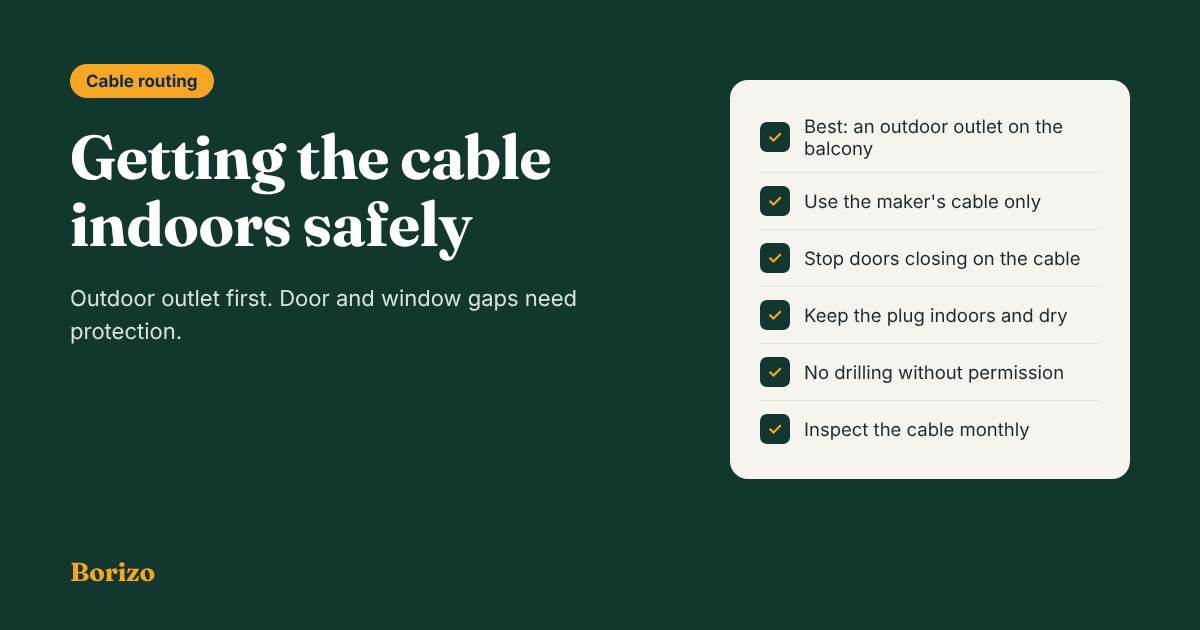
Running a Solar Cable Through a Window or Door: Safer Options
Many balconies have no outdoor outlet, so the first practical problem with a plug-in kit is getting the cable from the panel outside to an outlet inside. The tempting answer is to run it under a sliding door or through a cracked-open window. That works on day one, but a door or window that closes on a cable every day slowly crushes it, and a damaged cable carrying solar power is exactly the kind of fault you do not want. This guide explains the options for getting power indoors, from best to worst, what electrical rules and safety experts say, how to protect a cable you do run through an opening, and when to call an electrician. It is based on OSHA’s cord rules, UL Solutions’ safety commentary and state law text. We have not installed or tested any kit or cable.
The safest way to connect a balcony kit is to an outdoor outlet on the balcony, installed by a licensed electrician if there is not one already. Running the kit’s cable through a door or window gap is common, but the cable can be pinched, crushed or soaked, so use only the maker’s cable or an accessory the maker approves, protect it where the opening closes, and inspect it often. Never drill through a wall or frame without the owner’s permission and an electrician.
- Electrical rules dislike cords through openings. OSHA’s workplace rule says flexible cords may not be used “where run through doorways, windows, or similar openings” or through holes in walls.
- An outdoor outlet is the clean solution. It avoids the opening entirely, but outdoor outlets are often GFCI-protected, which raises its own questions.
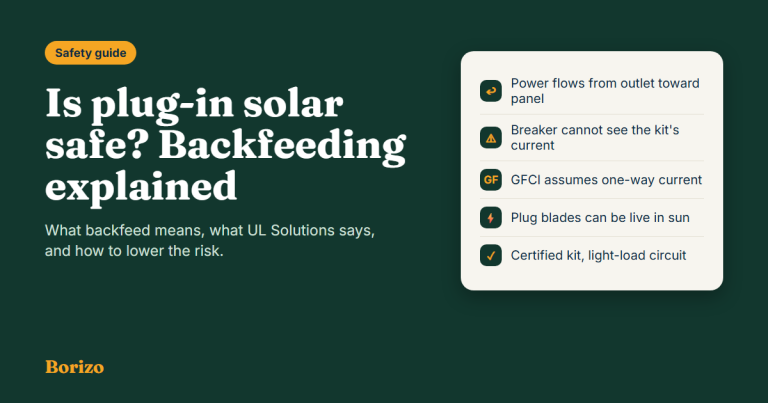
- The kit’s plug can be live. UL Solutions warns plug blades can be energized when the panels are in sunlight.
- Extension cords are not covered by official sources. Use the maker’s cable or an accessory it approves in writing.
- Renters need permission for holes and wiring. Vermont, for example, bars tenants from electrical work without the landlord’s permission.
Why the route matters
A kit’s AC cable carries current from the microinverter to your outlet. Its insulation is what keeps that current inside the wire. Anything that crushes, cuts or wears through the insulation creates a shock and fire risk, and a cable that is pinched every time a window or door closes is under repeated stress. Water on a damaged section makes things worse.
That is why electrical rules are wary of cords run through openings. OSHA’s general industry rule, 29 CFR 1910.305(g)(1)(iii), says flexible cords and cables may not be used as a substitute for fixed wiring, “where run through holes in walls, ceilings, or floors,” “where run through doorways, windows, or similar openings,” where attached to building surfaces, or where concealed behind walls, ceilings or floors. That rule applies to workplaces, not homes, but it reflects a long-standing safety view: cords are for temporary use, and permanent paths through a building need proper wiring.
Your options, from best to worst
| Option | Pros | Cons and checks |
|---|---|---|
| Existing outdoor outlet on the balcony | No opening to cross; short cable run | Often GFCI-protected; check its circuit and your manual |
| New outdoor outlet installed by an electrician | Clean, permanent, can be placed where you need it | Cost; needs owner or association approval; may need a permit |
| Cable through a door or window opening, protected | No wiring work | Pinching and wear; drafts and water; only with the maker’s cable or approved accessory |
| Cable through an unprotected gap, or an extension cord | Quick | Highest risk of damage; extension cords not covered by official guidance |
| Drilling your own hole through a wall or frame | None worth the risk | Needs permission; can hit wiring or plumbing; let an electrician do proper work |
Option 1: an outdoor outlet
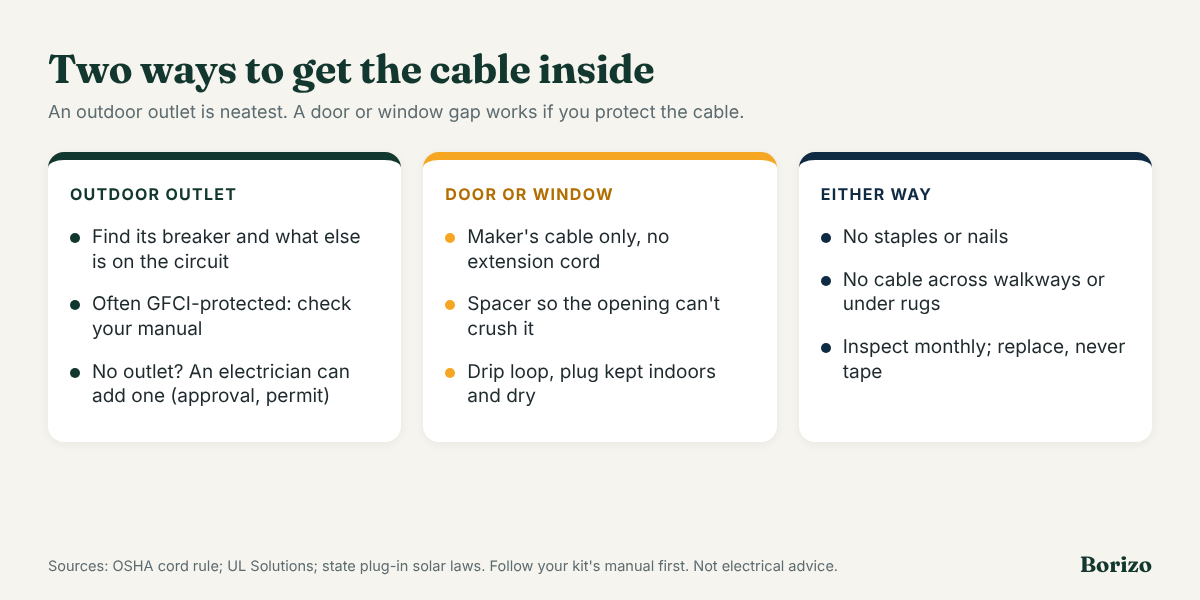
An outlet on the balcony is the neatest route. Before you use one, find which breaker feeds it and what else is on that circuit, as our outlet guide explains. Outdoor outlets are often GFCI-protected. UL Solutions notes that ground-fault devices are designed around one-way current and may not work as intended when a kit feeds power back. Read your manual on GFCI outlets and ask an electrician rather than assuming either way.
If there is no outdoor outlet, an electrician can add one, often from an indoor circuit on the other side of the wall. That needs the owner’s or association’s approval, and in many places a permit. Ask the electrician to choose a circuit without heavy loads, and tell them it will serve a plug-in solar kit.
Option 2: through a door or window, done carefully
Most balcony owners end up running the cable through a sliding door or window. If you do:
- Use the maker’s cable. Do not add an extension cord or power strip unless the manual allows it. The official sources we read do not cover them.
- Ask the maker about pass-through accessories. Flat “window feed-through” cables are sold for other outdoor uses. We found no official guidance approving them for plug-in solar, so use one only if your kit’s maker approves it in writing.
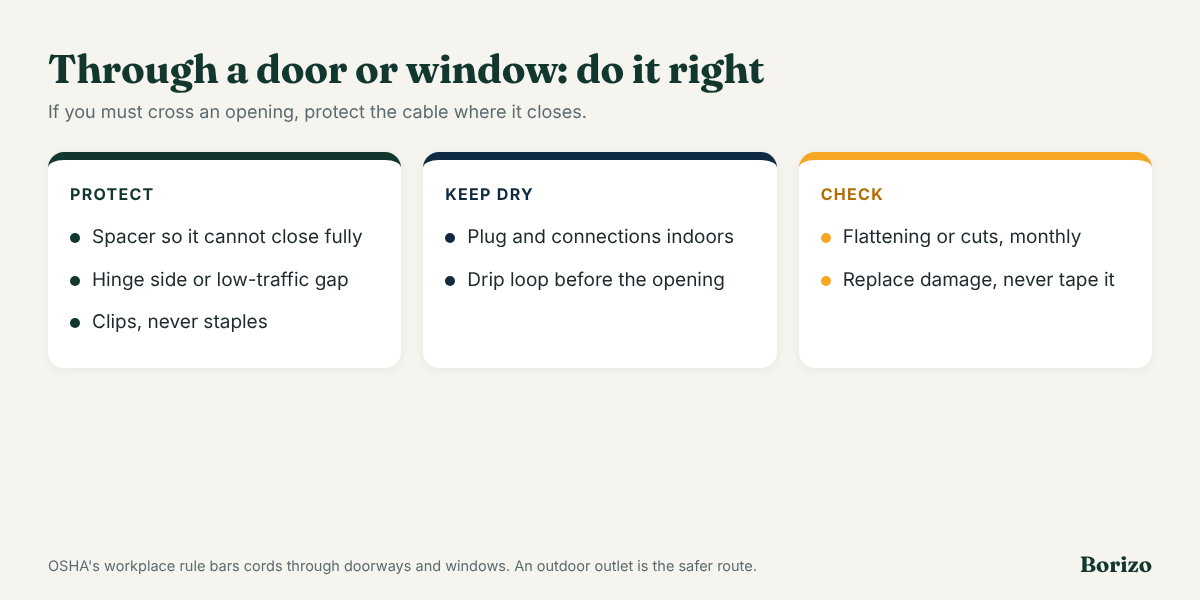
- Stop the opening from crushing the cable. Use a spacer or block so the door or window cannot close fully on the cable, and choose the hinge side or the lowest-traffic gap.
- Keep the plug and connections indoors and dry. Route the cable so rain runs away from the opening, with a drip loop, a downward dip before the opening, so water drips off rather than following the cable inside.
- Avoid trip hazards. Do not run the cable across a walkway, under a rug or behind furniture where you cannot see it.
- Do not staple or nail it. Fasteners can pierce the insulation. Use clips or ties that hold it loosely.
- Inspect monthly. Look for flattening, cuts, discoloration or stiffness where the cable crosses the opening. Replace a damaged cable; do not tape it.
Remember that the kit’s plug can be live in sunlight, according to UL Solutions. Plug in and unplug following the manual’s order, and keep the plug out of reach of children and pets.
Security, drafts and comfort
A door wedged slightly open is a draft, a gap for insects and, on lower floors, a security problem. A window or door that cannot lock may also matter for your insurance. If you rely on this route long term, it is a good argument for an outdoor outlet. Our insurance guide covers questions to ask your insurer.
Renters and condo owners
Running a cable through an existing opening is usually within a tenant’s normal use of the home, but anything more is a change to the building. Vermont’s law says a tenant may not do electrical work without the landlord’s permission, and Virginia’s says no wiring or panel changes without written approval. New outlets and holes through walls need the owner’s or association’s approval. Our renters and HOA guide includes what to put in a written request, and you can offer to pay for an electrician, which some state laws expect anyway.
A cable route checklist
- Is there an outdoor outlet, and have you checked its circuit and GFCI status?
- Is the kit’s cable long enough without an extension cord?
- Can the door or window close without pinching the cable?
- Is the plug indoors, dry and out of reach of children and pets?
- Is the cable clear of walkways and heavy furniture?
- Do you have permission for any hole or new outlet?
- Have you put a monthly cable check on your calendar?
The rest of the setup is in our installation checklist.
Frequently asked questions
Can I run a solar cable under a sliding door?
Many people do, but a door that closes on the cable will wear and crush it over time. Use only the maker’s cable, stop the door from closing fully on it, keep the plug dry and inspect the cable regularly. An outdoor outlet installed by an electrician is safer.
Can I drill a hole in the wall for the solar cable?
Not on your own, and not without the owner’s or association’s permission. A hole can hit wiring or plumbing, and electrical rules discourage cords through walls. A licensed electrician can install a proper outdoor outlet instead.
Is a flat window pass-through cable safe for plug-in solar?
We found no official guidance approving them for plug-in solar kits. Use one only if your kit’s manufacturer approves it in writing, and inspect it regularly.
Can I use an extension cord to reach an indoor outlet?
The official sources we read do not cover extension cords for plug-in solar. Use the cable the maker supplies, and ask the manufacturer and a licensed electrician before using anything else.
Sources
- OSHA, 29 CFR 1910.305(g)(1)(iii), flexible cords and cables, uses not permitted, text as published in the Code of Federal Regulations and discussed in OSHA’s May 5, 2006 interpretation letter.
- UL Solutions, “Question Corner,” IAEI Magazine, July 1, 2026 (GFCI and one-way current; energized plug blades).
- State laws, read October 26, 2026: Vermont Act 149, Virginia HB 395.
- Photos: stock images from Freepik, used for illustration only.

Borizo is an independent guide to plug-in and balcony solar in the US. We track state laws, check certification claims against official sources, and compare kits using published specifications. Laws change often, so every state page shows a “last updated” date and links to its sources. We earn a commission when you buy through our Amazon links, at no extra cost to you. Our content is for information only and is not legal or electrical advice.