Plug-in Solar for an Air Conditioner: What It Can and Cannot Do
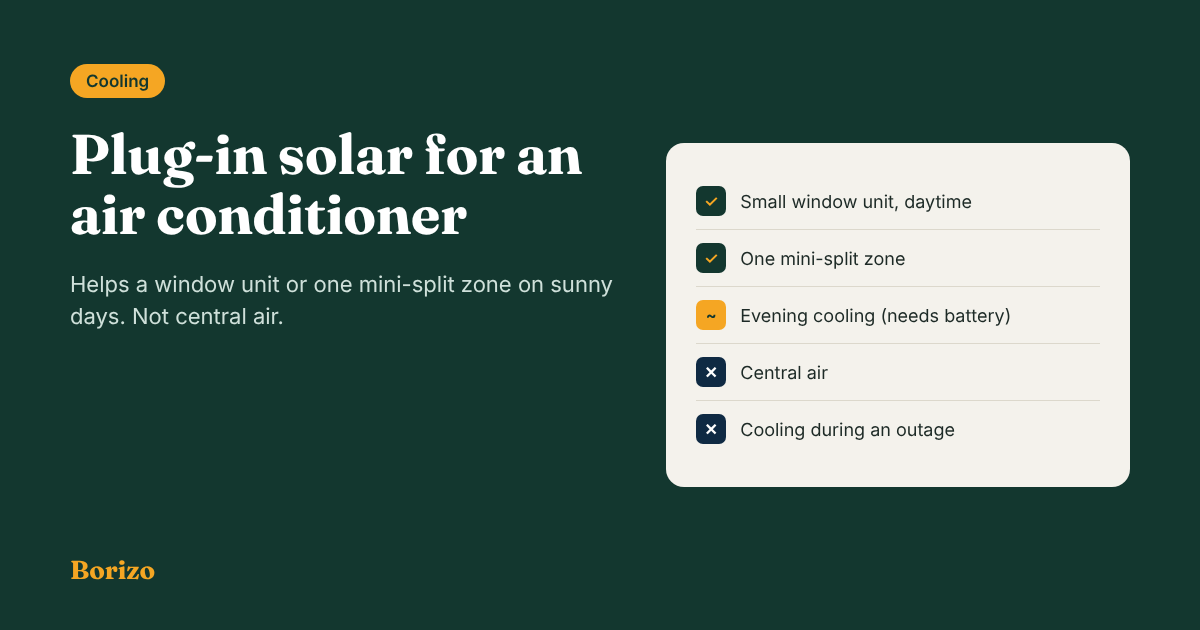
Plug-in solar can help with air conditioning, but only in a limited way. It is best for cutting daytime grid use for a small window unit or one mini-split zone, not for running central air. In the US, plug-in solar is generally limited to about 1,200 watts and is clearly allowed only in some states, so check your state rules before you buy. This guide is spec-based: it compares specifications and public data, not hands-on tests.
A 1,200 W plug-in kit can cover part of a window AC or a single mini-split zone on sunny afternoons, worth roughly $150 to $250 a year at the 2025 US average price if you use most of its output. It will not run central air, it stops in a power outage, and it does nothing for evening cooling unless you add a battery.
- Good overlap: solar peaks at midday, when air conditioners often work hardest.
- Partial, not full: the grid covers whatever the panels cannot.
- Window units and one-zone mini-splits are the realistic match; central air draws several thousand watts.
- Count only what you use. Exported power may earn little or no credit.
- No outage backup. A grid-tied kit shuts down when the grid does.
How plug-in solar helps an air conditioner
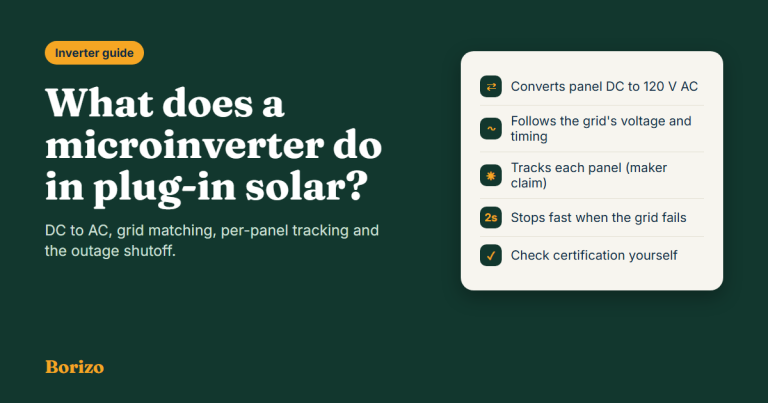
A plug-in kit usually includes one or two panels, a microinverter, mounting hardware and a cable that plugs into a standard outlet. The panels make direct current, the microinverter turns it into household alternating current, and your home uses that power first for whatever is running. The grid supplies the rest.
Timing is the key point. Panels produce the most power around midday and early afternoon, when air conditioners often run hardest. That overlap is useful. It does not mean the panels are wired to the air conditioner, or that the AC keeps running in an outage; a grid-connected kit is designed to shut down when the grid goes down.
Think of it as a daytime offset. If the panels make 600 watts and your window unit draws 800, the panels cover part of that load and the grid covers the rest. If the AC cycles off or no one is home, extra solar goes to other loads or out to the grid, where it may earn nothing. Our guide to what appliances plug-in solar can run shows how loads add up.
Which air conditioners it can help
Always check the nameplate or spec sheet of your own unit. Two units that look alike can draw very different amounts of power.
Window air conditioners: the best match
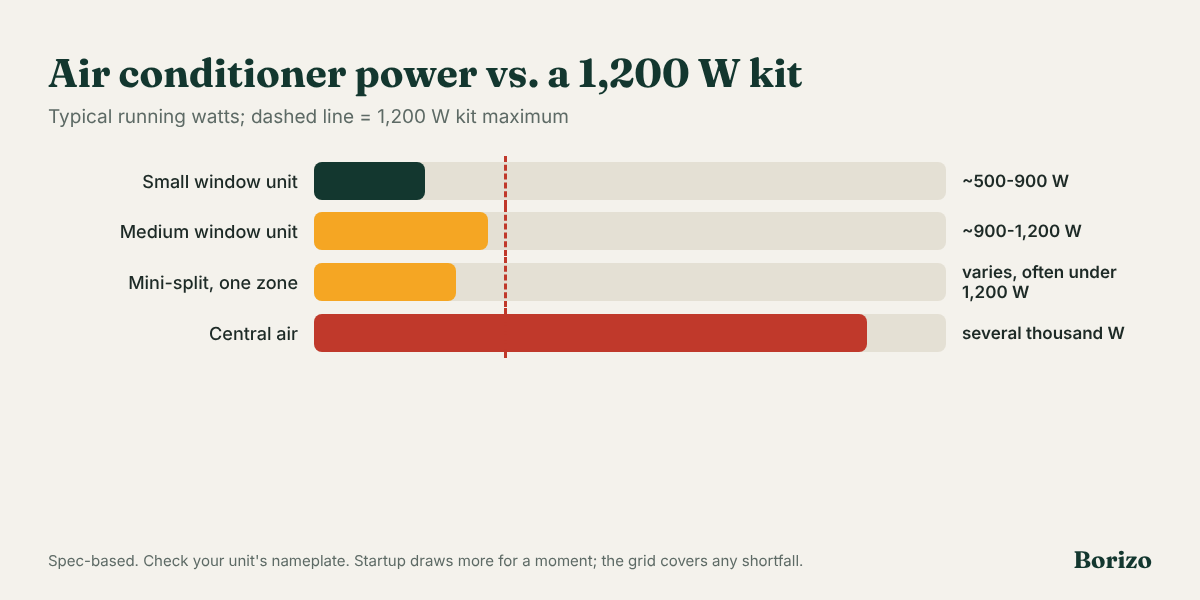
Small and medium window units are the most realistic match. Many draw well under 1,200 watts while running, though starting power is briefly higher. A unit that runs during sunny hours is a good candidate because solar output and cooling demand rise together. The kit usually covers only part of the load, but that is real saving if the power is used as it is made.
Mini-splits: possible for one zone
A ductless mini-split can also pair well when you cool one room during the day. Inverter mini-splits vary their power rather than switching fully on and off, which suits solar output that rises and falls. The same limit applies: 1,200 watts cannot carry a large multi-zone system plus other home loads.
Central air: usually not a good match
Central air cools a whole home, often draws several thousand watts while running, and more when the compressor starts. A kit capped at about 1,200 watts can offset only a small share of that, and only in sunshine. If central cooling is your main cost, efficiency upgrades or a full rooftop system are usually more relevant. The EIA puts air conditioning at about 19 percent of US home electricity use, so it is worth targeting, but a plug-in kit is a small tool for it.
How much power and money can it save?
Start with simple math: kit size, likely yearly output for your location, and your electricity price. The table uses an example of 1,200 kWh a year per kilowatt, a common middle figure in PVWatts estimates for US locations. Your address, angle, direction and shade change the result, so run your own.
| Kit size | Example yearly output | Value if all used at home | Value at 60% self-use |
|---|---|---|---|
| 400 W | 480 kWh | About $83 | About $50 |
| 800 W | 960 kWh | About $166 | About $100 |
| 1,200 W | 1,440 kWh | About $249 | About $149 |
The 17.30 cents is a national average, not your bill; check the energy rate on your own statement. The “60% self-use” column matters: if you use only 60 percent of the output at home, a 1,200 W kit is worth about $149 a year, not $249. A daytime window unit, fridge and home office use more of the output than an empty home does. Our savings and payback calculator lets you try your own numbers. On a time-of-use rate, afternoon solar can be worth more; see plug-in solar and time-of-use rates.
Is plug-in solar legal where you live?
This is the step buyers most often skip. A kit sold online is not automatically legal to plug in at your address. Rules vary by state, utility, building, lease and HOA, and they are still changing. Utah’s 2025 law, H.B. 340, created a category for portable solar devices of up to 1,200 watts; other states have different limits, notice rules and certification requirements. See our wattage limit guide and state laws hub. This is general information, not legal advice.
Certification is a practical filter. Read the spec sheet rather than trusting words like “solar ready.” UL Solutions has launched a certification program based on UL 3700 for plug-in systems. A microinverter certified to UL 1741 is a common baseline, but it is not the same as whole-system certification. Our UL 3700 guide explains how to check a listing.
What renters should check first
Plug-in solar appeals to renters because it needs no roof work and can move with you, but not every rental suits it. Get written permission from your landlord covering the mounting spot, railing use and removal at move-out. Our renters and HOA guide covers what to ask.
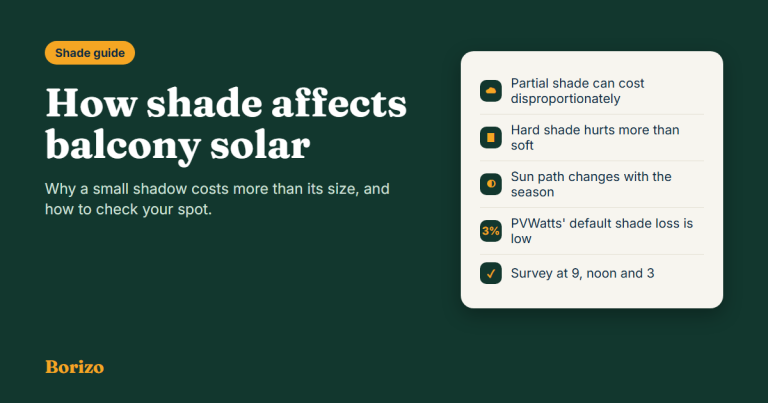
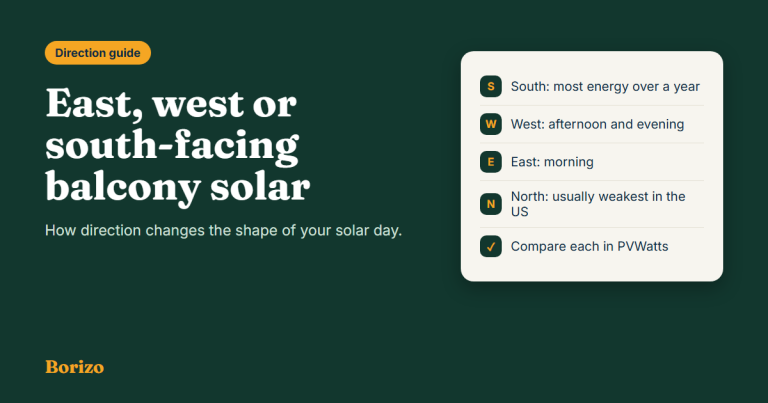
Then check the space. A north-facing or heavily shaded balcony makes far less than a sunny south-facing one. Measure the railing or floor area, check weight limits and plan for wind and rain. Follow the manufacturer’s instructions for outlet, cable and circuit; keep cables out of walkways and water, and do not use damaged extension cords or makeshift adapters. Our guide to which outlet a plug-in kit can use helps here.
How to choose a kit for air conditioning
Choose for your daytime load, not the biggest number on the box. Panel watts and inverter output are not always the same; a kit may advertise 1,200 watts of panels but limit inverter output to less. For AC, inverter output in sunny hours matters most.
- Confirm maximum AC output, panel wattage, and that the kit is at or below your state limit.
- Check the certification listing by name and number, and whether it covers the whole system or only the inverter.
- Check that the kit shuts down automatically in a grid outage.
- Check mounting options for your exact space, including tilt and direction.
- Check cable length, outlet type and outdoor rating.
- Prefer monitoring, so you can compare output with AC use.
- Compare warranties for panels, inverter and mounts separately, and the total price including mounts and any battery.
Match the kit to your cooling pattern. If you run a window unit mainly in the evening, a kit without a battery helps less. If you work from home or cool a room during the day, the match is better. See plug-in solar with a battery for evening cooling.
Common mistakes
- Expecting it to run central air. A 1,200 W kit is a partial offset, not whole-home cooling.
- Buying before checking state and building rules. A kit allowed in one state may not be in another.
- Confusing panel watts with usable output. Inverter output, direction, tilt, shade and weather decide what you get.
- Ignoring self-use. Solar is worth most when your home uses it as it is made.
- Choosing an uncertified kit. Certification, outage shutdown and secure mounting are not optional extras.
- Improvising cords to reach a sunny spot. Follow the manufacturer’s cable and outlet instructions.
- Counting on export payments. Many plug-in setups are not eligible for net metering.
- Judging by one summer week. Winter output is lower and fixed charges remain.
When it is worth it, and when it is not
It is most likely worth considering when your state allows it, you have a sunny and secure mounting spot, you run a window unit or one mini-split zone during the day, your electricity price is high, and you can use most of the output at home. It is less likely to be worth it if you need central cooling, mostly cool in the evening, have a shaded balcony, or face a high kit price compared with realistic savings. Cheaper steps such as shading windows, sealing air leaks and using a fan may save more first.
If you go ahead, write down your kit size, your own price per kWh, your expected self-use share and your total kit cost, and work out a payback range rather than one optimistic number.
Frequently asked questions
Can plug-in solar run my air conditioner?
It can cover part of a small window unit or one mini-split zone during sunny hours, but it cannot run central air on its own. Plug-in kits are generally limited to about 1,200 watts in states that allow them, and central systems draw much more.
How many solar panels do I need for a window air conditioner?
It depends on the unit’s running watts, your sun and how long it runs. As a spec-based starting point, one or two modern panels with an 800 to 1,200 W inverter can offset a useful share of a small daytime window unit. Compare inverter output, not panel rating, with the unit’s nameplate watts.
Will plug-in solar work at night or during a power outage?
No, not on its own. A grid-connected kit makes power only while the sun shines and the grid is up, and it shuts down in an outage for safety. A battery can store some daytime power, but it adds cost and is not whole-home backup.
Is plug-in solar legal in the United States?
It depends on your state. It is expressly allowed in some states and not clearly addressed in many others. Utah, for example, created a 1,200-watt category in H.B. 340 (2025). Check your state law, utility and lease or HOA rules before buying.
Do I need a battery for plug-in solar and air conditioning?
Not necessarily. If you cool a room during the day, using solar directly is the simplest and cheapest option. A battery helps more with evening cooling; compare its price with the evening kWh it would actually shift.
Sources
- US Energy Information Administration, Electricity explained: prices and factors affecting prices (average residential price 17.30 cents per kWh in 2025), read October 27, 2026.
- US Energy Information Administration, Electricity use in homes (air conditioning about 19% of residential electricity use in 2020).
- PVWatts Calculator, pvwatts.nlr.gov (output estimates by address).
- Utah Legislature, H.B. 340 Solar Power Amendments, enrolled text (1,200 W portable solar device).
- UL Solutions, UL Solutions debuts testing and certification framework for safer plug-in solar (UL 3700 program).

Borizo is an independent guide to plug-in and balcony solar in the US. We track state laws, check certification claims against official sources, and compare kits using published specifications. Laws change often, so every state page shows a “last updated” date and links to its sources. We earn a commission when you buy through our Amazon links, at no extra cost to you. Our content is for information only and is not legal or electrical advice.