Plug-in Solar for Renters and HOAs: What State Laws Say
Plug-in solar is pitched at people who cannot put panels on a roof, and renters and condo owners are the obvious example. Whether you may actually hang a panel on your balcony or fence depends on your state, your lease and, if you live in a condo or planned community, your association’s rules. Some new state laws speak to this directly. Others say nothing, which means your lease or covenants decide. This guide sums up what the enacted or enrolled texts we read say, what is still unclear, and how to ask for permission without a fight.
- Only a few states we checked address tenants or associations: Vermont, Virginia, New Jersey and, for associations and covenants, Colorado.
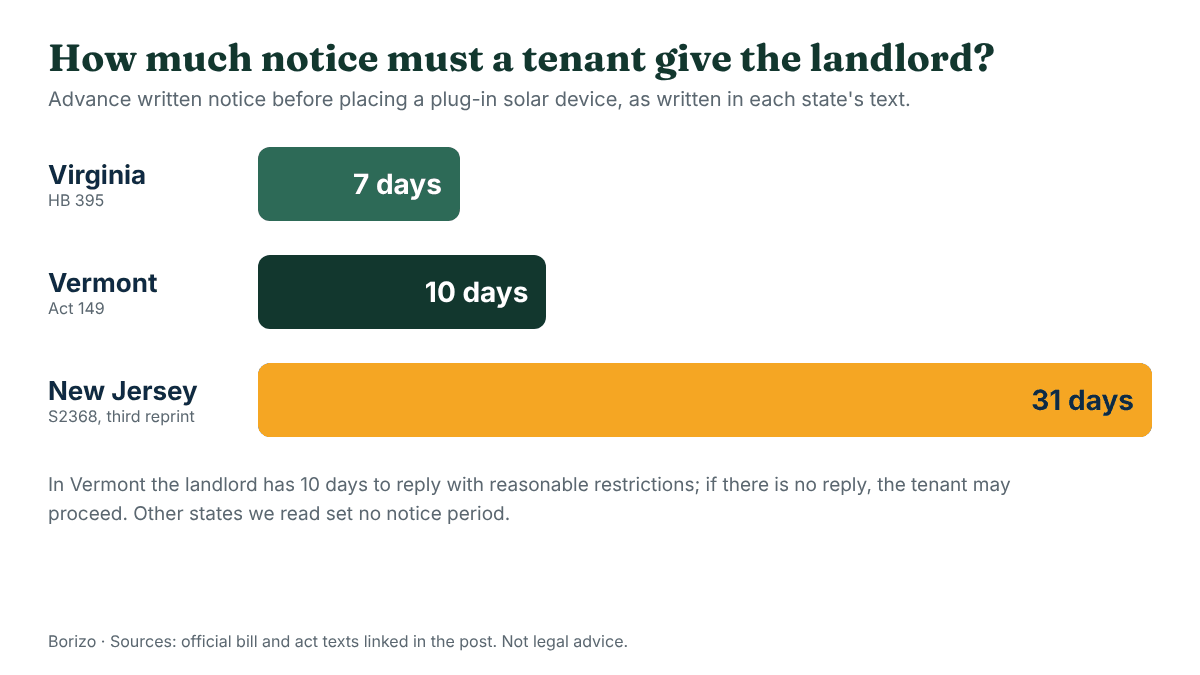
- Where a state protects renters, it still lets landlords set reasonable limits and requires advance written notice: 7 days in Virginia, 10 in Vermont and 31 in New Jersey’s bill.
- In Utah, Connecticut and New Hampshire we found no landlord or association provision. Your lease and community rules still apply, and nothing in those laws overrides them.
- Rules about power (1,200 W caps, certification, the utility) are separate from rules about property (your lease and covenants). You need to meet both.
- General information only, not legal advice. Read your lease and ask your landlord or association in writing.
Two sets of rules, not one
Most plug-in solar laws are written about electricity. They set a wattage cap, name a safety certification and stop the utility from demanding an application or fees. Connecticut, New Hampshire, Utah and Vermont spell out that the utility cannot require approval for a compliant device. None of that makes a landlord or association say yes. Your right to place something on the balcony, railing, fence or patio comes from property law, your lease or your community’s declaration. A handful of states have now added a few lines to the law about that second set of rules, and those lines are what this guide covers. For the power rules, see our guides on wattage limits and circuit safety and UL 3700 certification.
What each state’s text says
We read the enacted or enrolled text for each state below, except where noted. Links go to the official source.
| State | Renters | HOA, condo and covenants | Source |
|---|---|---|---|
| Vermont | Tenant gives the landlord at least 10 days’ notice. The landlord has 10 days to reply with reasonable restrictions, which can include paying for electrical work by a licensed electrician. If the landlord does not reply, the tenant may proceed. The tenant may not do electrical work without the landlord’s permission. | Deeds, covenants and similar agreements cannot prohibit plug-in devices. The condo/co-op patio-railing exemption does not apply to plug-in devices. | Act 149 |
| Virginia | A landlord with more than four rental units cannot bar a tenant from installing a small portable device on the exterior of the premises, but may set reasonable size, place and manner limits. The tenant gives 7 days’ notice with documentation and the proposed location, and is responsible for damage. Tenants in units on ratio utility billing may not install one, and none may make wiring or panel changes without written approval. | The law does not override private agreements such as recorded covenants, condominium instruments and association declarations. | HB 395 (effective January 1, 2027) |
| New Jersey | In the third reprint we read, a landlord cannot bar a tenant who pays the electric service from using a portable device within the leased premises, including a leased balcony or patio. The landlord may set reasonable size and placement limits and restrictions needed for code compliance. The tenant gives written notice at least 31 days ahead with documentation and the location, and pays for damage. | Associations, condo boards and co-ops cannot enforce rules that prohibit an owner or tenant from using a device on the exterior of the premises, but may set reasonable size and placement limits and may require indemnification. | S2368 (third reprint) |
| Colorado | The bill summary does not mention landlords or tenants. It refers to a “real property owner” and says covenants that unreasonably prohibit or restrict these devices are unenforceable. | From January 1, 2027, an association in a common interest community may not prohibit the device, but the owner may have to secure it reasonably and bears liability and costs. | HB26-1007 (summary page) |
| Maine | No landlord provision. A customer who installs on a structure they do not own must not weaken it or violate codes, and must restore it when the system is removed. | None found. | LD 1730 |
| Utah, Connecticut, New Hampshire | None found. | None found. | UT HB 340, CT PA 26-127, NH SB 540 |
What these rules mean in practice
If you rent
- The lease still matters. A state protection usually sets a floor, not a promise that any placement will do. Landlords in Virginia, Vermont and New Jersey may still set reasonable limits on size, location or how the device is attached.
- Who pays for electricity matters. New Jersey’s bill protects a tenant who pays the electric service for the unit. Virginia excludes units on ratio utility billing, where the landlord splits a building’s electric bill among tenants.
- Do not alter the wiring. Vermont says a tenant may not do electrical work without permission, and Virginia says no wiring or panel changes without written approval. A plug-in kit is meant to be plugged into an existing outlet. If an electrician is needed, the landlord can require the tenant to pay.
- You pay for damage. Virginia and New Jersey make the tenant responsible for damage caused by the device. Vermont lets landlords condition permission on reasonable restrictions.
- Outlet and circuit still count. A rental’s circuits may be shared with other rooms or units. The safety questions in our circuit safety guide apply to rentals too, and an electrician’s check can be a reasonable thing to offer your landlord.
If you own a condo or live under an HOA
- Read the declaration and the rules. In Virginia, the law says it does not override recorded covenants or condominium instruments, so those documents may still decide. Vermont, New Jersey and Colorado go the other way and limit what an association may enforce.
- Expect reasonable conditions. New Jersey lets associations set size and placement limits and ask for indemnification. Colorado’s summary says the owner may have to secure the device and carry liability and costs.
- Ask in writing even where you are protected. A written request with the product details and location keeps a record and often avoids a dispute.
What to put in your written request
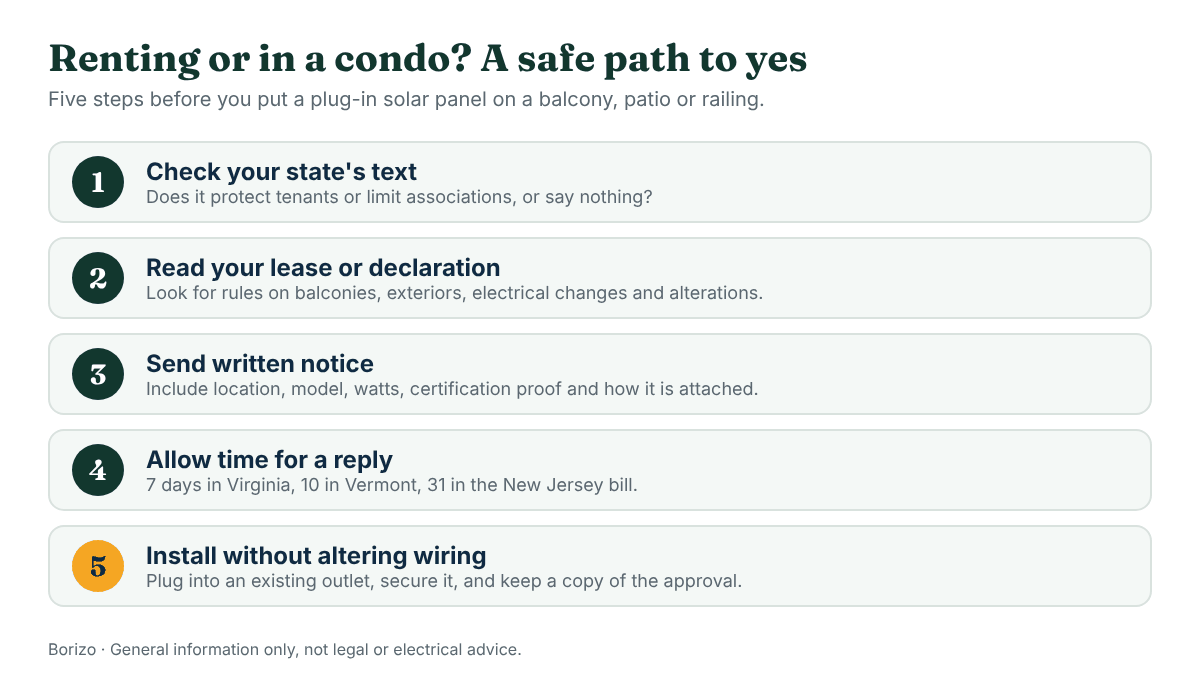
The state texts that require notice ask for the same few items, so a good request covers them even where the law is silent:
- Who and where. Your name, unit and the exact place you propose, such as the balcony floor or a freestanding stand on your patio.
- The product. Model, size, output in watts AC and the certification the maker claims, with the document that supports it. Our guide to checking certification claims shows how to verify it.
- How it is attached. Vermont requires devices to be temporarily but securely attached to the ground or a structure. Say how yours is secured and that nothing is drilled or wired in.
- The date. State the earliest date you plan to install, at least the notice period for your state (7 days in Virginia, 10 in Vermont, 31 in the New Jersey bill).
- Your commitments. Offer to remove the device when you leave, repair any damage and, if the landlord or association asks, provide proof of insurance. Ask your insurer first.
Frequently asked questions
Can my landlord say no to plug-in solar?
It depends on the state and your lease. In Vermont, Virginia and, in the bill text we read, New Jersey, a landlord cannot flatly prohibit a qualifying device but can set reasonable limits and requires advance notice. In Utah, Connecticut and New Hampshire we found no landlord rule, so your lease governs.
Can an HOA ban a plug-in solar panel on my balcony?
In Vermont, covenants cannot prohibit plug-in devices. In New Jersey’s bill, associations cannot enforce rules that prohibit an owner or tenant from using one on the exterior, and in Colorado associations may not prohibit them from 2027. Virginia’s law leaves recorded covenants in place. Elsewhere, check your declaration.
Do I have to tell the utility if I rent?
The utility rules do not change because you rent. Virginia uses a state notice form, Maine requires notice above 420 W, and Connecticut, Vermont and New Hampshire do not require utility approval. See our wattage limit guide for the state-by-state table.
Will I be allowed to take it with me when I move?
Plug-in kits are designed to be portable, and Vermont requires only a temporary attachment. Nothing in the texts we read says otherwise, but moving a device between states means checking the rules in the new state.
Sources
- State laws: links in the table above, all official bill, act or summary pages.
- UL Solutions, announcement of its plug-in solar certification program, January 8, 2026 (context on renters and condo owners as an intended audience).
- Our own guides: wattage limits and circuit safety, UL 3700 certification.

Borizo is an independent guide to plug-in and balcony solar in the US. We track state laws, check certification claims against official sources, and compare kits using published specifications. Laws change often, so every state page shows a “last updated” date and links to its sources. We earn a commission when you buy through our Amazon links, at no extra cost to you. Our content is for information only and is not legal or electrical advice.