Plug-in Solar for a Refrigerator: Savings, Sizing and Limits
Plug-in solar can help with a refrigerator in a practical, limited way: a small balcony or patio kit can offset part of the electricity your fridge uses during sunny hours. It does not run the fridge on its own, it does not keep food cold during a power outage, and it is clearly legal only in some US states, so check your state rules before you buy. This guide is spec-based, not based on hands-on testing of any product.
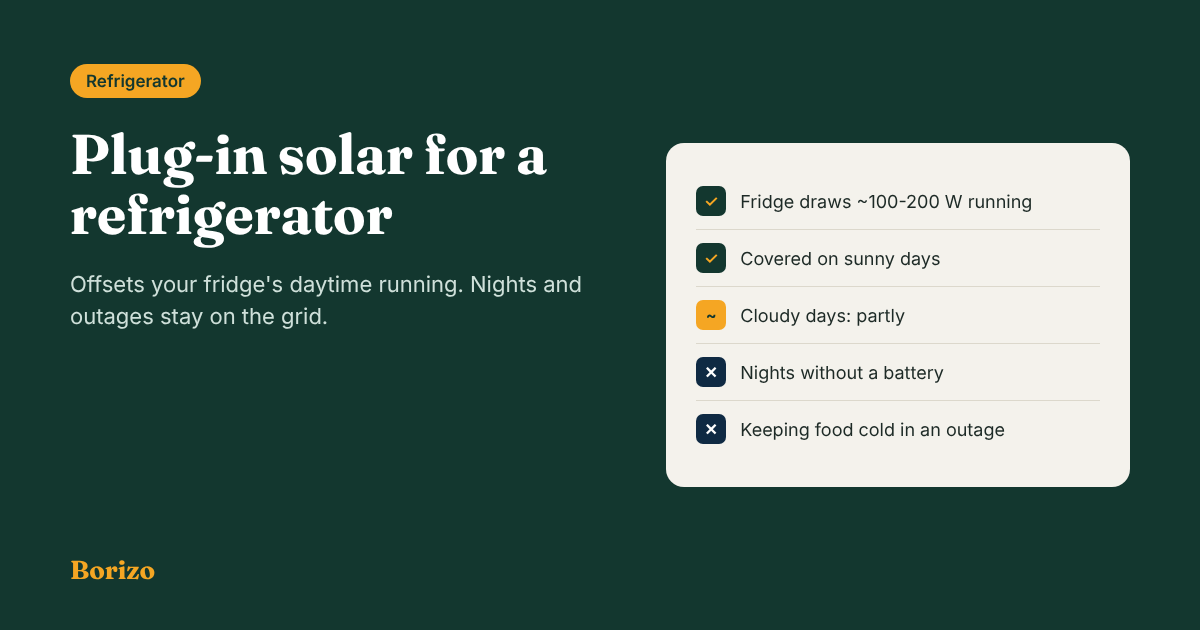
A modern fridge draws about 100 to 200 watts while its compressor runs, well within a plug-in kit’s output, so solar can cover much of its daytime running. At night, on dark days and in outages the fridge runs on the grid as usual. For a fridge rated around 450 to 650 kWh a year, solar used at home might be worth roughly $50 to $95 a year at average US prices.
- Your fridge stays plugged in where it is. Solar enters your home wiring and any running appliance shares it.
- Read your EnergyGuide label. Its yearly kWh figure divided by 365 gives your daily use.
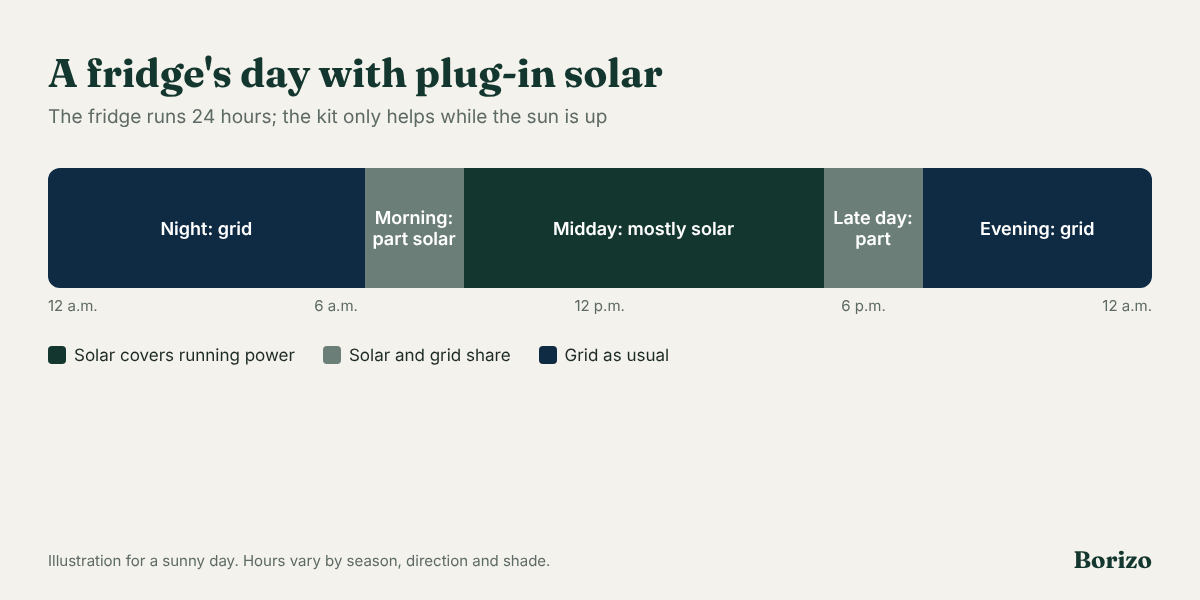
- Day only. A fridge runs 24 hours; panels make power only in daylight.
- A big kit is not better for a fridge alone. Extra midday power may flow to the grid for little credit.
- No outage backup without a battery designed for it.
How plug-in solar works with a refrigerator
Plug-in solar, often called balcony solar, connects through a standard 120-volt outlet instead of a hardwired rooftop installation. A typical kit includes one or two panels, a microinverter, mounting hardware and a cable with a standard plug. The panels make direct current, the microinverter converts it to alternating current, and that power flows into your home wiring.
Your refrigerator is not plugged into the panels. It stays in its normal outlet and draws power as usual. When the sun shines, the solar kit supplies part of that power, so less comes from the grid. When it is cloudy or dark, the grid supplies the rest.
A fridge runs around the clock, but panels produce only in daylight. So a kit fits best with daytime fridge use. It lowers grid use over a day and a year, but it cannot cover the fridge at 2 a.m. unless you add storage, which changes the cost and setup.
What a plug-in kit does not do
- It does not provide backup power. Certified equipment shuts off in an outage so it cannot energize lines that utility workers expect to be dead. This anti-islanding shutdown is a safety feature. See does plug-in solar work during a power outage.
- It does not send power to one appliance. Solar mixes with the rest of your home’s electricity, and all running appliances share it.
- It does not erase your fridge’s cost. Savings depend on how much solar your home uses as it is made, your rate, panel direction and shade.
How much power does a refrigerator use?
Start with your own fridge, not an average. Refrigerators sold in the US carry a yellow EnergyGuide label showing estimated yearly use in kWh. Divide that number by 365 for an average daily figure. If you cannot find the label, the model number usually brings up the spec sheet online.
The EIA lists refrigerators among the largest uses of electricity in US homes, after heating and cooling and alongside lighting. Use varies widely: a large side-by-side model with an ice maker usually uses more than a smaller top-freezer model, and a hot garage or worn door seals push use higher. As worked examples, a fridge rated 450 kWh a year uses about 1.2 kWh a day, and one rated 650 kWh a year about 1.8 kWh a day. At the EIA’s 2025 average US residential price of 17.30 cents per kWh, they cost about $78 and $112 a year to run.
Do not confuse average power with peak power. A compressor cycles on and off, so its average draw is much lower than the short burst it needs to start. A plug-in kit does not need to match that burst to be useful; it needs to make energy during the hours your home is using power.
How much can a small plug-in kit make?
A common kit uses one or two panels of about 400 watts each, often with an inverter output limit below the panel total. In states with a 1,200-watt limit, the inverter output, not the panel label, is the number to watch (see our wattage limit guide).
Output depends on location, direction, tilt and shade. The PVWatts Calculator gives a location-specific estimate. As a planning range, a well-placed system in much of the US makes about 1,100 to 1,600 kWh a year per kilowatt, with sunny, unshaded sites near the top and cloudy or north-facing sites near the bottom. Run your own estimate for your balcony direction.
The useful question is how much your home uses while the kit is producing. If a router, lights or a laptop are also running, more solar is used at home. If only the fridge and standby loads are on, more may flow to the grid, where plug-in kits often earn no credit. See what happens to extra power from plug-in solar.
| Example | Fridge yearly use (label) | Solar used by the home for it | Value at 17.30 cents per kWh |
|---|---|---|---|
| Smaller fridge | 450 kWh | About 300 kWh | About $52 |
| Larger fridge | 650 kWh | About 400 kWh | About $69 |
| Larger fridge, high daytime use at home | 650 kWh | About 550 kWh | About $95 |
Choosing a size for a refrigerator
For most homes, aim for a modest kit that covers a meaningful share of daytime use without making far more than the home can use at midday. One panel of about 400 watts is a sensible start for a fridge plus small daytime loads. Two panels of about 800 watts can cover more, especially with other daytime loads or a sunnier balcony. Our guide on how many panels you need goes further, and our list of what appliances plug-in solar can run helps you count other daytime loads.
Do not size from the fridge label alone. Add what else runs in the day, check your balcony direction, and check shade from railings, trees and nearby buildings. South-facing usually beats east- or west-facing, and north-facing often makes much less.
What to look for in a kit
- Certification: a microinverter listed to UL 1741 at minimum, and system-level certification such as UL 3700 if your state requires it. Our UL 3700 guide explains how to check a listing.
- Anti-islanding shutdown: the spec sheet should say the kit shuts off in a grid outage.
- Output limit: check inverter output in watts, not only panel wattage, and stay within your state limit.
- Mounting: a mount made for your railing, wall or ground space, secure against wind.
- Outdoor-rated outlet and cable where required, kept dry and out of walkways.
- Monitoring: an app or meter showing output; see how to monitor plug-in solar output.
Is plug-in solar legal where you live?
In the US, plug-in solar is generally limited to about 1,200 watts and is explicitly allowed only in some states. A product sold online is not proof it is legal at your address. Utah’s 2025 law, H.B. 340, for example, created a category for portable solar devices of up to 1,200 watts that plug into a standard 120-volt outlet. Other states have different limits, notice rules, landlord rules and certification requirements, and some have no plug-in law yet. Check our state laws hub, then your utility and any landlord or HOA rules, in writing. This is general information, not legal advice.
- Confirm plug-in solar is allowed in your state and building type.
- Confirm the watt limit that applies to you.
- Confirm the certification your state requires.
- Get written permission from your landlord or HOA if one applies.
- Ask your utility how it treats power that flows back to the grid.
Renters and homeowners: what to check first
Plug-in solar appeals to renters because it needs no roof access or permanent installation, but approval is not automatic. A lease may limit balcony attachments, a building may have railing rules, and a landlord may need to approve the mount and outlet in writing. Ask whether the mount must be freestanding, which outlet you may use, who pays for damage and whether you can take the kit when you move. Our renters and HOA guide covers this in detail.
Homeowners have more placement choices, such as a patio, yard or ground mount, but the same state and utility checks apply, and an HOA may have its own rules.
Common mistakes
- Expecting the fridge to run on solar alone. A kit offsets grid power in daylight; it does not keep food cold at night or in an outage.
- Buying before checking rules. A kit allowed in Utah may not be allowed in your state, city or building.
- Using panel watts instead of inverter output. Two 460 W panels do not mean 920 W of usable output.
- Ignoring shade and direction. A panel behind a railing or facing north can make far less.
- Counting exported power as savings. Many plug-in rules give no net metering credit.
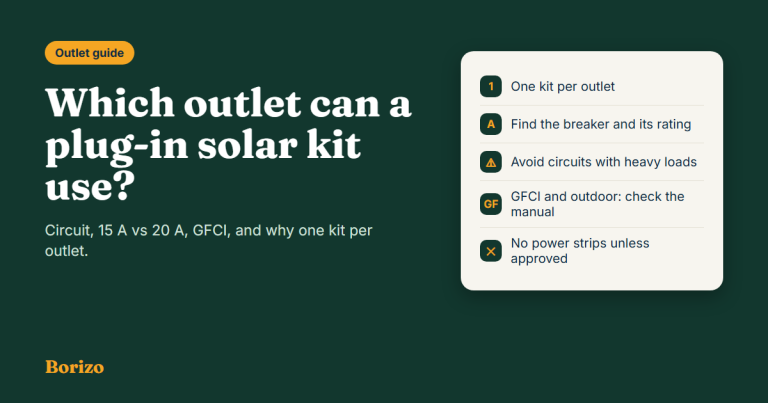
- Using the wrong outlet or circuit. Avoid damaged outlets, long indoor extension cords and circuits already loaded with big appliances. Follow the manual and ask a qualified electrician if unsure.
- Assuming a fast payback. It depends on cost, output, self-use and your rate.
Frequently asked questions
Can plug-in solar run my refrigerator?
It can offset much of your fridge’s power use during the day, but it does not run it by itself. The fridge still uses grid power at night, on cloudy days and in outages, when a certified kit shuts off for safety.
How many panels do I need for a refrigerator?
One panel of about 400 watts is a reasonable start, and two panels of about 800 watts cover more daytime use. The right size depends on your EnergyGuide label, balcony direction and shade, other daytime loads and your state limit. Run PVWatts first.
Will plug-in solar keep my fridge running during a power outage?
No. A basic grid-tied kit shuts off in an outage to protect utility workers, and it makes nothing at night. Outage backup needs a battery or power station designed for it.
Is plug-in solar legal in my state?
It depends on your state. Utah explicitly allows portable devices up to 1,200 watts under H.B. 340, but other states differ and some have no plug-in law yet. Check your state, utility and landlord or HOA rules before you buy.
How much money can plug-in solar save on a refrigerator?
In our worked examples, 300 to 550 kWh of solar used at home a year is worth about $52 to $95 at the EIA’s 2025 average of 17.30 cents per kWh. You save more with a higher rate and good sun, and less with shade, a low rate or high exports.
The bottom line
Plug-in solar for a refrigerator works best as a small, practical daytime offset, not a replacement for grid power. Check your state first, size the kit for your daytime use, choose certified equipment, and redo the numbers with your own EnergyGuide label, PVWatts estimate and electricity rate.
Sources
- US Energy Information Administration, Electricity explained: prices and factors affecting prices (average residential price 17.30 cents per kWh in 2025), read October 27, 2026.
- US Energy Information Administration, Electricity use in homes (refrigerators among the largest home electricity end uses).
- PVWatts Calculator, pvwatts.nlr.gov (output estimates by address).
- Utah Legislature, H.B. 340 Solar Power Amendments, enrolled text (1,200 W portable solar device, 120 V outlet).
- Fridge figures in the table are worked examples; use the yearly kWh on your own EnergyGuide label.

Borizo is an independent guide to plug-in and balcony solar in the US. We track state laws, check certification claims against official sources, and compare kits using published specifications. Laws change often, so every state page shows a “last updated” date and links to its sources. We earn a commission when you buy through our Amazon links, at no extra cost to you. Our content is for information only and is not legal or electrical advice.