Plug-in Solar on a Wall or Window: Mounts, Output and Rules
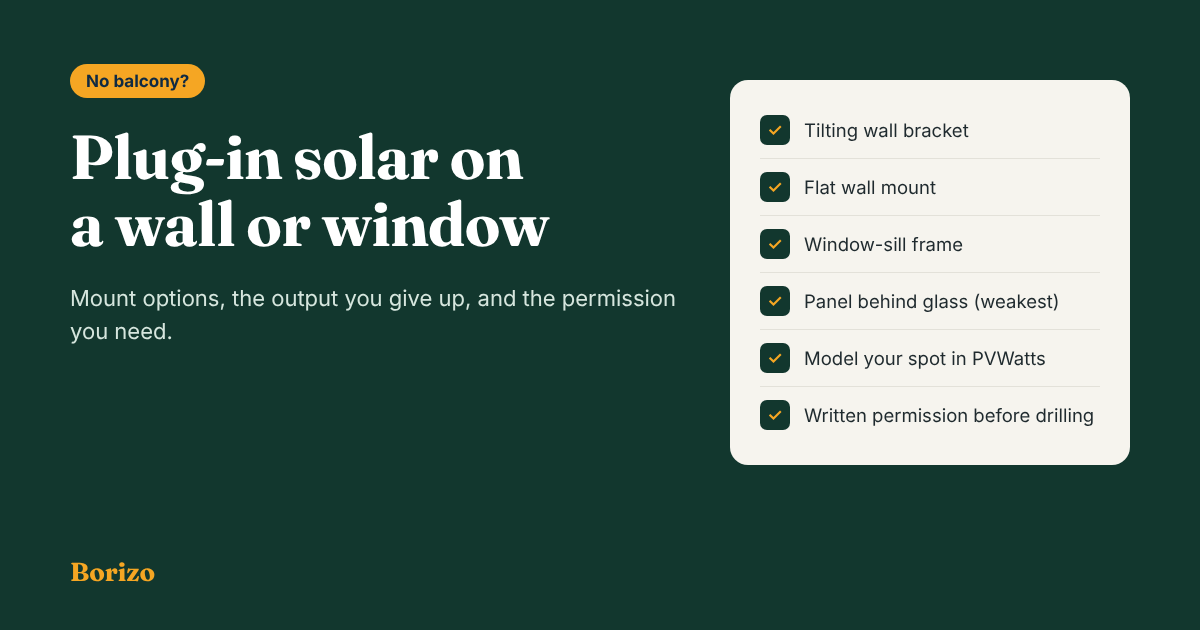
No balcony, no yard, no roof you control? A sunny wall or a window can still hold a plug-in solar panel. Wall brackets, window-sill frames and even panels standing behind the glass are all on the market. Each one trades something away: a wall mount usually means drilling and permission, a vertical panel makes less power over the year than a tilted one, and a panel behind glass loses part of the light before it arrives. This guide explains the main wall and window options, how much the angle matters, what to check about the wall and the wind, the permission and state rules that apply, and a step-by-step plan. It is based on Department of Energy guidance, NREL tools and state law text. We have not installed or tested any mount.
A sun-facing exterior wall can work well for plug-in solar, ideally with a bracket that tilts the panel out from the wall. A panel hung flat against the wall makes less power, and a panel inside a window makes less still. Get written permission before drilling if you rent or live in a condo, use a mount rated for the panel’s weight and your wind, and keep the panel and cable away from walkways below.
- Tilt matters. DOE says the best fixed tilt equals your latitude, and that 15° to 40° facing south gives the best production in the continental US. A wall panel hangs at or near 90°.
- Check your own spot with NREL’s free PVWatts tool. Enter a 90° tilt and your wall’s direction to see the yearly difference before you buy.
- Wind and falling risk are the main safety issues. Steeper panels catch more wind, and a wall panel often hangs over a path or a neighbor’s space.
- Permission comes first. Drilling an exterior wall usually needs the owner’s or association’s consent. Vermont requires plug-in devices to be “temporarily but securely attached.”
- Behind-glass panels are the weakest option. Glass and window coatings reflect or absorb part of the light, and the panel gets sun only through the window opening.
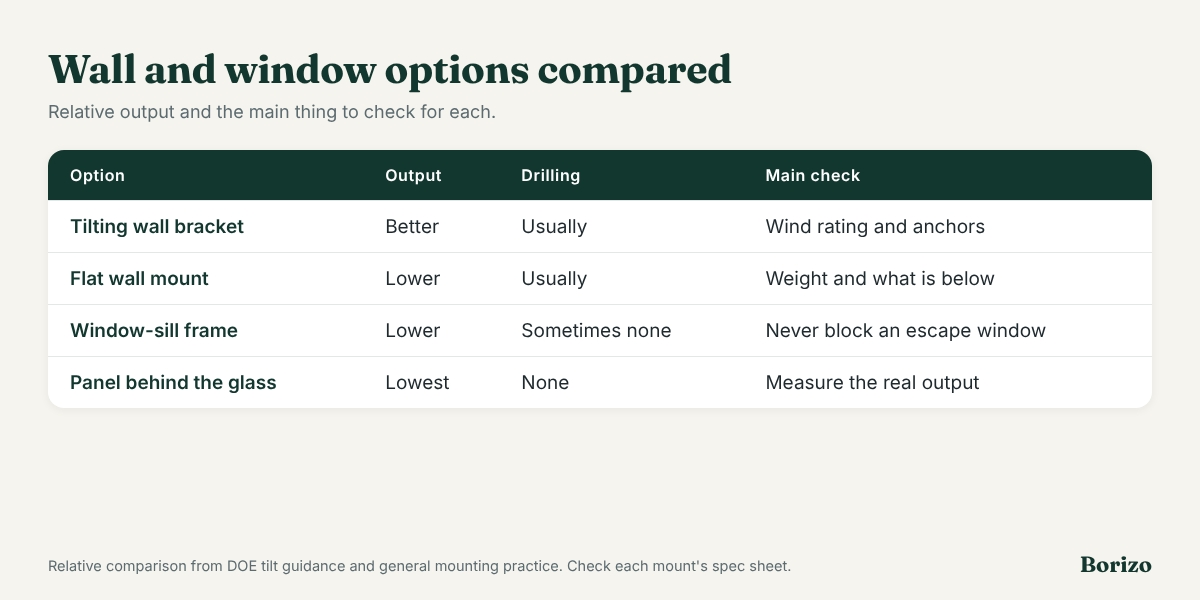
The wall and window options
| Option | How it works | Typical trade-off |
|---|---|---|
| Tilting wall bracket | Brackets screwed to the wall hold the panel angled out at the bottom | Better angle than flat, but needs drilling and catches more wind |
| Flat wall mount | Panel fixed parallel to the wall, at about 90° | Simple and low-profile, but lower yearly output |
| Window-sill or window-box frame | Frame rests on or hooks over an outside sill | No drilling in some designs; small panels only; must not block an escape window |
| Panel behind the glass | Panel stands inside, facing out through the window | No exterior work, but the weakest output; mostly for small panels |
We list categories, not products. Read each mount’s specification sheet for the panel size and weight it supports, its wind rating and the fasteners it expects.
How much power you give up on a wall
A fixed panel makes the most energy over a year when it faces south and tilts at about your latitude. The Department of Energy’s Federal Energy Management Program says exactly that: optimal tilt equals local latitude, and a tilt between 15° and 40° facing south gives the best production in the continental US. EIA adds that tilting a fixed panel toward the south is the simplest way to maximize its yearly output in the Northern Hemisphere.
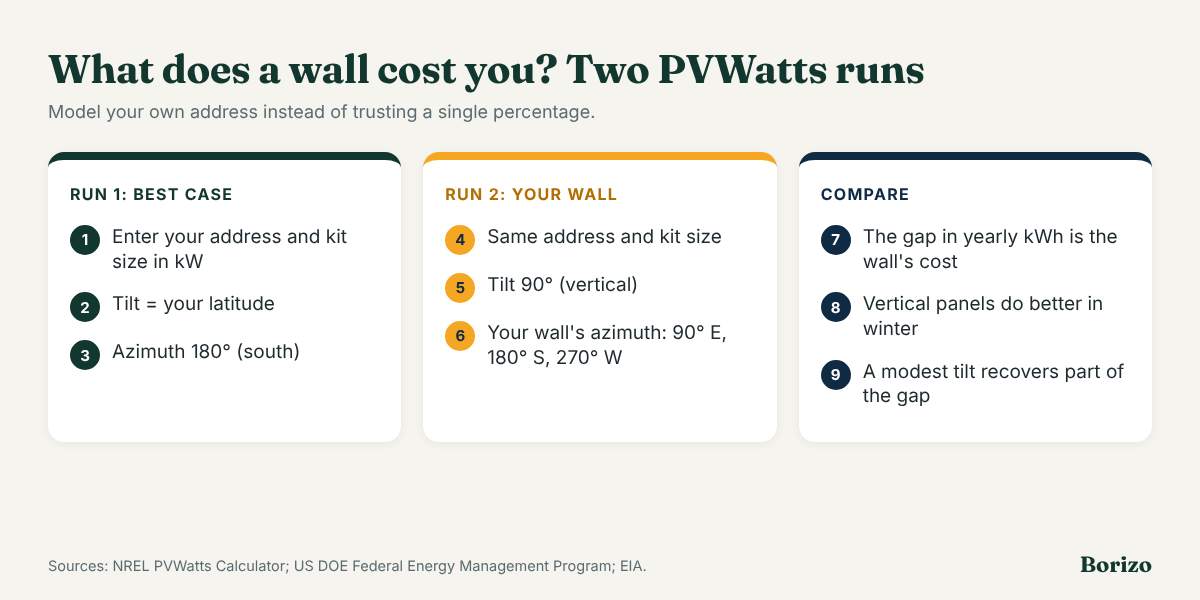
A wall panel breaks that rule by hanging at or near 90°. How much it costs you depends on where you live and which way the wall faces, so we will not quote a single percentage. The honest way to find out is to model your own spot:
- Open NREL’s free PVWatts Calculator and enter your address.
- Enter your kit’s size in kW (for example 0.8 for 800 W).
- Run it once with a tilt equal to your latitude and an azimuth of 180° (south).
- Run it again with a tilt of 90° and your wall’s real azimuth (90° east, 180° south, 270° west).
- Compare the two yearly kWh results. That gap is what the wall costs you.
Two patterns are worth knowing. A vertical panel does relatively better in winter, when the sun is low, and it sheds snow easily. A tilting bracket that angles the panel out by even a modest amount usually recovers part of the gap. Our angle guide has a latitude table, and east, west and south-facing explains what the wall’s direction means.
Panels behind a window
Standing a panel inside, facing out through a window, avoids every exterior question: no drilling, no wind, no falling risk. The cost is output. Glass reflects part of the light, many modern windows carry coatings designed to block part of the sun’s energy, and the panel only sees the sky through the window frame, which narrows the hours of direct sun. Dirt on either pane adds to the loss.
We found no official source that puts a reliable number on behind-glass losses for plug-in kits, so treat any figure you see in an ad with caution. If you try it, measure. A plug-in energy monitor shows what the kit actually delivers, as our monitoring guide explains. Keep the panel from touching the glass, leave space for air to circulate, and never block a window you might need as an emergency exit.
Checking the wall
- What is it made of? Brick, concrete, wood framing and siding each need different anchors. Vinyl or fiber-cement siding alone is not a structural surface; fasteners need to reach the framing or masonry behind it.
- Weight. Look up the panel’s weight and the mount’s weight on their spec sheets and make sure the anchors are rated for the total with a margin.
- Wind. The DOE FEMP guidance notes that steeper tilts shed snow and hail better but increase wind load. A panel angled out from a wall acts like a sail, so follow the mount’s wind rating and its fastener spacing exactly.
- What is underneath? If the panel hangs over a sidewalk, entrance, parking space or a neighbor’s balcony, a failure could hurt someone. Choose a different spot or add a secondary safety cable if the maker allows it.
- Water. Every hole in an exterior wall is a path for water. Seal fasteners as the mount maker and wall manufacturer specify.
If you are unsure about the wall or the anchors, a contractor or structural engineer can check it. For balcony railings, see our no-drill mounting guide, which covers clamps, hooks and ballast.
Permission and state rules
Drilling into an exterior wall is a change to the building, so in most rentals and condos it needs the owner’s or association’s written approval even where plug-in solar itself is protected. State laws that mention plug-in solar handle attachment in different ways:
- Vermont requires plug-in devices to be “temporarily but securely attached” to the ground or a structure, and a tenant may not do electrical work without the landlord’s permission.
- Maine says a customer who installs on a structure they do not own must not weaken it or violate codes, and must restore it when the system is removed.
- Virginia lets landlords with more than four units set reasonable size, place and manner limits and makes the tenant responsible for damage, starting January 1, 2027.
- New Jersey’s bill, in the third reprint we read, lets landlords and associations set reasonable size and placement limits.
Our renters and HOA guide has the full table and a template for your written request. Separately, the power rules (wattage cap, certification, utility notice) still apply; check them in our wattage limit guide.
Step by step: a wall or window setup
- Check sun and shade. Watch the wall or window at mid-morning, noon and mid-afternoon. See how shade affects balcony solar.
- Model it. Run PVWatts at 90° and at your best realistic tilt.
- Check the rules. Your state’s plug-in law, your lease or HOA documents, and any local rules.
- Ask in writing. Include the panel size, weight, mount type, fastener plan and location.
- Choose a rated mount. Matching the panel size, weight, wall type and wind exposure.
- Plan the cable. Keep the kit’s cable short, protected and out of walkways, and plug into an outlet you have checked. See which outlet to use.
- Install as the manual says, or hire a contractor for the wall work.
- Inspect after storms and take the panel down if severe wind is forecast and the maker recommends it.
Frequently asked questions
Can I mount a plug-in solar panel on a wall?
Often, yes, if you own the wall or have written permission, your state allows plug-in solar, and the mount is rated for the panel’s weight and your wind exposure. A tilting bracket usually produces more than a panel fixed flat against the wall.
Does a solar panel work behind a window?
It works, but it makes less power than the same panel outside, because glass and window coatings reflect or absorb part of the light and the window frame limits the hours of direct sun. Measure the real output with an energy monitor before relying on it.
How much less power does a vertical panel make?
It depends on your location and the wall’s direction. Model both a tilted and a 90° panel at your address in NREL’s free PVWatts Calculator and compare the yearly results.
Do I need permission to drill into the wall of a rental?
In most cases, yes. Even states that protect tenants’ right to use plug-in solar let landlords set reasonable limits on placement and attachment. Ask in writing and keep the reply.
Sources
- US Department of Energy FEMP, Install and Commission a Photovoltaic System (optimal tilt equals latitude; 15° to 40° facing south; steeper tilts shed snow and hail but increase wind load).
- US Energy Information Administration, Solar photovoltaic output depends on orientation, tilt, and tracking.
- NREL, PVWatts Calculator.
- State laws, read October 26, 2026: Vermont Act 149, Maine LD 1730, Virginia HB 395, New Jersey S2368 (third reprint).
- Photos: stock images from Freepik, used for illustration only.

Borizo is an independent guide to plug-in and balcony solar in the US. We track state laws, check certification claims against official sources, and compare kits using published specifications. Laws change often, so every state page shows a “last updated” date and links to its sources. We earn a commission when you buy through our Amazon links, at no extra cost to you. Our content is for information only and is not legal or electrical advice.