How Much Electricity Does a Balcony Solar Panel Make Per Day?
The number on the box says 800 W, but how much electricity does a balcony solar panel actually make in a day? The honest answer is “far less than 800 W times 24 hours,” and it depends mostly on how much sun your spot gets. This guide gives you a simple way to estimate daily output, a table for common kit sizes, what that energy can mean for a typical home, and why real days differ from the average. It is based on NREL’s PVWatts method and EIA data. The numbers are our own arithmetic, not product tests, and we have not tested any kit.
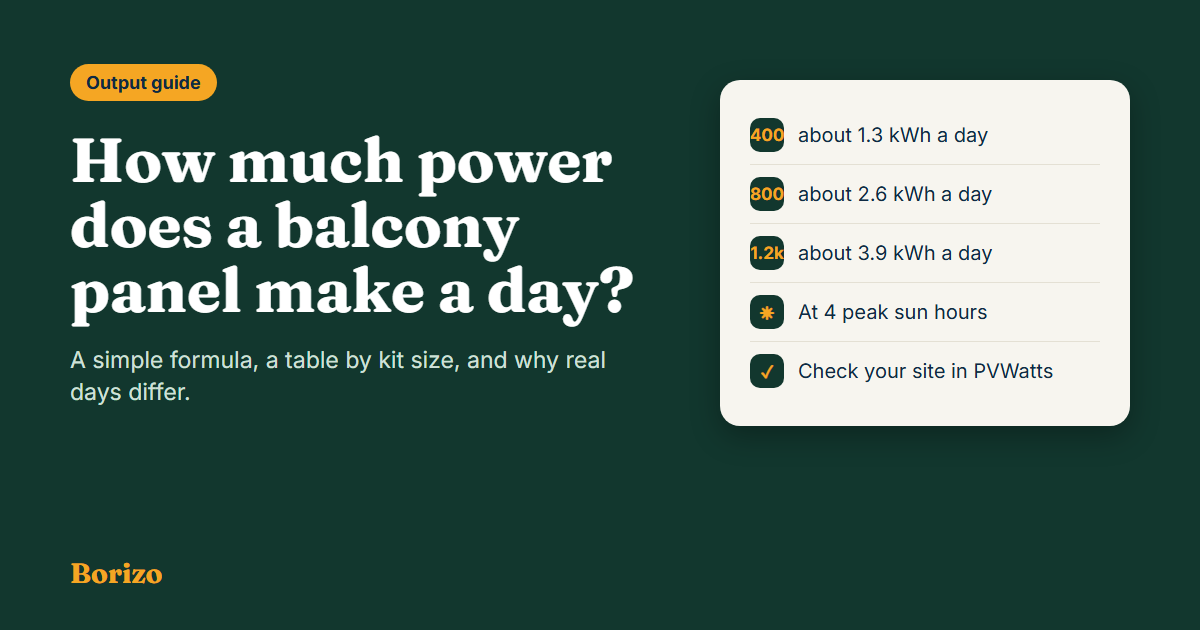
On an average day with 4 peak sun hours, an 800 W kit makes about 2.6 kWh, a 400 W kit about 1.3 kWh and a 1,200 W kit about 3.9 kWh. Summer days are higher, winter days lower, and shade or a poor angle can cut it a lot. Run PVWatts for your address to get a real figure.
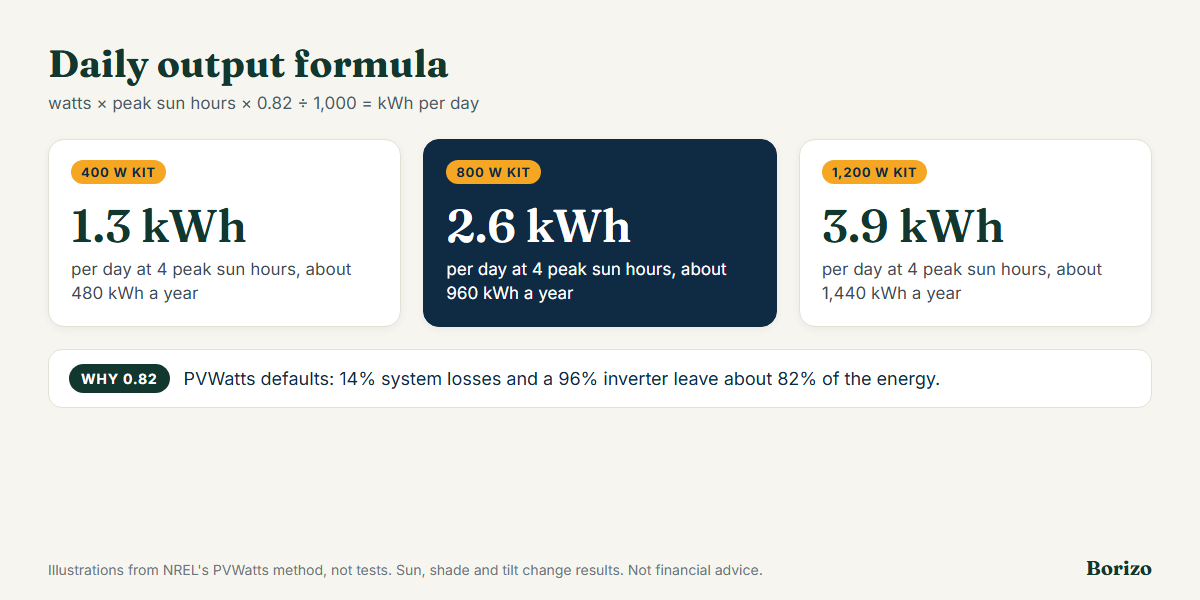
- Formula: daily kWh ≈ panel watts × peak sun hours × 0.82 ÷ 1,000.
- The 0.82 factor comes from NREL’s PVWatts defaults: 14% system losses and a 96% inverter.
- 800 W at 4 peak sun hours gives about 2.6 kWh a day, or about 960 kWh a year.
- The average US home used about 899 kWh a month in 2022, so one small kit covers a modest slice.
- It is an average. A good summer day can produce much more and a cloudy winter day much less.
The simple formula
A peak sun hour is one hour of sunlight at full strength. A day with 4 peak sun hours has as much total sunlight as 4 hours at full strength, even though the sun is up for much longer. NREL publishes solar resource data in kWh per square meter per day, which is the same number as peak sun hours. For example, NREL’s developer documentation shows an annual average of about 4.81 kWh/m²/day for a point near Denver. That is one location, not a national average; your own number comes from NREL’s maps or PVWatts.
The calculation has three steps:
- Multiply panel watts by peak sun hours. An 800 W kit × 4 hours = 3,200 Wh.
- Apply losses. PVWatts’ default system losses are 14%, and its default inverter efficiency is 96%, which together leave about 82% of that energy (0.86 × 0.96 ≈ 0.82). 3,200 Wh × 0.82 ≈ 2,620 Wh.
- Convert to kWh. Divide by 1,000: about 2.6 kWh.
Multiply by 365 and you get about 960 kWh a year, which matches the shortcut we use elsewhere (watts × peak sun hours × 0.30 = kWh per year). It assumes a well-aimed panel with little shade. The details of the method are in the PVWatts Version 5 manual, and our sizing guide shows where the 0.30 comes from.
Daily output by kit size and sun
| Kit size | 3 peak sun hours | 4 peak sun hours | 5 peak sun hours |
|---|---|---|---|
| 400 W | about 1.0 kWh | about 1.3 kWh | about 1.6 kWh |
| 800 W | about 2.0 kWh | about 2.6 kWh | about 3.3 kWh |
| 1,200 W | about 3.0 kWh | about 3.9 kWh | about 4.9 kWh |
What that means for your home
EIA reports that US residential customers averaged 10,791 kWh a year in 2022, about 899 kWh a month or roughly 30 kWh a day. Against that average:
| Kit size | Daily output at 4 sun hours | Share of 30 kWh a day | Yearly output |
|---|---|---|---|
| 400 W | about 1.3 kWh | about 4% | about 480 kWh |
| 800 W | about 2.6 kWh | about 9% | about 960 kWh |
| 1,200 W | about 3.9 kWh | about 13% | about 1,440 kWh |
Only the part you use at home counts as savings. At a price of 20¢ per kWh, 2.6 kWh a day is worth about 52¢ a day if you use all of it, or about $190 a year. The price of electricity varies a lot: EIA data show a 2025 average residential price of 17.23¢ per kWh, from 11.82¢ in North Dakota to 40.40¢ in Hawaii. Use our savings and payback calculator with your own bill, and read is plug-in solar worth it for payback examples.
A worked example you can copy
Say you have an 800 W kit on a balcony in a sunny region with about 5 peak sun hours on a clear summer day, and about 3 in midwinter. These are made-up round numbers to show the steps, not a forecast for any place.
- Summer day: 800 × 5 × 0.82 ÷ 1,000 ≈ 3.3 kWh.
- Winter day: 800 × 3 × 0.82 ÷ 1,000 ≈ 2.0 kWh.
- Average day (4 peak sun hours): about 2.6 kWh, which gives about 960 kWh a year.
- Value at your rate: 2.6 kWh × 20¢ ≈ 52¢ a day if you use all of it. At 15¢ it is about 39¢, and at 30¢ about 78¢.
- Reality check: if shade or a vertical mount cuts output by a third, the average day is closer to 1.7 kWh. That is why we suggest testing your tilt and direction in PVWatts first.
You can swap in your own watts, sun hours and rate. If your bill shows time-of-use rates, the midday hours when a kit produces may be priced lower or higher than your average, which changes the value of each kilowatt-hour. The payback guide shows how to find your price per kWh on your bill.
Why a real day differs from the average
| Factor | What happens | What to check |
|---|---|---|
| Season | Long, high-sun summer days give more peak sun hours than short winter days | Look at PVWatts’ monthly output, not just the yearly total |
| Weather | Overcast days produce a fraction of clear-sky output | Judge the kit over a year, not one week |
| Tilt and direction | A poor angle or a north-facing spot cuts output | See the best angle for a balcony panel |
| Shade | Railings, trees and buildings block light for part of the day | Check the spot at several times of day; NREL’s default allowance for shading is only 3%, so real shade can be far worse |
| Heat and dirt | Hot panels and dust reduce output slightly; PVWatts’ default soiling allowance is 2% | Leave airflow behind the panel; clean it as the manual says |
| Inverter limit | An inverter rated lower than the panels clips the extra | Match panel and inverter ratings, and stay within your state’s cap |
| Grid outage | A grid-tied kit shuts off, so output is zero | See plug-in solar in a power outage |
How to measure your own output
- Estimate first. Enter your address, kit size, tilt and direction in PVWatts and note the daily or monthly figure.
- Use the maker’s app. Many kits show production in an app. APsystems, for example, says its EZ1 has built-in Bluetooth and Wi-Fi and shows production in its AP EasyPower app.
- Compare over weeks, not days. One sunny and one cloudy day will look very different. A large gap from the estimate over a month usually points to shade or panel angle.
- Do not trust the nameplate. A panel’s watt rating is a laboratory number; real output is usually lower.
Frequently asked questions
How much electricity does a 400 W balcony solar panel produce per day?
About 1.3 kWh on an average day with 4 peak sun hours, or about 1.0 to 1.6 kWh depending on whether your area gets 3 to 5 peak sun hours. That is our estimate from the PVWatts method, not a test.
How much does an 800 W kit produce per day?
About 2.6 kWh at 4 peak sun hours, roughly 960 kWh a year. A sunnier site makes more and a shaded one less.
Does a kit make 800 W all day?
No. The rating is a peak value reached only in strong, well-aimed sun, and output is zero at night. The daily total is a fraction of 800 W times 24 hours.
How many kWh does a balcony solar panel make in winter?
Less than the yearly average, because days are shorter and the sun is lower. PVWatts shows monthly output for your address, which is the best way to see the winter figure.
Sources
- NREL, PVWatts Version 5 Manual (default system losses of 14% with 3% shading and 2% soiling allowances; 96% inverter efficiency) and the PVWatts Calculator.
- NREL, Solar Resource Data API (values in kWh/m²/day, the same as peak sun hours).
- US Energy Information Administration, How much electricity does an American home use? (10,791 kWh in 2022) and Electric Power Annual, average retail price by state.
- APsystems, EZ1 for consumers (Bluetooth, Wi-Fi and app monitoring), read October 26, 2026.

Borizo is an independent guide to plug-in and balcony solar in the US. We track state laws, check certification claims against official sources, and compare kits using published specifications. Laws change often, so every state page shows a “last updated” date and links to its sources. We earn a commission when you buy through our Amazon links, at no extra cost to you. Our content is for information only and is not legal or electrical advice.