What Happens to Extra Power From Plug-in Solar?
On a sunny afternoon, your plug-in kit might be making 600 or 800 watts while your home only needs 300. Where does the rest go? It does not get stored or wasted inside your walls. It flows back out through your meter onto the grid, where your neighbors use it. Whether you get anything for it, nothing at all, or in a few cases are charged as if you used it, depends on your meter and your utility’s rules. This guide explains what happens to extra power from a plug-in kit, how much extra a small kit really makes, how different meters and billing rules treat it, and how to use more of your own solar. It is based on a Congressional Research Service report and an engineering study submitted to the Vermont legislature. We have not tested any kit.
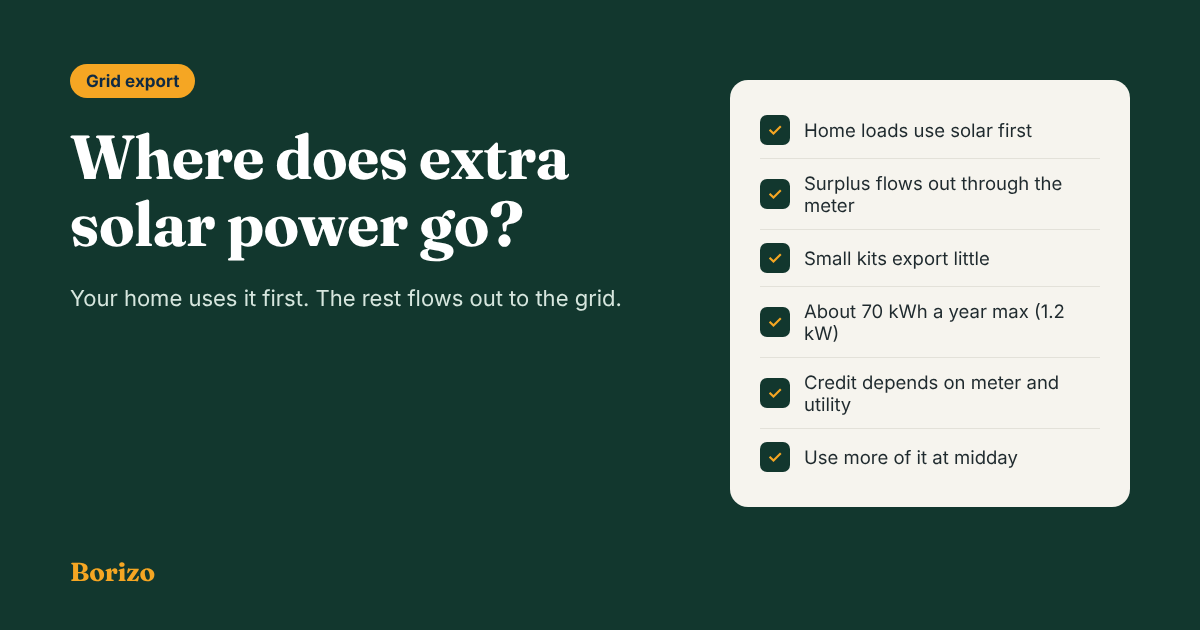
Extra power from a plug-in kit flows out through your meter to the grid and is used by nearby homes. A small kit exports little, because your home usually uses most of what it makes. What you get for exports depends on your meter and utility: a one-for-one credit under net metering, a lower rate under net billing, nothing, or, with some meters, a charge as if you had used it. Ask your utility how your meter records it.
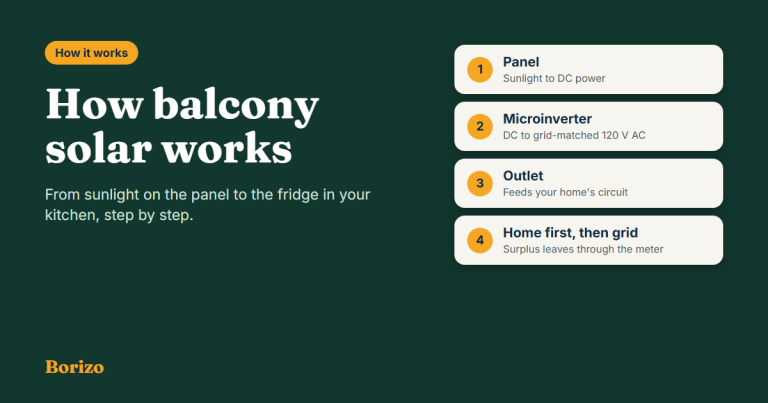
- Your home uses solar first. Power from the kit feeds whatever is running; only the surplus leaves through the meter.
- Small kits export little. An engineering report for the Vermont legislature estimated a 1.2 kW system exports at most about 70 kWh a year, mostly in spring and fall.
- Meters differ. The same report says some meters do not reverse, recording energy in one direction only, and others record flow in either direction as energy consumed.
- Billing rules differ. The Congressional Research Service describes net metering, net billing, value of solar and buy-all, sell-all arrangements.
- Using more yourself beats exporting in most cases, because your own electricity usually costs more than any export credit.
Where the electricity actually goes
Electricity follows the path of least resistance to wherever it is being used. When your kit feeds an outlet, its power first supplies devices on that circuit, then other circuits in your home, all of which are connected at your electrical panel. Only if your whole home is using less than the kit makes at that moment does the extra flow back through your meter and onto the utility’s lines, where the nearest homes on the same line use it.
That is why plug-in solar works without a battery: there is always somewhere for the power to go while the grid is up. It is also why plug-in kits must shut off when the grid goes down, so they do not energize lines that crews are repairing. Our guides to how balcony solar works and backfeeding explain both sides.
How much extra does a small kit make?
Less than most people expect. A typical home always has some load running: a fridge, routers, chargers, standby devices, and often more. Brooks Engineering, in a report for the Vermont legislature, concluded that export from plug-in systems happens only “from time to time,” typically in spring and fall, when solar output is decent and heating and cooling loads are low. It estimated that a 1.2 kW system “can only generate an excess of 0.76 kWh on the days when the home is at its lowest consumption,” and about 70 kWh of excess a year at best.
For a smaller 400 W or 800 W kit, exports will usually be lower still. Homes that are empty and nearly switched off during the day, or very efficient apartments, will export more. You can check your own pattern with your utility’s hourly data or a plug-in monitor; see our monitoring guide.

Stock photo (Freepik) for illustration only. It is not a Borizo installation, and we have not tested any product shown.
How your meter records it
The Vermont report notes that standard utility meters “will run in both directions quite accurately,” but that utilities have invested in meters that measure and record energy in different ways:
| Meter behavior | What happens to exported energy | Effect on your bill |
|---|---|---|
| Runs in both directions (net) | Export subtracts from what you used | You are credited at your full retail rate, in effect |
| Records each direction separately | Import and export are counted on their own registers | Depends on the export rate in your utility’s rules |
| Non-reversing (one direction only) | Export is not recorded | You get nothing for exports, but are not charged |
| Records either direction as consumed | Export is counted as if you used it | You pay for energy you sent out |
The last row is the one to rule out. The Vermont report estimated that for utilities that record produced energy as consumed energy, a 1.2 kW plug-in customer would lose about $14 a year, and it described the issue as generally too small to have any real impact. Small or not, it is worth asking your utility how your meter handles export before you plug in.
How utilities pay for exports
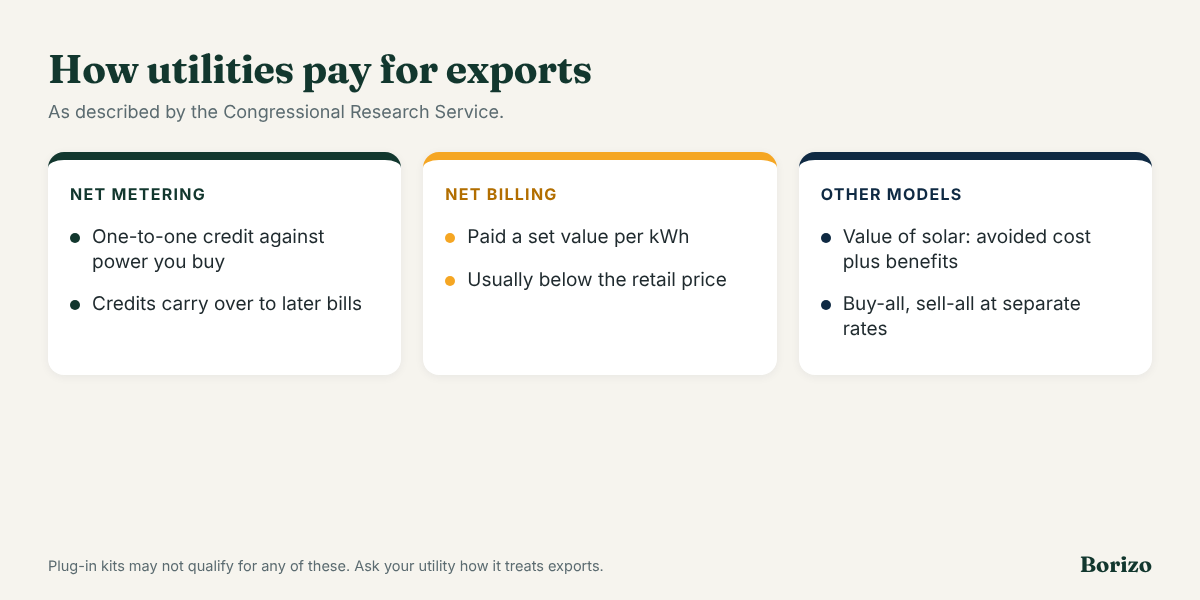
The Congressional Research Service’s report on net metering describes the main ways utilities compensate customers who send power to the grid:
- Net energy metering (NEM): electricity sent to the grid is credited one-to-one against electricity bought from the grid, often described as “the meter running backward.” CRS notes most meters today are digital and do not literally run in reverse. Excess credits carry over to later bills, with state rules on how long.
- Net billing: exported electricity is paid at a predetermined value, which may be a rate or a fixed amount, usually lower than the retail price.
- Value of solar: a rate based on avoided costs plus societal benefits, which CRS says is often above avoided-cost rates but below retail rates.
- Buy-all, sell-all: the utility buys all of a customer’s generation at one rate and sells all consumption at the retail rate.
Whether a plug-in kit qualifies for any of these depends on your state’s law and your utility’s tariffs. Some utilities may treat a plug-in kit like any other generator; others may not credit it at all. The Vermont report notes that many utilities have different rates for buying and selling electricity and that plug-in systems would need to be exempt from those tariffs. Ask your utility, and check our wattage limit guide for your state’s plug-in rules.
What exports are worth
The Vermont report gives a simple illustration: if a utility charges $0.20 per kWh and pays $0.05 for exported energy, each exported kWh earns $0.15 less than using it yourself would have saved. On its estimate of about 70 kWh of exports a year for a 1.2 kW system, that gap is about $10.50 a year. For most plug-in owners, exports are a small part of the value. The main savings come from the electricity you no longer buy, as our savings and payback guide explains.
How to use more of your own solar
- Run flexible loads at midday. Dishwashers, washing machines and chargers can often run while the sun is up.
- Size the kit to your daytime use. If your home uses little during the day, a bigger kit mostly adds exports. See how many panels you need.
- Consider panel direction. East or west panels spread output across the day, which can match household use better. See east, west or south.
- Add storage only if it pays. A battery can keep extra midday power for the evening, but with small exports it rarely pays for itself.
Frequently asked questions
What happens to extra electricity from plug-in solar?
It flows back out through your meter onto the grid, where nearby homes use it. Your own home always uses the kit’s power first; only the surplus leaves.
Do I get paid for extra power from a balcony solar kit?
It depends on your meter, your state’s law and your utility. You might get a full retail credit under net metering, a lower rate under net billing, or nothing. Ask your utility how it treats exports from a plug-in device.
Can my meter charge me for solar I send to the grid?
With some meters, yes. An engineering report for the Vermont legislature notes that some meters record energy flowing in either direction as consumed, which would bill you for exports. It estimated the cost at about $14 a year for a 1.2 kW system. Ask your utility how your meter records it.
How much power does a plug-in kit send to the grid?
Usually little. The same report estimated a 1.2 kW system exports at most about 70 kWh a year, mostly in spring and fall, because a typical home uses most of the kit’s output as it is made.
Sources
- Brooks Engineering for Bright Saver, Plug-In Solar Utility Impact in the United States, December 3, 2025, submitted to the Vermont legislature (export frequency; 0.76 kWh; about 70 kWh a year; meter behaviors; tariffs; $0.20/$0.05 and $14 examples; pages 1, 11, 12).
- Ashley J. Lawson, Congressional Research Service, Net Metering: In Brief, R46010, November 14, 2019 (NEM, net billing, value of solar, buy-all sell-all; digital meters).
- Photos: stock images from Freepik, used for illustration only.

Borizo is an independent guide to plug-in and balcony solar in the US. We track state laws, check certification claims against official sources, and compare kits using published specifications. Laws change often, so every state page shows a “last updated” date and links to its sources. We earn a commission when you buy through our Amazon links, at no extra cost to you. Our content is for information only and is not legal or electrical advice.