Plug-in Solar in an Apartment: A Step-by-Step Guide
Plug-in solar was made for apartments. You do not need a roof, a contractor or a permit in the states that have passed plug-in laws, and the kit can move with you. But an apartment adds steps a house owner can skip: a lease, a landlord or building manager, a balcony you share a wall with, and wiring you do not control. This guide walks through the whole process in order, from checking whether your state allows it to plugging in and tracking output, with the official rule behind each step. Use it alongside our renters and HOA guide for the legal details. It is based on state law text, Department of Energy guidance and EIA data. We have not tested any kit.
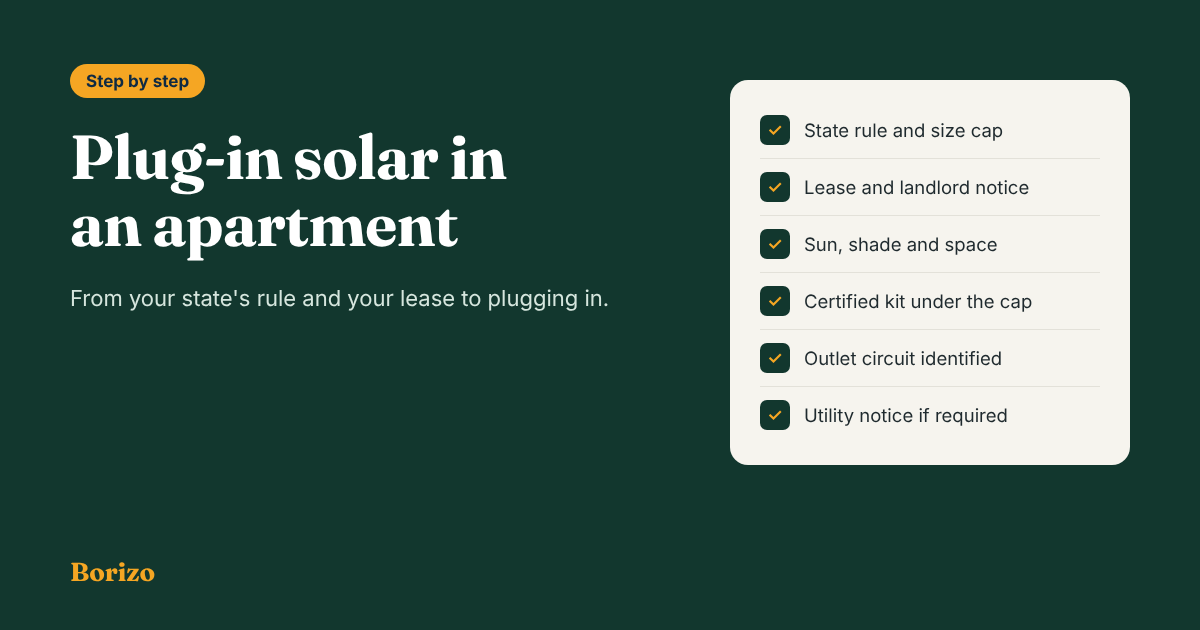
Check your state’s plug-in law and your lease, measure your balcony’s sun and space, pick a certified kit sized under your state’s cap, and send your landlord a written notice or request with the product details. Then identify the outlet’s circuit, secure the panel, notify the utility if your state requires it, and plug in following the manual. Track output in the first weeks to confirm it works as expected.
- Two sets of rules apply: your state’s power rules (size cap, certification, utility notice) and your lease or building rules.
- Some states protect renters, with notice periods: 7 days in Virginia, 10 in Vermont and 31 in New Jersey’s bill. Landlords can still set reasonable limits.
- Who pays the electric bill matters. New Jersey’s bill protects tenants who pay their own electric service; Virginia excludes units on ratio utility billing.
- Sun beats size. A smaller kit in full sun can beat a bigger one in shade. Check your balcony at different times of day first.
- No wiring changes. Plug into an existing outlet. Anything more needs written permission and an electrician.
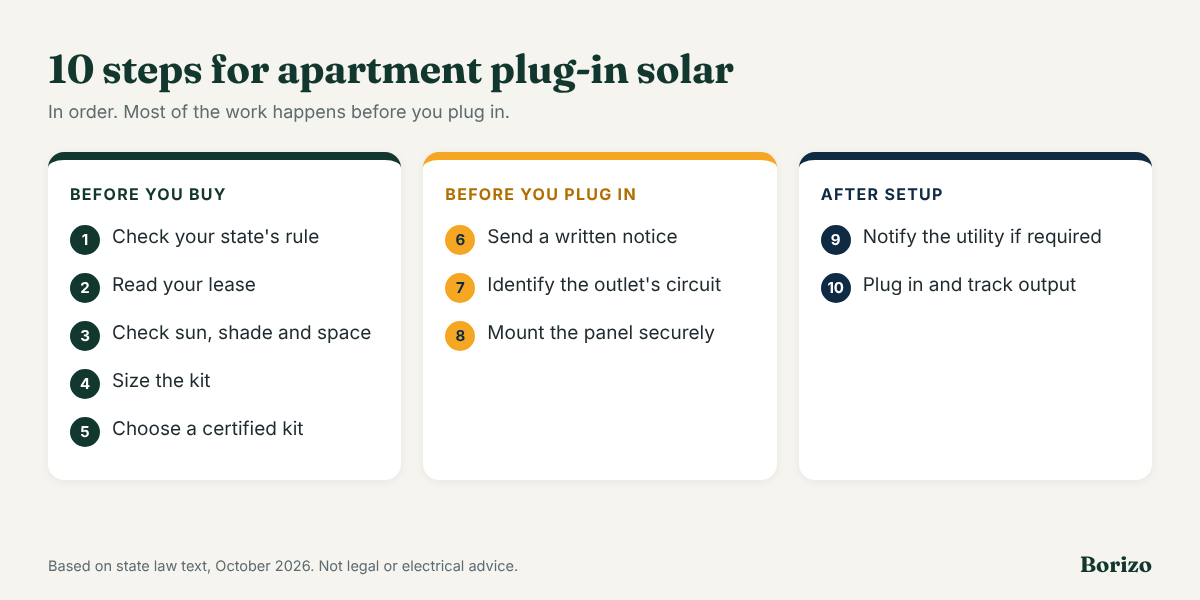
Step 1: Check your state’s rule
Ten states have enacted plug-in solar laws so far, and each sets its own size cap, certification wording and notice rules. Most cap output at 1,200 W; Colorado allows 1,920 W, and Maine requires a licensed electrician and a dedicated circuit above 420 W. Use our state rule checker to see your state’s rule with links to the official text. If your state has no plug-in law, a kit may still need a standard interconnection agreement with your utility, so ask the utility before buying.
Step 2: Read your lease and building rules
Look for clauses about balconies, exterior changes, appliances, electrical work and “alterations.” A state protection does not erase every lease term, but it may limit what a landlord can prohibit:
- Vermont: the tenant gives at least 10 days’ notice; the landlord may reply with reasonable restrictions.
- Virginia (from January 1, 2027): landlords with more than four units cannot bar a small portable device on the exterior but may set reasonable size, place and manner limits; the tenant gives 7 days’ notice and is responsible for damage. Tenants on ratio utility billing may not install one.
- New Jersey (third reprint of the bill we read): a landlord cannot bar a tenant who pays the electric service from using a portable device on a leased balcony or patio; the tenant gives 31 days’ written notice.
In states with no tenant provision, your lease decides. Asking politely in writing is still the best route.
Step 3: Check sun, shade and space
Your balcony’s direction and shade decide most of what a kit will produce. Watch it at mid-morning, noon and mid-afternoon, and remember the sun is lower in winter, so the balcony above yours casts a longer shadow. Our guides to balcony direction and shade show how to read your spot, and NREL’s free PVWatts tool can estimate yearly output for your address and direction.
Then measure. Note the railing length and height, the railing type (bars, glass, solid), and the floor space if you would use a stand. Compare these with panel dimensions on spec sheets. Many apartment balconies fit one or two full-size panels.
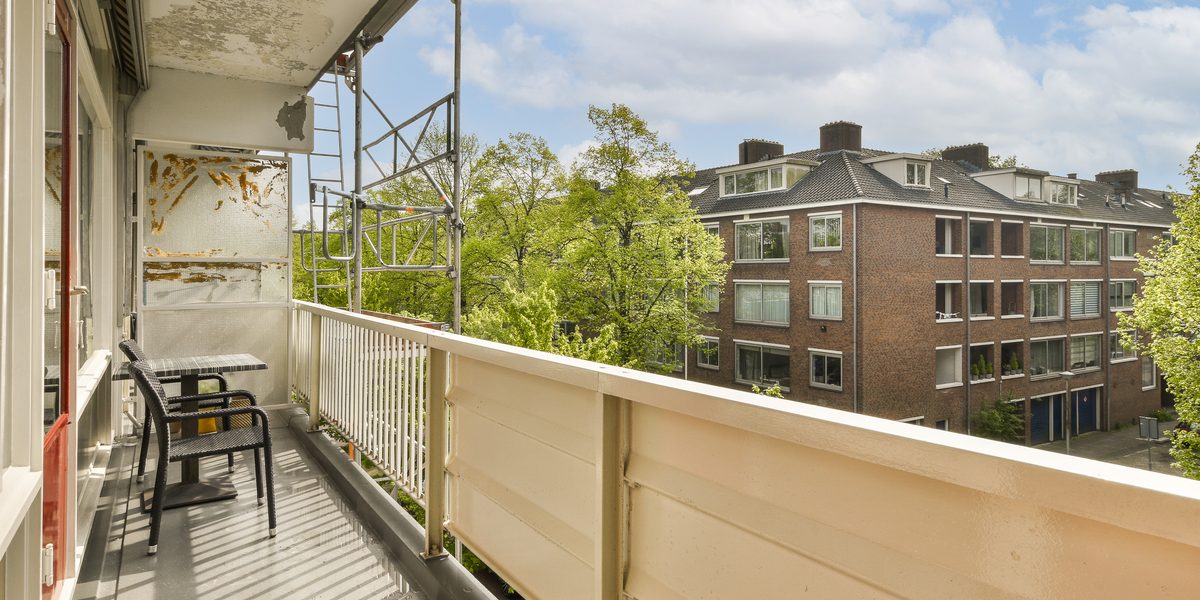
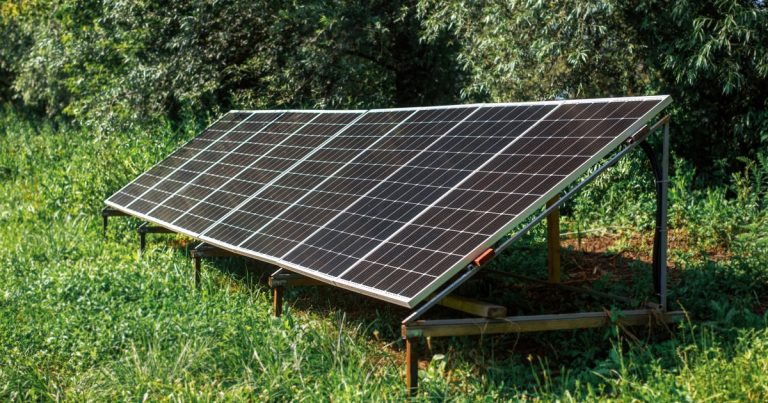
Stock photo (Freepik) for illustration only. It is not a Borizo installation, and we have not tested any product shown.
Step 4: Size the kit
Apartments tend to use less electricity than houses, and a small kit’s output is mostly used the moment it is made. EIA reports that monthly electricity use per US residential customer averaged 865 kWh in 2024, across all home types. A typical 800 W kit in our savings example makes roughly 960 kWh a year, or about 80 kWh a month, so it covers a modest share of an average bill. Check your own monthly kWh on your bill.
Stay under your state’s cap, and think about what fits and what is in the sun. Our how many panels guide covers sizing in more detail, and kit costs covers prices.
Step 5: Choose a certified kit
Several states require UL 3700 or an equivalent listing, and others require a listing from a nationally recognized testing laboratory. Confirm the certification in the lab’s own database rather than trusting a logo; our certification guide shows how. Also check that the mount fits your railing and that the cable is long enough to reach an outlet without an extension cord.
Step 6: Send a written notice or request
Whether your state requires notice or not, put it in writing. Include:
- Your name, unit and the exact location, such as the balcony railing facing the courtyard.
- The product: model, size, output in watts AC and the certification, with the supporting document.
- How it is attached: clamps or a freestanding stand, nothing drilled or wired in. Vermont requires devices to be “temporarily but securely attached.”
- The planned installation date, at least your state’s notice period away.
- Your commitments: remove it when you leave, repair any damage and show proof of insurance if asked.
Keep a copy and any reply.
Step 7: Identify your outlet’s circuit
Find which breaker feeds the outlet you plan to use, note its rating and list what else runs on it. Avoid circuits with space heaters, window air conditioners or microwaves. Apartment panels are often inside the unit, but if yours is locked or shared, ask building management. Our outlet guide explains 15 A versus 20 A circuits, GFCI outlets and why one kit per outlet matters.
Step 8: Mount the panel securely
Follow the mount’s instructions exactly, use its wind rating and torque values, and never lean over the railing to install. On upper floors, think about what is below: a sidewalk, an entrance or a neighbor’s balcony. A safety cable, if the maker allows one, adds a backup. See mounting without drilling for clamp and stand options.
Step 9: Notify the utility if required
Utility rules do not change because you rent. Virginia requires a state notice form before installing, with a 15-day review and no fee or approval. Maine requires notice above 420 W, and Colorado lets the utility require notice. Connecticut, Vermont, New Hampshire and Utah say the utility cannot require approval for a compliant device. Check our wattage limit guide for the details.
Step 10: Plug in and check it works
Plug in following the manual’s order. Many microinverters wait a few minutes after detecting a stable grid before they start sending power. Then set up the kit’s app or a plug-in energy monitor and watch output over the first sunny days. If the numbers are far below what PVWatts suggested, look for shade, a poor angle or a fault. Our monitoring guide shows what to look for.
When you move out
Plug-in kits are designed to be portable. Unplug following the manual, take the panel down, repair any marks from clamps and give the landlord notice that the device is gone. If you move to another state, check its rules before plugging in again.
Frequently asked questions
Can I put plug-in solar on my apartment balcony?
Often, yes, if your state allows plug-in solar and your lease or landlord permits it. Some states, including Vermont, Virginia and, in the bill text we read, New Jersey, limit a landlord’s ability to prohibit it but allow reasonable restrictions and require advance notice.
Do I need my landlord’s permission for balcony solar?
In most places you need permission or at least written notice. Even in states that protect renters, the landlord can set reasonable size and placement limits. Ask in writing and keep the reply.
How big a solar kit do I need for an apartment?
Usually a small one: one or two panels and an 800 W to 1,200 W microinverter, within your state’s cap. What matters most is how much sun your balcony gets and how much electricity your apartment uses during the day.
Do renters need to tell the utility?
Only where the state requires it. Virginia uses a state notice form, Maine requires notice above 420 W, and Colorado lets utilities ask for notice. Several other states say the utility cannot require approval for a compliant device.
Sources
- State laws, read October 26, 2026: Vermont Act 149, Virginia HB 395 and Code § 56-596.8, New Jersey S2368 (third reprint), Colorado HB26-1007, Maine LD 1730, Connecticut PA 26-127, New Hampshire SB 540, Utah HB 340.
- US Energy Information Administration, Today in Energy, May 12, 2025 (monthly use per residential customer averaged 865 kWh in 2024).
- NREL, PVWatts Calculator.
- Photos: stock images from Freepik, used for illustration only.

Borizo is an independent guide to plug-in and balcony solar in the US. We track state laws, check certification claims against official sources, and compare kits using published specifications. Laws change often, so every state page shows a “last updated” date and links to its sources. We earn a commission when you buy through our Amazon links, at no extra cost to you. Our content is for information only and is not legal or electrical advice.