Plug-in Solar in Winter and on Cloudy Days: What to Expect
Plug-in solar sounds like a summer product, and it is true that a balcony kit makes far more power in June than in December. But winter and cloudy days are not zero, and a kit that looks weak on a gray day can still earn its keep over a year. This guide explains what happens to output on cloudy days and in winter, why the sun’s angle matters, how snow changes the picture, what to do about it, and how to see your own winter numbers in NREL’s free PVWatts calculator before you buy. It is based on Department of Energy and NREL sources and our own arithmetic. We have not tested any kit, and the examples are illustrations, not forecasts.
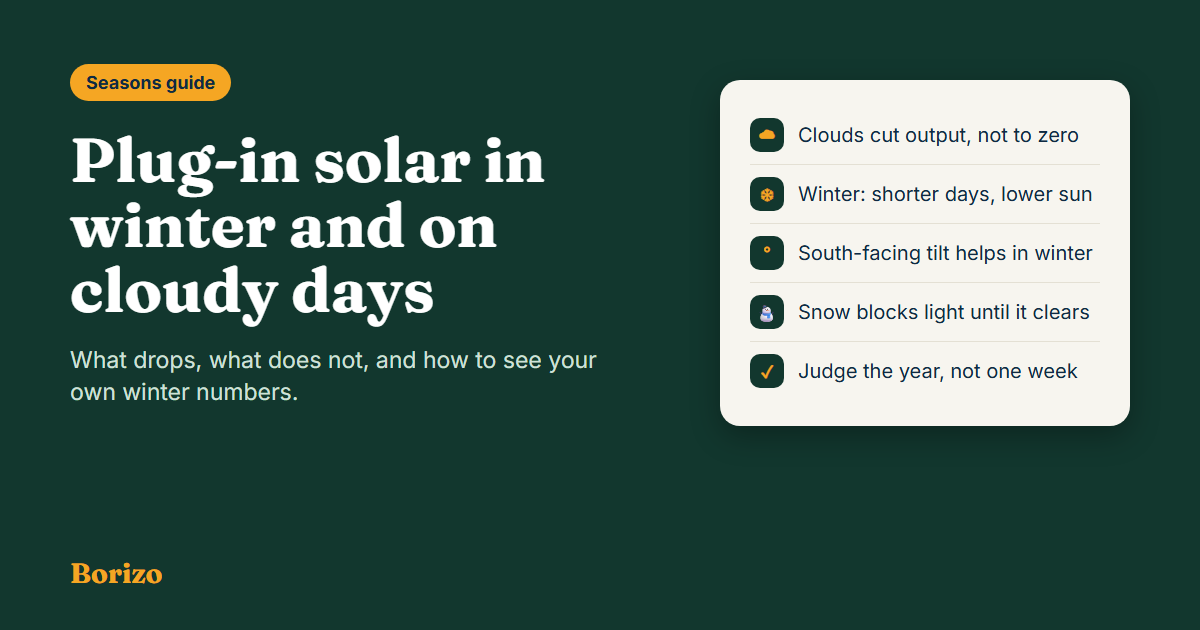
Solar panels keep producing on cloudy days, just much less, and winter output is lower because days are shorter and the sun is lower. Judge a plug-in kit on its yearly output, not a single gray week. PVWatts shows month-by-month estimates for your address, so you can see your own winter.
- Clouds cut output but do not stop it. The Department of Energy notes that cloudy days can hamper panels’ production; the drop depends on how thick the cloud is.
- Winter has fewer peak sun hours, so daily output is lower. PVWatts shows how much lower for your place.
- Direction and tilt matter more in winter, because the low sun favors a steeper, south-facing panel.
- Snow and shade add to the loss, and steeper tilts shed snow better but add wind load.
- The value is in the year: sunny months do most of the work.
What clouds do
Clouds scatter and absorb sunlight, so less reaches the panel. A panel still produces power from the diffuse light that gets through, which is why a kit does not shut off when the sun goes behind a cloud. The Department of Energy’s science office notes that cloudy days can hamper solar panels’ ability to produce electricity, and we did not find an authoritative percentage for a typical overcast day from DOE, EIA or NREL, so we do not quote one. The drop varies widely with how thick the cloud is, and a thin haze costs far less than a dark storm. A few implications:
- A single gray day tells you little about the year. Look at monthly or yearly totals.
- Your kit’s app may show a very small output at dusk or in heavy cloud. That is normal, not a fault, though persistent very low readings in clear weather can point to shade, dirt or a problem to check with the maker.
- Cloudy places can still be good for solar. NREL’s PVWatts and its solar resource data are built from long-term weather records for each location, so the yearly estimate already includes typical clouds for your area.
Why winter output is lower
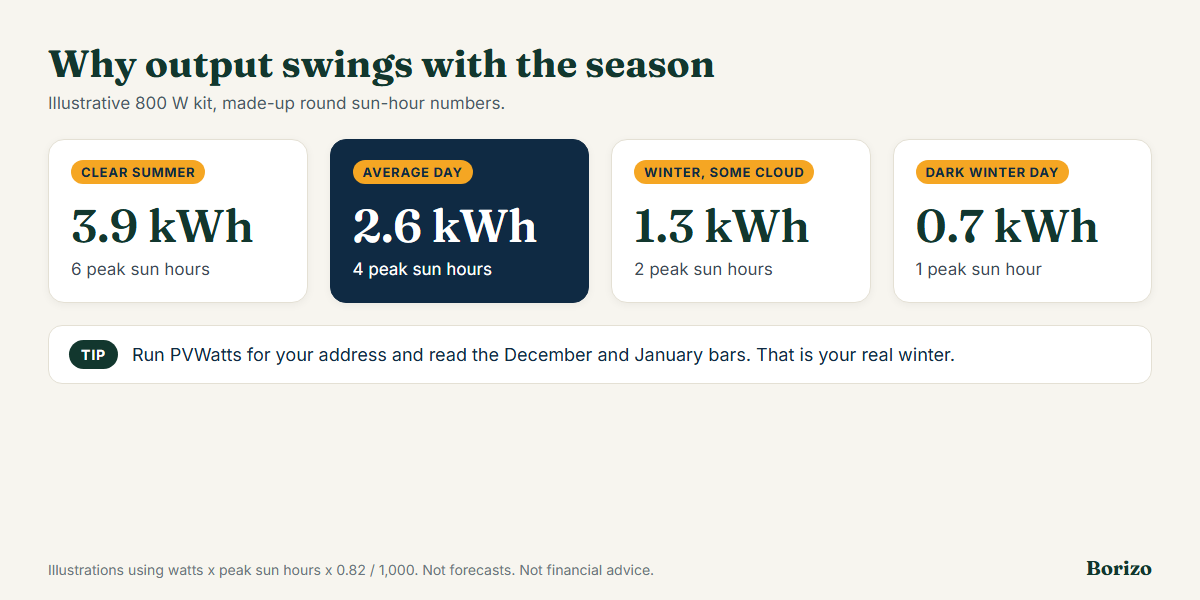
Three things combine in winter: shorter days, a lower sun and, in many places, more cloud. Peak sun hours, the measure of a day’s total sunlight, fall, and a lower sun means light reaches a vertical railing panel at a different angle. Using our shortcut (watts × peak sun hours × 0.82 ÷ 1,000 = kWh per day), here are illustrations for an 800 W kit with made-up round sun-hour numbers to show the shape, not a forecast for any place:
| Illustrative day | Peak sun hours | 800 W kit, kWh per day |
|---|---|---|
| Clear summer day | 6 | about 3.9 kWh |
| Average day | 4 | about 2.6 kWh |
| Winter day, some cloud | 2 | about 1.3 kWh |
| Dark winter day | 1 | about 0.7 kWh |
These numbers are examples, using the method in how much a balcony panel makes per day. Your own winter value could be higher or lower. In PVWatts, enter your address, size, tilt and direction and look at the monthly chart: the December and January bars are your real winter.
Direction and tilt matter more in winter
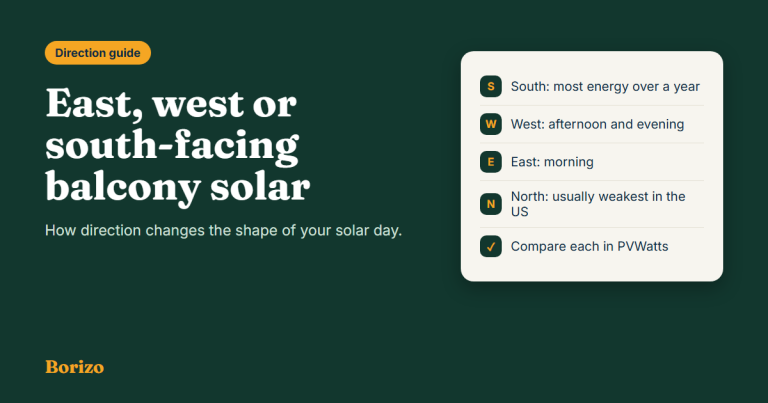
EIA says the simplest way to maximize the annual output of a fixed panel in the Northern Hemisphere is to tilt it south, and that tilt tends to rise with latitude. In winter the sun sits low in the southern sky, so a steeper south-facing panel meets it better than a flat one. A vertical railing mount may lose less in winter than it does in summer for that reason, though we cannot give you a number for your site. For details, see the best angle for a balcony panel and east, west and south-facing balconies. Also check shade in winter: low sun makes longer shadows from buildings and trees. See how shade affects balcony solar.
Snow, ice and cold
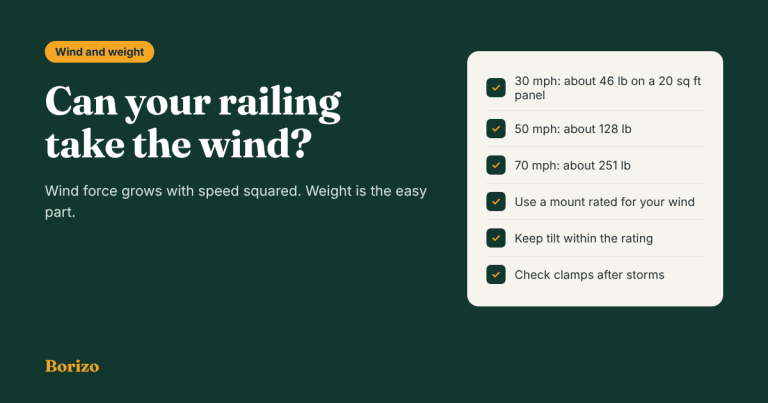
- Snow cover blocks light. A panel covered in snow makes little or nothing until it clears. The Department of Energy’s guidance notes that steeper tilts, up to 60°, are more effective at shedding snow and hail, but they also increase wind load. A near-vertical panel may shed snow more easily, though we have not tested any mount.
- Do not climb or scrape on a balcony or over a drop. Follow the manual for clearing snow, and never use a tool that could scratch the glass or injure someone below. If you are not sure it is safe, leave it.
- Ice and wind. Winter storms are when mounts are tested. Inspect clamps and straps afterward. See mounting without drilling.
- Cold itself. We did not find a source in our research that puts a number on cold-weather performance for plug-in kits, so we do not claim one. Check the manual’s operating temperature range.
Is it still worth it?
Look at the whole year. If your winter months are dark and your summer months are sunny, the sunny months do most of the work, and the yearly total is what the PVWatts estimate gives. Then compare it with your price per kWh in the savings and payback calculator, and read is plug-in solar worth it. If your electricity rates are higher in winter, or you use more power then, the value of winter kilowatt-hours may be higher than the yearly average suggests. Check your bill.
A kit also keeps working in a grid-tied way only while the grid is up. See plug-in solar in a power outage, since winter storms and outages often go together.
Getting more from the dark months
- Keep the panels clear and clean, following the manual, since dirt and leaves add to the loss when light is already low.
- Re-check the shade. If a shadow now covers the panel at noon, moving it a short distance may help.
- Use the power when it is made. A smaller number of winter kilowatt-hours is worth more if you use them yourself; daytime loads such as a home office, a dehumidifier or a fridge help.
- Set expectations. A kit that makes a third or less of its summer output in a bad month is not broken. Compare it with PVWatts’ figure for that month, not the nameplate.
- Do not chase small gains at the cost of safety. Re-tilting a panel on a balcony in winter wind is not worth a fall or a dropped panel.
A simple winter check
- Run PVWatts for your address and note December and January output.
- Compare with your summer months to see the swing.
- Check your winter shade with a quick survey, ideally on a clear winter day.
- Check the manual for operating temperature, snow guidance and storm instructions.
- Decide on the yearly numbers, not the worst month.
Frequently asked questions
Does plug-in solar work on cloudy days?
Yes, but at much lower output. Panels still make power from diffuse light. How much depends on the thickness of the cloud, and yearly estimates from PVWatts already include typical weather for your area.
How much less does it produce in winter?
It depends on your latitude, direction, tilt and weather. Winter days have fewer peak sun hours, so output per day is lower. PVWatts shows month-by-month estimates for your address.
What about snow on the panels?
Snow blocks light until it melts or slides off. Steeper tilts shed snow better but add wind load. Follow the manual for clearing it and do not put yourself at risk on a balcony.
Is plug-in solar worth it in a cloudy or northern state?
It can be, especially where electricity is expensive, but the yearly estimate for your address is the test. Run PVWatts and compare the output with your rate.
Sources
- US Department of Energy, 5 Ways to Get Sunshine on a Cloudy Day (cloudy days can hamper solar production).
- US Department of Energy FEMP, Install and Commission a Photovoltaic System (steeper tilts shed snow and hail but increase wind load).
- US Energy Information Administration, Solar photovoltaic output depends on orientation, tilt, and tracking (south tilt; tilt rises with latitude).
- NREL, PVWatts Calculator and PVWatts Version 5 Manual (monthly estimates, default losses).

Borizo is an independent guide to plug-in and balcony solar in the US. We track state laws, check certification claims against official sources, and compare kits using published specifications. Laws change often, so every state page shows a “last updated” date and links to its sources. We earn a commission when you buy through our Amazon links, at no extra cost to you. Our content is for information only and is not legal or electrical advice.