Average US Home Electricity Use: What Plug-in Solar Can Cover
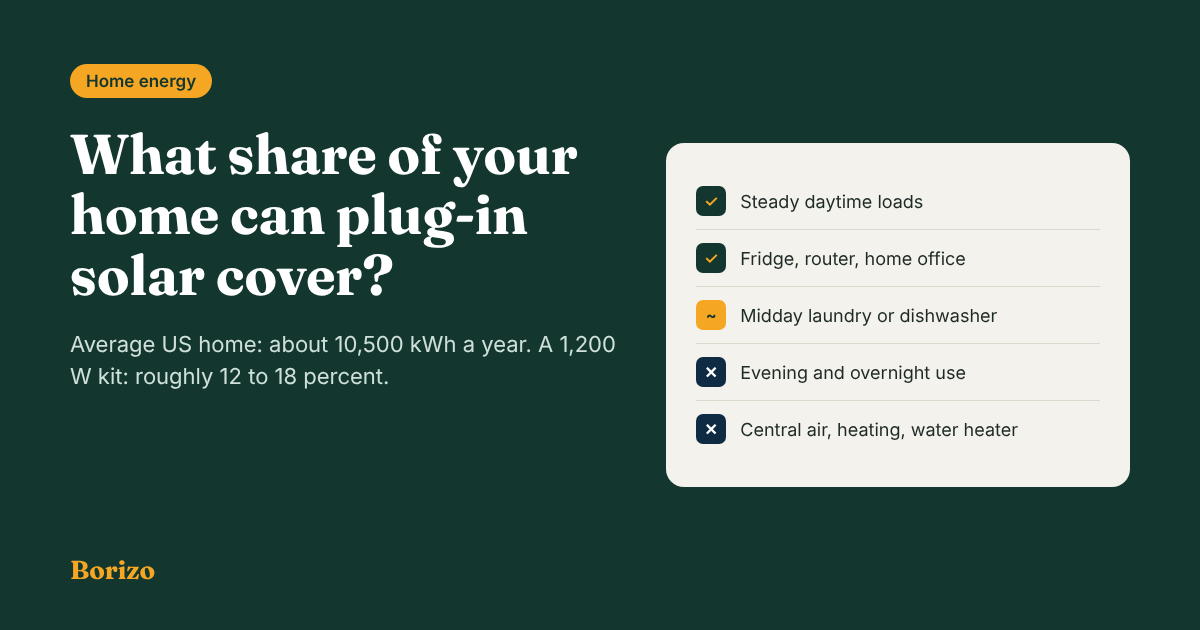
The average US home uses about 10,500 kilowatt-hours (kWh) of electricity a year, or about 875 kWh a month. A plug-in solar kit at the common US size of about 1,200 watts typically makes roughly 1,300 to 1,900 kWh a year in good, unshaded spots, which is about 12 to 18 percent of that average. It can cover a bigger share of a small apartment’s use, but it will not power a whole average home on its own. This guide shows where those numbers come from, why timing matters more than the yearly total, and how to work out your own share. Figures are spec-based estimates from public data and calculators, not hands-on tests of any product.
A 1,200 W plug-in kit usually covers about one-eighth to one-fifth of an average US home’s yearly electricity. The share you can actually use is often lower, because solar peaks at midday while many homes use the most power in the evening. Start from your own 12 months of bills, not the national average.
- About 10,500 kWh a year is the average US household’s use, according to the EIA. That is roughly 29 kWh a day.
- A 1,200 W kit makes roughly 1,300 to 1,900 kWh a year in good conditions; shade and a poor direction cut that.
- Timing beats totals. Power made while nobody is using it may earn little or no credit.
- Big loads are out of reach. Air conditioning, heating and water heating run at the wrong time, too hard, or both.
- Check your state first. Plug-in solar is clearly allowed only in some states.
What plug-in solar is
Plug-in solar, often called balcony solar, is a small kit of one or two panels and a microinverter that plugs into a standard 120-volt household outlet. The panels usually go on a balcony railing, a patio, a deck or a small ground stand. While the sun shines, the kit feeds electricity into your home wiring, so you draw less from the grid at that moment.
It is designed to offset part of your use, not to replace your grid connection. It does not make a home off-grid, and a standard grid-tied kit shuts off during a power outage for safety.
How much electricity does the average US home use?
The US Energy Information Administration (EIA) says the average US household uses about 10,500 kWh of electricity a year, on its page Electricity use in homes. That is about 875 kWh a month and about 29 kWh a day.
The national average hides wide variation. The EIA notes that use differs by region and housing type: apartments in the Northeast use the least on average, and single-family homes in the South use the most. A small apartment with gas heat may use far less than 875 kWh a month, while a large all-electric home with central air may use far more.
Where the power goes also matters. The EIA puts air conditioning at about 19 percent of home electricity use in 2020, and space heating and water heating at about 12 percent each. Much of that heating and cooling happens in the evening or overnight, when panels make little or nothing. Your own bill is a better starting point than the national average: add the kWh from your last 12 bills. Our guide on how to read your electric bill before buying solar shows where to find that number.
What a 1,200 W plug-in kit can realistically cover
In the states that have created a category for plug-in solar, the limit is usually about 1,200 W of output (see our plug-in solar wattage limit guide). That cap limits how much power the kit can make at any moment. A 1,200 W kit cannot run a whole home at once, because many homes briefly draw more than that when several loads run together.
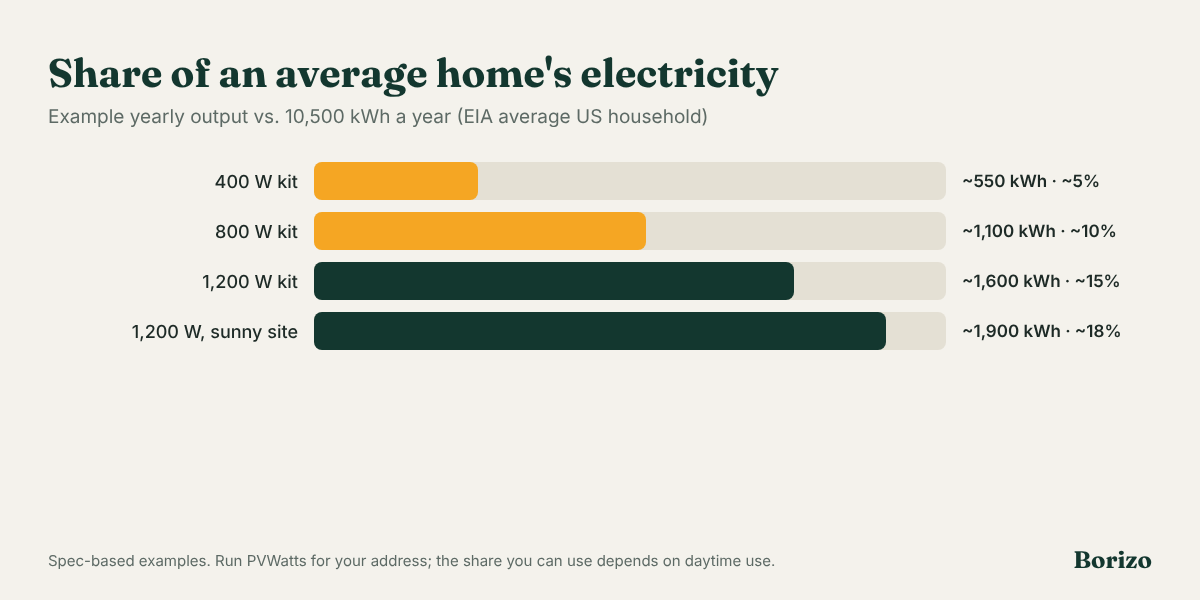
Yearly output is a different question. A well-placed system often makes roughly 1,100 to 1,600 kWh a year for each kilowatt of capacity, depending on sunshine and direction, or about 1,300 to 1,900 kWh a year for a 1,200 W kit. A shaded, north-facing or nearly vertical balcony will make less. To check your address, use the PVWatts Calculator: enter 1.2 kW, your real panel direction and a realistic tilt. Treat the result as a planning estimate, not a guarantee.
The table uses example yearly outputs for each kit size. The shares are simple division: yearly solar output divided by yearly home use.
| Kit size | Example yearly output | Share of an average home (10,500 kWh) | Share of a smaller home (6,000 kWh) |
|---|---|---|---|
| 400 W, one panel | About 550 kWh | About 5% | About 9% |
| 800 W, two panels | About 1,100 kWh | About 10% | About 18% |
| 1,200 W, the common US limit | About 1,600 kWh | About 15% | About 27% |
Read the table as a range, not a promise. If your PVWatts result for 1,200 W is 1,300 kWh, the share for an average home falls to about 12 percent; at 1,900 kWh it rises to about 18 percent. For a different number of panels, see how many panels you need.
Why timing matters more than the yearly total
Solar panels make the most power in the middle of the day. Many homes use the most power in the morning and evening. That mismatch is the main reason a plug-in kit often offsets less of your bill than its yearly total suggests.
Daytime loads are a good match: a refrigerator runs all day, a home office runs during working hours, and a dishwasher or washing machine can sometimes run at midday. Evening lighting, cooking, TV and overnight heating or cooling are a poor match unless you add storage, which most basic kits do not include.
Export rules matter too. Under some plug-in solar laws, extra power sent to the grid is not credited the way rooftop solar is under net metering. Power you do not use when it is made may have little or no bill value. Our guide on what happens to extra power from plug-in solar explains the options.
What plug-in solar can and cannot cover
It can help with steady daytime loads and part of your daytime bill. If you work from home or can run appliances at midday, it can make a noticeable dent in daytime grid use. Our list of what appliances plug-in solar can run goes through common loads one by one.
It cannot reliably cover central air on its own, an electric water heater, or electric heating on a cold evening. Those loads are too large, run at the wrong time, or both. It also is not backup power in an outage unless the product is designed and certified for that, which a standard grid-tied kit is not.
Is plug-in solar legal where you live?
Plug-in solar is clearly allowed only in some US states, and the rules are still changing. A kit being sold online does not make it legal to plug in where you live. Check your state law, your utility’s rules, and any landlord or HOA rules before you buy. Our state laws hub tracks each state with links to the enacted text.
Utah is an example. Its 2025 law, H.B. 340, created a category for a portable solar device of up to 1,200 W that connects through a standard 120-volt outlet. Other states use a similar figure, but details on certification, landlord permission, utility notice and export credit differ. Look for a kit certified by a nationally recognized testing laboratory; our UL 3700 guide explains what to look for.
Renters and homeowners: different checks
Renters often gain the most from plug-in solar because it needs no roof, but they also face the most permission questions. Get written permission before mounting anything on a railing or wall, and check whether your lease bans exterior equipment, limits railing weight or requires removal when you move out. Our renters and HOA guide covers this.
Homeowners have fewer landlord questions but still need to check association rules, deck or balcony weight limits and any utility requirements. For both, confirm legality and permission first, then compare kit specifications and prices.
How to estimate your own coverage in four steps
- Find your yearly use. Add the kWh from your last 12 bills. If you have only one bill, multiply a typical month by 12 and treat the result as rough.
- Run PVWatts for your address. Use a 1.2 kW system (or your kit size), your real direction and a realistic tilt.
- Estimate daytime use. If most of your use is in the evening, plan on a lower usable share than the PVWatts total suggests.
- Apply your own rate. Multiply only the kWh you expect to use at home by the energy rate on your bill. The EIA’s 2025 average was 17.30 cents per kWh, but yours may differ. Our savings and payback calculator does the math.
Common mistakes
- Treating yearly output as bill savings. Power made when no one is home, or exported without credit, may save little or nothing.
- Buying before checking state rules. A kit allowed in Utah may not have the same status in your state.
- Ignoring direction and shade. A north-facing or shaded balcony makes far less than a sunny south-facing one. See east vs west vs south facing balconies.
- Expecting whole-home power or backup. A 1,200 W kit is a partial offset, and a standard grid-tied kit stops during an outage.
- Counting incentives that do not apply. Check a rebate, tax credit or export payment on the official program page before adding it to your math.
- Confusing panel watts with inverter watts. A kit may list more panel watts than its inverter can deliver. For state limits, the output rating is what counts.
Frequently asked questions
How much electricity does the average US home use?
About 10,500 kWh a year, or about 875 kWh a month, according to the EIA. Your last 12 bills give the best figure for your own home.
What share will a 1,200 W plug-in kit cover?
In good, unshaded conditions, roughly 12 to 18 percent of an average home’s 10,500 kWh a year, based on about 1,300 to 1,900 kWh of yearly output. For a home using 6,000 kWh a year, the same output is about 22 to 32 percent, but the usable share depends on daytime use.
Can plug-in solar power my whole home?
No, not at the common 1,200 W limit. It can offset part of your daytime use, especially steady loads like a refrigerator and home office equipment, but it cannot meet whole-home peak loads or evening and overnight use.
Is plug-in solar legal in every US state?
No. It is clearly allowed only in some states, and size limits, certification rules and renter or HOA protections differ. Check your state law and utility rules before you buy or plug in a kit.
Do I need a south-facing balcony for plug-in solar to be worth it?
South-facing is usually best, but east- or west-facing panels can still make useful daytime power. Run PVWatts with your real direction and shade before deciding, and be cautious if your only space is heavily shaded or faces north.
The bottom line
Start with your own numbers, not a headline percent. For a home using about 10,500 kWh a year, a well-placed 1,200 W kit is a partial daytime offset of roughly one-eighth to one-fifth of yearly use. If you use less, live somewhere sunny, face south and use power during the day, the share is higher. If you are shaded or use most power at night, it is lower. Check your state, get permission in writing if you rent, choose a certified kit within your state’s limit, and run PVWatts for your address before you buy.
Sources
- US Energy Information Administration, Electricity use in homes (average household about 10,500 kWh a year; air conditioning 19%, space heating 12%, water heating 12% of residential electricity use in 2020), read October 27, 2026.
- US Energy Information Administration, Electricity explained: prices and factors affecting prices (average residential price 17.30 cents per kWh in 2025).
- PVWatts Calculator, pvwatts.nlr.gov (output estimates by address).
- Utah Legislature, H.B. 340 Solar Power Amendments, enrolled text (1,200 W portable solar device, 120 V outlet).

Borizo is an independent guide to plug-in and balcony solar in the US. We track state laws, check certification claims against official sources, and compare kits using published specifications. Laws change often, so every state page shows a “last updated” date and links to its sources. We earn a commission when you buy through our Amazon links, at no extra cost to you. Our content is for information only and is not legal or electrical advice.