Plug-in Solar vs Portable Power Station: Which Do You Need?
Plug-in solar and portable power stations are often sold side by side, and both can sit on a balcony next to a solar panel. They solve different problems, though. A plug-in solar kit sends power into your home circuit to cut your electric bill, and it switches off when the grid goes down. A portable power station is a battery in a box: it keeps a few devices running during an outage or on a camping trip, but on its own it does little for your bill. This guide explains how each one works, what each can and cannot do, the safety and legal points that apply to each, and how to decide which one fits your situation. It is a spec-based comparison from public sources. We have not tested any product.
- Plug-in solar lowers your bill. A power station keeps things running in a blackout. Few single products do both well.
- A grid-connected plug-in kit is designed to stop producing when grid power is lost, so it will not power your home during an outage. That is a safety feature, not a defect.
- A power station stores energy and powers only what you plug into it. Charged from the wall, it saves you nothing.
- Plug-in solar falls under new state laws (10 states so far, usually up to 1,200 W). A power station is an appliance, with no utility notice or wattage law.
- Never connect a power station or generator to your home wiring through a wall outlet. The CPSC warns this “backfeeding” can electrocute utility workers.
- Look for certification on both: UL 3700 or an equivalent for plug-in solar, and UL 2743 (portable power packs) for power stations.
What each one is
Plug-in solar (balcony solar)
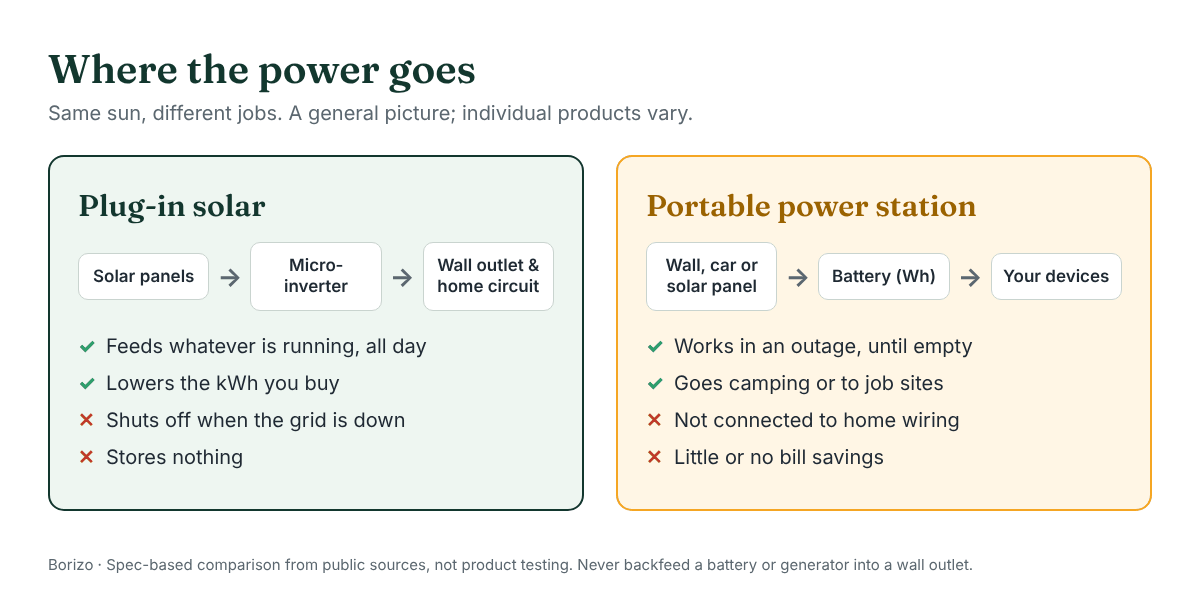
A plug-in kit is one to a few solar panels with a microinverter that turns their DC power into AC power matched to the grid. You plug it into a standard outlet, and the power flows into that circuit, where it feeds whatever is running at that moment: the fridge, a router, a TV. Your meter spins more slowly, so you buy fewer kilowatt-hours. Power that your home is not using at that moment flows out to the grid. See wattage limits and circuit safety for how the power flows and why size limits exist.
Portable power station
A portable power station is a rechargeable lithium-ion battery with built-in AC outlets, USB ports and often a car-style 12 V socket. You charge it from a wall outlet, a car or portable solar panels, and you plug devices into it. It does not connect to your home wiring, and it does not feed the grid. Its job is to store energy and hand it back later, wherever you are.
Side-by-side comparison
| Plug-in solar kit | Portable power station | |
|---|---|---|
| Main job | Lower your electric bill | Backup and portable power |
| Works in a power outage? | No. Designed to shut off when the grid is down | Yes, until the battery runs out |
| Stores energy? | No (unless paired with a battery system) | Yes, that is its purpose |
| Connects to home wiring? | Yes, through an outlet, under state rules | No. Devices plug into the station |
| Lowers your bill? | Yes, by the kWh your home uses from it | Barely, unless charged from solar |
| Key size number | Watts of output (often up to 1,200 W by state law) | Watt-hours of capacity and watts of output |
| State law and utility | Covered by plug-in solar laws in 10 states; rules vary | No plug-in solar law applies; it is an appliance |
| Safety standard to look for | UL 3700 or equivalent (state rules vary) | UL 2743, portable power packs |
| Moves with you? | Yes, but needs a mount and a sunny spot | Yes, it is made to be carried |
The outage question: why plug-in solar goes dark
This is the point that surprises most buyers. The US Department of Energy explains that grid-connected solar systems “generally depend on the electrical grid to produce power” and that, “for safety reasons, they’re designed to switch off if the grid power cuts out.” To keep producing on its own, a system needs a properly configured inverter and a storage system, such as a battery, that can run in “islanded” mode.
The reason is the people repairing the lines. If a home system kept pushing power into a dead grid, it could energize wires that crews expect to be safe. Several state laws write this in: New Jersey’s Garden State Balcony Solar Act requires a feature that prevents export during an outage, and Vermont requires plug-in devices to be installed and operated to IEEE 1547-2018, the US standard for equipment connected to the grid. See our certification guide for what UL 3700 checks.
So if your main worry is keeping the fridge and phones going in a storm, a plug-in kit alone is the wrong tool.
The savings question: why a power station saves little
A power station only moves energy through time. If you charge it from a wall outlet, you pay for that electricity, and a bit more is lost to charging and inverter losses before you use it. It can save money in a few cases: when you charge it from portable solar panels and actually use that energy, or on a time-of-use plan where you charge when power is cheap and use it when it is expensive. Those savings are usually small, because you can only use the energy by plugging devices into the station one by one.
A plug-in kit, by contrast, offsets whatever is running on the circuit, all day, without you doing anything. For the numbers, see plug-in solar savings and payback. An 800 W kit with 4 peak sun hours makes roughly 960 kWh a year in our example.
How to size a power station
Two numbers matter on a power station’s spec sheet:
- Output in watts (W). The most power it can deliver at once. Add up the running watts of everything you want to plug in at the same time. Motors, such as those in a fridge or pump, can need a short surge above their running watts, so check the station’s surge rating too.
- Capacity in watt-hours (Wh). How much energy it holds. Divide capacity by your load in watts for a rough runtime: a 1,000 Wh station running a 100 W load lasts up to about 10 hours, minus conversion losses. Usable energy is less than the rated capacity, so check the manual.
- Recharging. Check how fast it charges from the wall and how many watts of solar input it accepts, which decides how quickly a portable panel can refill it on a cloudy day.
A generator sizing tool such as the Generator Size Calculator helps you add up running and starting watts for a list of appliances. The same totals tell you what output rating a power station needs.
What about solar batteries for balconies?
Some products combine the two ideas: a balcony battery with a built-in grid-tied microinverter. EcoFlow’s STREAM series, launched for US apartments starting in Utah, is one example. Solar Builder described the STREAM Ultra as “a 1.92 kWh solar battery with a built-in grid-tied microinverter” that sends up to 1,200 W to the home and stores extra solar for later. That storage can raise how much of your solar you use at home, which helps savings.
Whether a product like this also gives you backup power in an outage is a separate question. The grid-tied output still has to stop during an outage, so backup depends on whether the unit has its own off-grid outlets that keep working. Do not assume it does. Read the manual, and check that the product’s certification fits your state’s plug-in solar law.
Safety and the law
Plug-in solar
- State law. Ten states have passed plug-in solar laws so far, most with a 1,200 W limit and a certification requirement. Check your state before you buy, and see wattage limits.
- Renters and HOAs. Landlord and association rules still apply in many places. See renters and HOAs.
- Certification. Look for a listing from a nationally recognized testing laboratory, and check the claim yourself. See how to check a certification claim.
Portable power stations
- Battery fire risk is real. The CPSC announced a recall of about 5,740 HALO 1000 portable power stations in August 2024, after four fire reports and one death from smoke inhalation. In September 2025 it warned consumers to stop using Aeiusny 400 W and 500 W power stations, sold on Amazon, after 24 reports of fires and explosions. Search CPSC recalls for any model before you buy.
- Certification. UL 2743 is the safety standard for portable power packs with lithium-ion or lead-acid batteries. Look for a listing from a recognized lab, not just a logo.
- Never backfeed. The CPSC says: “NEVER try to power the house wiring by plugging the generator into a wall outlet, a practice known as ‘backfeeding,'” because it “presents an electrocution risk to utility workers.” The same danger applies to a power station connected with a double-male cord. Powering home circuits takes a transfer switch or inlet installed by a licensed electrician.
- No fumes. Unlike a gas generator, a battery station does not make carbon monoxide, so it can be used indoors. Keep it away from heat, and charge it where you can see it.
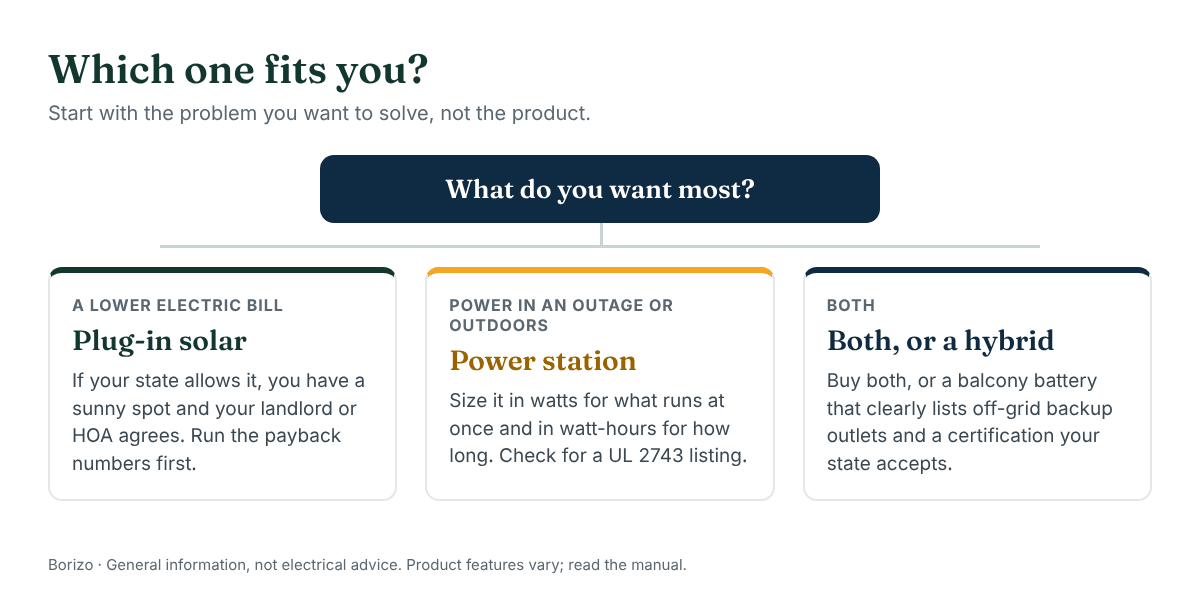
Which one should you buy?
You want a lower bill
Choose plug-in solar, if your state allows it and you have a sunny spot. Use our payback calculator first.
You want outage or camping power
Choose a portable power station sized to your devices. A folding solar panel lets you recharge it without the grid.
You want both
Buy both, or look at a balcony battery system that clearly lists off-grid backup outlets and a certification your state accepts.
Frequently asked questions
Does plug-in solar work during a power outage?
No. A grid-connected plug-in kit is designed to stop producing when grid power is lost, so it does not energize lines that repair crews are working on. Some laws, such as New Jersey’s, require this feature. For outage power you need a battery, such as a portable power station.
Can I charge a portable power station with plug-in solar?
Not directly. A plug-in kit feeds your home circuit, not a battery. You can plug the station into a wall outlet, and while the sun shines, part of that charging power is covered by your plug-in kit. Many stations can also charge straight from portable solar panels through their own solar input.
Is a portable power station worth it for saving money?
Usually not. Charged from the wall, it costs you electricity plus losses. It can save a little if you charge it from your own solar panels or on a time-of-use plan. Buy one for backup and portable power, not for bill savings.
Do I need permission to use a portable power station?
Generally no, because it is an appliance that is not connected to your home wiring or the grid. That changes if someone wires it into your home’s circuits, which needs a licensed electrician and the right equipment.
Sources
- US Department of Energy, “Solar and Resilience Basics” (grid-connected solar switches off when grid power cuts out; storage and islanded mode).
- US Department of Energy, “Solar Integration: Inverters and Grid Services Basics” (grid-following inverters disconnect during large or long disruptions).
- New Jersey Legislature, S2368, third reprint (feature preventing export during an outage) and the Governor’s signing release, September 1, 2026.
- Vermont, Act 149 (S.202) as enacted (UL 3700 or equivalent; IEEE 1547-2018).
- US Consumer Product Safety Commission, Portable Generator Hazards safety alert (backfeeding warning).
- CPSC, HALO 1000 portable power station recall, August 29, 2024.
- CPSC, warning on Aeiusny power stations, September 4, 2025.
- Standards Council of Canada, ANSI/CAN/UL 2743, Portable Power Packs (scope; superseded by the 2025 edition).
- Solar Builder, “EcoFlow launches STREAM series to bring balcony solar to the U.S.”, May 7, 2025.
- Our guides on wattage limits, certification, renters and HOAs and savings and payback.

Borizo is an independent guide to plug-in and balcony solar in the US. We track state laws, check certification claims against official sources, and compare kits using published specifications. Laws change often, so every state page shows a “last updated” date and links to its sources. We earn a commission when you buy through our Amazon links, at no extra cost to you. Our content is for information only and is not legal or electrical advice.