How Balcony Solar Works: Panel, Microinverter, Outlet
A balcony solar kit looks almost too simple: a few panels, a small box and a cable with a plug. So how does power from a panel on your railing end up running your fridge, and what stops it from flowing into the street when the grid goes down? This guide follows the electricity step by step, from sunlight on the panel to the microinverter, through the outlet and into your appliances, and explains what happens to the power you do not use, why output changes through the day, and what the kit does in a blackout. It is based on government research, safety-standard documents and manufacturer information. We have not installed or tested any kit.
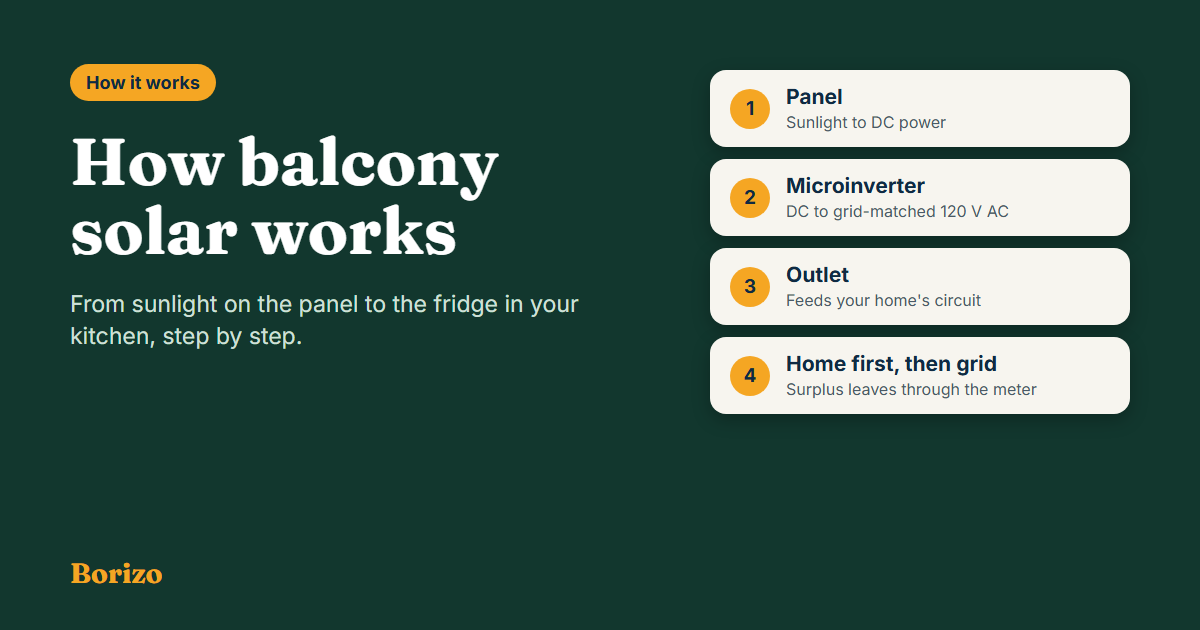
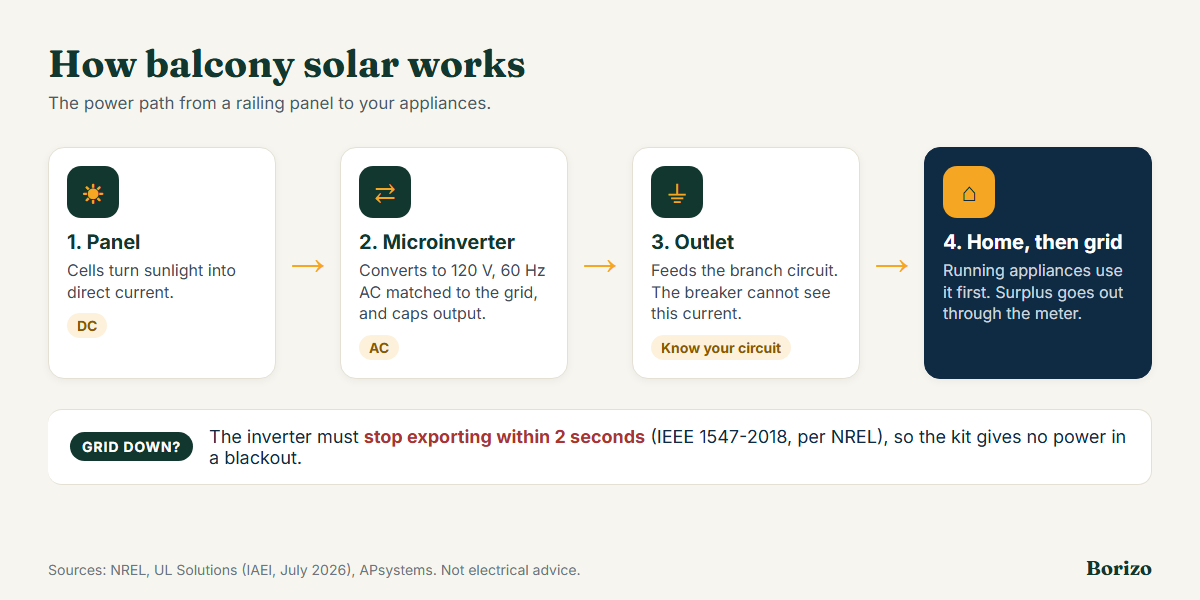
The panels make direct current, a microinverter turns it into grid-matched 120 V alternating current, and the plug feeds it into your home’s circuit. Appliances that are running use that solar power first, so less comes from the utility. If the grid goes down, the inverter stops within seconds.
- Four parts do the work: panels, a microinverter, the outlet and your home’s wiring. No battery is needed.
- The inverter is the key part. It matches the grid’s voltage and timing, limits the AC output, and shuts off when grid power is lost.
- Your own use comes first. Solar power serves whatever is running in your home. Only the surplus leaves through the meter, and it may earn little or nothing.
- Output follows the sun: highest around midday in summer, low on cloudy days, zero at night.
- The circuit is the main safety issue, because the breaker in your panel cannot see the current the kit adds at the outlet.
The power path in four steps
1. The panels turn sunlight into DC power
Each solar panel is a set of cells that produce direct current (DC) when light hits them. A panel’s watt rating, such as 400 W, is measured under standard laboratory test conditions. On a real balcony it usually delivers less, because the sun is not always strong or straight on, the panel gets warm, and some light is blocked by railings, trees or other buildings.
A useful way to think about a day of sun is peak sun hours: the number of hours of full-strength sunlight a day’s light adds up to. Four peak sun hours does not mean four hours of sun. It means the whole day’s light equals four hours at full strength. NREL’s free PVWatts calculator estimates this for your address, tilt and direction.
2. The microinverter makes grid-ready AC power
Your outlets carry alternating current (AC) at about 120 V, switching direction 60 times a second. The microinverter is the small box, usually clipped behind a panel, that converts the panels’ DC into AC that matches the grid. It does three more jobs that matter:
- It tracks the best operating point. Most microinverters adjust continuously to get the most power from each panel as light changes. APsystems, for example, says its EZ1 takes one or two panels and tracks each one independently.
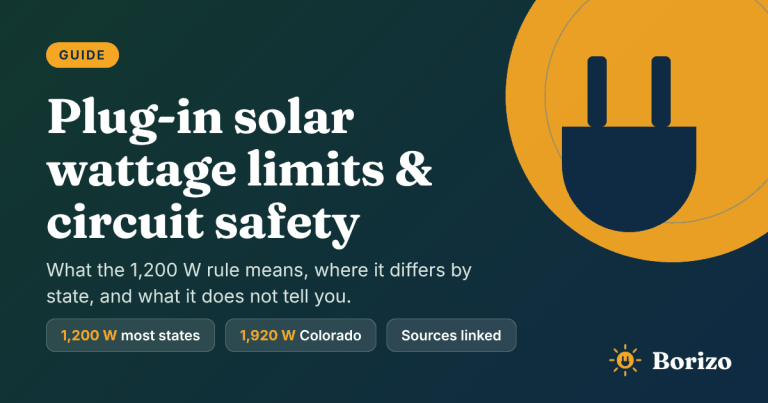
- It sets the AC output. The inverter’s AC rating is the ceiling on what reaches the outlet, and it is the number most state laws count. If the panels can make more than the inverter allows, the extra is simply not used. Most US state laws we have read cap this at 1,200 W; see our wattage limit guide.
- It watches the grid. It only exports while it senses normal grid voltage and frequency, and it stops when they disappear (step 4 below).
Because the inverter decides what the kit may do, it is also what the certification covers. State laws require UL 3700, a comparable standard, or listing by a nationally recognized testing laboratory. APsystems says its EZ1 is certified to UL 3700 and meets UL 1741 SB requirements. Check any claim in the lab’s own directory; our UL 3700 guide shows how.
3. The plug feeds the power into your circuit
The AC cable plugs into a normal wall outlet. From there, the solar power joins the wires of that branch circuit, which connect to the other outlets on the same breaker and back to your electrical panel. Electricity flows to whatever is drawing power. If the fridge on the same circuit is running, the kit’s power goes there first. If not, it travels back through the panel to other circuits in your home.
This is the part safety experts focus on. UL Solutions, which wrote the UL 3700 standard, notes that home branch circuits are designed for one-way power flow from the panel to the load. The breaker only measures the current coming from the panel, not the current the kit adds at the outlet, so the wire between the kit and a large appliance could carry more than its rating without the breaker tripping. That is the reason for state caps, for one kit per outlet, and for Maine’s dedicated-circuit rule above 420 W. See the diagram in our circuit safety guide and step 7 of the installation checklist.
4. Your home uses it first, and the surplus goes to the grid
Your home’s electrical system works like a shared pool. At every moment, the appliances that are running draw power, and the kit adds some. If the kit makes less than your home is using, all of it is used at home and the utility supplies the rest. If the kit makes more than your home is using, the extra flows out through your meter to the grid.
What happens to that surplus depends on your meter and your utility, not on the kit. It may be credited, paid at a low rate, or not paid at all, and how it is recorded depends on the type of meter you have. We have not found a promise of payment for exported power in the state texts we read, so ask your utility. For savings, what counts is the solar power you use at home.
A sunny day, hour by hour
Here is an illustration for an 800 W kit on a south-facing balcony on a clear day, in a home with a fridge, a router and a laptop running. The numbers are our own round examples, not measurements.
| Time | Kit output | Home is using | Used at home from solar | Sent to the grid | Bought from the utility |
|---|---|---|---|---|---|
| 7 am | 50 W | 400 W (coffee, lights) | 50 W | 0 W | 350 W |
| 10 am | 450 W | 250 W | 250 W | 200 W | 0 W |
| 1 pm | 700 W | 1,300 W (microwave on) | 700 W | 0 W | 600 W |
| 4 pm | 350 W | 300 W | 300 W | 50 W | 0 W |
| 8 pm | 0 W | 600 W (cooking, TV) | 0 W | 0 W | 600 W |
Two things stand out. Even near noon the kit stays below its 800 W rating, and the hours with surplus are the ones where your home uses little. Shifting flexible loads into the middle of the day, such as a dishwasher, laundry or a dehumidifier, raises the share you use yourself. Our savings and payback calculator lets you set that share.
What happens in a power outage
When the grid goes down, a grid-tied inverter must stop exporting. Otherwise it could keep a dead line energized, a situation engineers call an unintentional island, which can endanger utility crews and damage equipment. NREL’s primer on the IEEE 1547-2018 interconnection standard says the inverter must cease to energize and trip within 2 seconds after an island forms. Virginia’s plug-in law and New Jersey’s bill both require a feature that prevents export during an outage.
So a balcony kit does not keep your lights on in a blackout. When power returns, the inverter waits before starting again; APsystems says the EZ1 restarts only after grid power has been stable for five minutes. If backup power is the goal, compare plug-in solar with a portable power station.
One more safety point from UL Solutions: the blades of a kit’s plug can be energized when the panels are in sunlight. Follow the manual’s order for connecting and disconnecting, and never touch the prongs.
What decides how much it makes
| Factor | Effect | What you can do |
|---|---|---|
| Direction | South-facing gets the most sun across the day in the US; east and west shift output to morning or afternoon | Run PVWatts with your real azimuth |
| Tilt | A panel hanging flat against a railing catches less midday sun than one tilted toward the sky | Use an adjustable mount where the rules allow it |
| Shade | Even partial shade on one panel cuts its output | Check the spot at several times of day before buying |
| Season and weather | Longer, sunnier summer days produce much more than short winter days | Judge the kit on a full year, not one week |
| Heat | Panels lose some output as they get hot | Leave airflow behind the panel |
| Inverter limit | Output above the AC rating is cut off | Match panel watts to the inverter, within your state’s cap |
NREL’s PVWatts defaults assume about 14% system losses, including 3% for shading and 2% for soiling. A railing-mounted panel in partial shade can lose much more. For a rough yearly figure, our shortcut is panel watts × peak sun hours × 0.30 = kWh per year, so an 800 W kit with 4 peak sun hours makes about 960 kWh. Our sizing guide explains where that comes from.
Where a battery fits
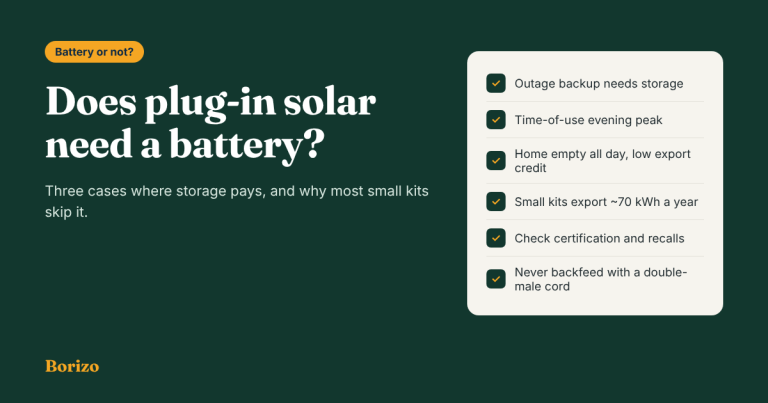
Some kits add a battery between the panels and the outlet. Instead of sending midday surplus to the grid, the battery stores it and releases it in the evening, which raises the share of solar you use yourself. It also adds cost, and whether a battery system can power anything during an outage depends on its design, so read the manual rather than assuming it can. A battery does not change your state’s output cap.
Common misunderstandings
- “It powers only what is plugged into it.” No. The kit feeds the whole home’s wiring through the outlet. Power reaches any running appliance, not just one on a nearby outlet.
- “An 800 W kit makes 800 W all day.” No. That is a peak rating. Real output rises and falls with the sun and is zero at night.
- “It is backup power.” No. It shuts off when the grid goes down.
- “More panels always means more savings.” Only up to the inverter’s limit and your state’s cap, and only if you use the power at home.
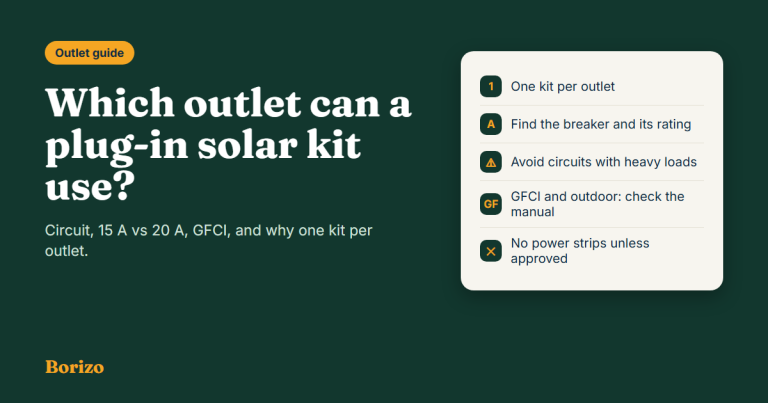
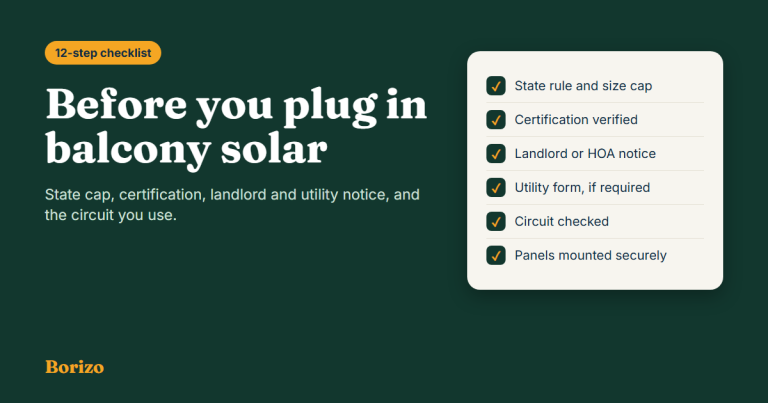
- “Any outlet will do.” Not necessarily. Know what else is on the circuit, and ask an electrician about outdoor or GFCI-protected outlets. The full list is in the installation checklist.
New to the topic? Start with what plug-in solar is and check your state in the State Laws hub.
Frequently asked questions
Does balcony solar need a battery?
No. A standard kit feeds power straight into your home’s wiring through the outlet, and your running appliances use it immediately. A battery is optional. It stores midday surplus for the evening but adds cost.
Where does the extra power go?
If the kit makes more than your home is using at that moment, the surplus flows out through your meter to the grid. Whether you get credit for it depends on your utility and meter, and it may earn little or nothing, so ask your utility.
Can I plug balcony solar into any outlet?
Plug it into a standard outlet on a circuit without heavy loads, one kit per outlet, using only the cable the maker supplies or approves. Ask a licensed electrician about outdoor or GFCI-protected outlets, and check your state’s rules, since Maine requires a dedicated circuit above 420 W.
Does balcony solar work on cloudy days?
Yes, but much less. Panels still make some power from diffuse light, but output on a heavily overcast day can be a small fraction of a sunny day. Yearly estimates from PVWatts already include typical weather for your location.
Sources
- NREL, A Primer on the Unintentional Islanding Protection Requirements in IEEE 1547-2018 (cease to energize and trip within 2 seconds).
- NREL, PVWatts Calculator and PVWatts Version 5 Manual (default system losses).
- UL Solutions, “Question Corner,” IAEI Magazine, July 1, 2026 (one-way branch circuits, energized plug blades, GFCI).
- APsystems, EZ1 for consumers (independent panel tracking, UL 3700 and UL 1741 SB, five-minute restart), read October 26, 2026.
- State laws: Virginia HB 395, New Jersey S2368 (outage export protection) and Maine LD 1730 (dedicated circuit above 420 W), read October 26, 2026. All states: State Laws hub.

Borizo is an independent guide to plug-in and balcony solar in the US. We track state laws, check certification claims against official sources, and compare kits using published specifications. Laws change often, so every state page shows a “last updated” date and links to its sources. We earn a commission when you buy through our Amazon links, at no extra cost to you. Our content is for information only and is not legal or electrical advice.