What Is Plug-in Solar? A Plain-English Guide
Plug-in solar is a small solar system that you connect to your home by plugging it into an ordinary wall outlet. It is also called balcony solar, because it took off in Europe on apartment balconies. You hang one to four panels on a railing, wall, patio or yard stand, and a small inverter turns their power into the same kind of electricity your outlets carry. Whatever the panels make is used first by the things running in your home, so you buy a little less power from the utility. This guide explains what is in a kit, how it differs from rooftop solar, where it is allowed in the US, what it can realistically save, and who it suits. It is based on state law text, government sources and manufacturer documents. We have not installed or tested any kit.
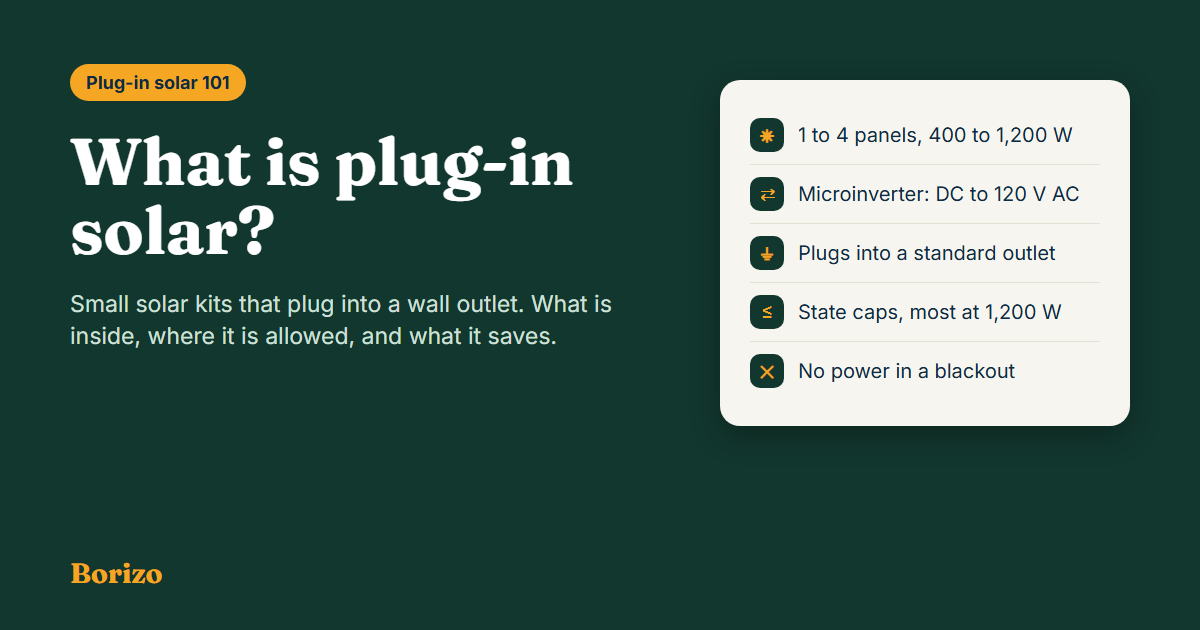
Plug-in solar is a kit of usually 400 to 1,200 watts that plugs into a standard 120 V outlet and offsets part of your electricity use. It needs no roof work, but a growing list of US states set its size cap, certification and notice rules, and it does not power your home during a blackout.
- What it is: panels plus a microinverter and a plug-in cable. The inverter syncs with the grid and feeds power into the circuit it is plugged into.
- What it is not: a backup power source. It is built to shut off when grid power is lost.
- Size: most US state laws we have read cap output at 1,200 W. Colorado allows 1,920 W, and Maine needs an electrician above 420 W.
- Savings: an 800 W kit with 4 peak sun hours makes roughly 960 kWh a year, worth about $192 at 20¢ per kWh if you use all of it at home.
- Best fit: renters, condo owners and anyone with a sunny balcony, wall or yard who cannot or does not want to put panels on a roof.
What is in a plug-in solar kit
Most kits sold in the US have the same four or five parts. The names change from brand to brand, but the jobs do not.
| Part | What it does | What to check |
|---|---|---|
| Solar panels (1 to 4) | Turn sunlight into direct current (DC). A typical panel in these kits is rated 100 to 450 W. | Panel size and weight against your space; total DC watts |
| Microinverter | Converts DC to alternating current (AC) that matches the grid, and stops output when grid power is lost | AC output in watts (this is what state caps count) and the certification |
| AC cable with a plug | Carries the inverter’s output to a wall outlet | Length; use only the cable the maker supplies or approves |
| Mounting hardware | Holds the panels on a railing, wall, ground stand or flat roof | Wind and weight instructions; no drilling into a structure you do not own without permission |
| App or monitor (often) | Shows how much the kit produces; often used to register the warranty | Wi-Fi or Bluetooth needs, warranty terms |
Some kits add a battery, which stores daytime power for the evening. That changes the cost and, in some designs, how the system behaves in an outage, so read the manual closely if you are considering one. The inverter is the heart of the system. APsystems, for example, describes its EZ1 microinverter as taking one or two panels, offering up to 900 W of AC output, and restarting only after grid power has been stable for five minutes. Our guide on how balcony solar works follows the power step by step, from the panel to your appliances.
Plug-in solar vs rooftop solar
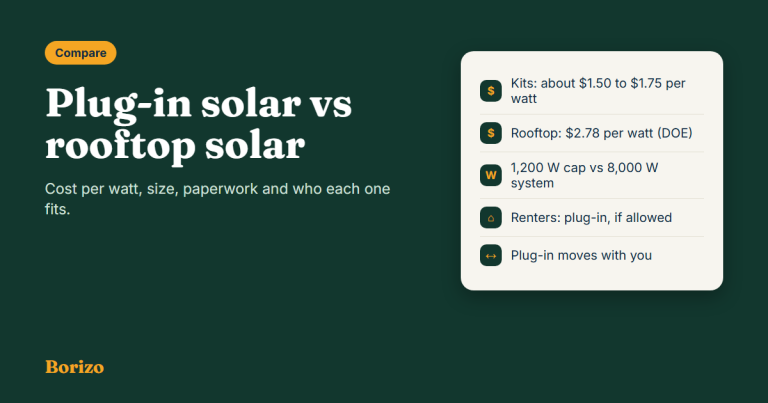
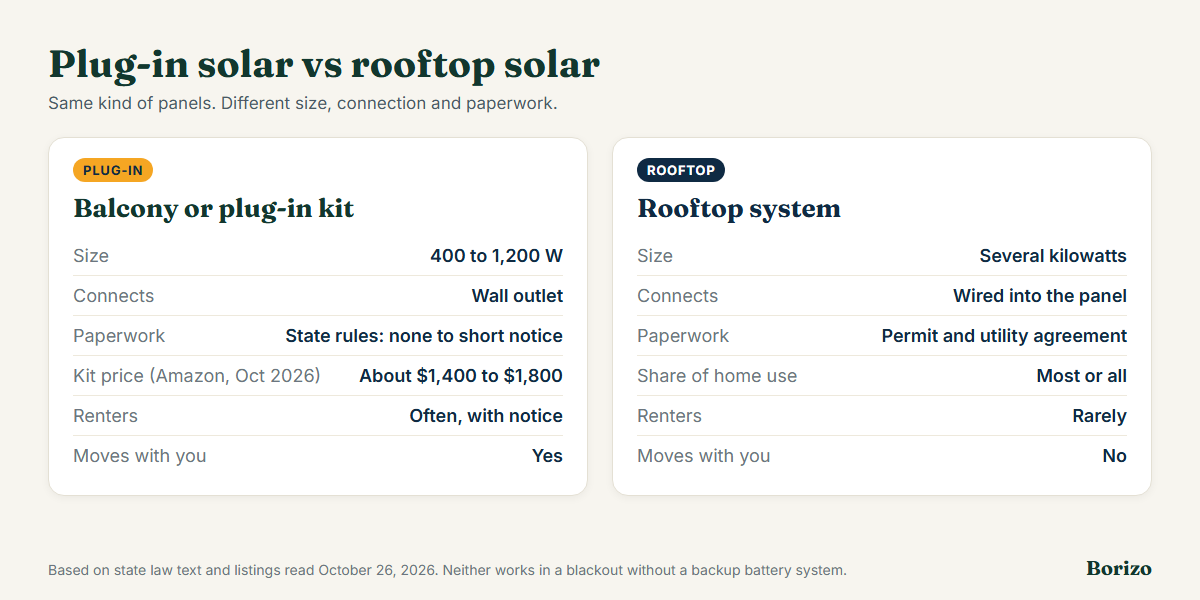
Both use the same kind of panels. The difference is scale and how they connect. A rooftop system is wired into your electrical panel by a contractor and usually needs a permit and a utility interconnection agreement. A plug-in kit is small enough that several states now let it connect through an outlet without that agreement, as long as it stays under the state’s cap.
| Plug-in solar | Rooftop solar | |
|---|---|---|
| Typical size | 400 to 1,200 W (state caps apply) | Several kilowatts |
| How it connects | Plugs into an existing outlet | Wired into the electrical panel by a contractor |
| Paperwork | Depends on the state: none, a landlord notice, or a short utility form | Usually a permit, inspection and utility interconnection agreement |
| Share of a home’s use | A slice, often a few hundred to about 1,000 kWh a year | Can cover most or all of it |
| Works for renters | Often, with notice and landlord limits where state law allows | Rarely |
| Moves with you | Yes | No |
| Power in a blackout | No | Only with a battery and a system designed for backup |
If you own a house with a good roof and use a lot of electricity, rooftop solar will usually offset far more of your bill. Plug-in solar is for people who cannot use a roof, want a small start, or expect to move.
Where the idea came from
Balcony solar spread first in Germany, where people call it a Balkonkraftwerk, or “balcony power plant.” Germany’s grid regulator, the Bundesnetzagentur, says special rules apply to plug-in devices with up to 2,000 W of panels and an inverter output of up to 800 VA in total. Since the country’s Solar Package took effect on May 16, 2024, owners of such devices no longer have to notify the grid operator, but they must still register them in the national market data register, a process the regulator says now needs only a few entries.
US laws borrowed the idea but set their own numbers. US outlets run at 120 V instead of 230 V, and most state laws we have read cap output at 1,200 W rather than 800 VA.
Is plug-in solar legal in the US?
It depends on your state. Since 2025, a growing number of states have passed laws that let a certified kit below a size cap connect through an outlet without a standard interconnection agreement. In the states whose enacted or enrolled text we have read (Colorado, Connecticut, Maine, New Hampshire, New Jersey, Utah, Vermont and Virginia), the main rules are:
- A size cap. 1,200 W in most of them. Colorado allows 1,920 W with one device per wall outlet, and Maine allows 420 W without an electrician and up to 1,200 W with a licensed electrician and a dedicated circuit. The counting unit differs: per meter, per customer, per dwelling unit or per address.
- Certification. UL 3700, a comparable standard, or listing by a nationally recognized testing laboratory, depending on the state.
- Notice in some states. Virginia requires a state utility form before installing from January 1, 2027, and tenants there, in Vermont and in New Jersey’s bill owe the landlord advance notice.
Maryland and California have signed laws we have not yet read in full. If your state has no plug-in law, your utility may still treat a kit as a generator that needs an interconnection agreement, so ask before you buy. The sources and dates for each state are in our State Laws hub, the wattage limit guide and the renters and HOA guide.
How much power and money can it save?
A quick estimate needs three numbers: the kit’s size, the sun at your site and your price per kilowatt-hour. Our shortcut, built from NREL’s PVWatts defaults, is panel watts × peak sun hours × 0.30 = kWh per year.
| Kit size | Yearly output at 4 peak sun hours | Value at 15¢/kWh | Value at 20¢/kWh | Value at 30¢/kWh |
|---|---|---|---|---|
| 400 W | about 480 kWh | about $72 | about $96 | about $144 |
| 800 W | about 960 kWh | about $144 | about $192 | about $288 |
| 1,200 W | about 1,440 kWh | about $216 | about $288 | about $432 |
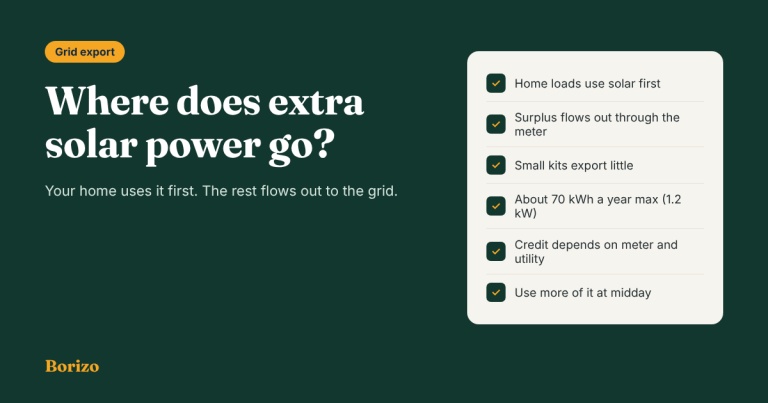
These are our own illustrations, not tests or promises. They assume every kilowatt-hour is used at home. Power your home is not using at that moment flows out to the grid, where it may earn little or nothing, and a shaded or east-facing balcony can produce much less. For scale, EIA data show a 2025 US average residential price of 17.23¢ per kWh, from 11.82¢ in North Dakota to 40.40¢ in Hawaii. Get a figure for your own address with NREL’s free PVWatts calculator, then use our savings and payback calculator. The full method is in is plug-in solar worth it.
Who plug-in solar suits, and who it does not
It can make sense if you:
- rent or own a condo and have a balcony, patio or wall in good sun, in a state that allows it;
- pay a high price per kWh, since that is the biggest lever on payback;
- use power during the day, for example working from home or running a fridge, dehumidifier or pool pump;
- plan to move and want to take the system with you;
- want to try solar on a small budget before deciding on a rooftop system.
It is a poor fit if you:
- want backup power in an outage (look at a portable power station instead; see plug-in solar vs a power station);
- have only a shaded or north-facing spot;
- live in a state without a plug-in law and your utility will not accept one;
- would need several kits to make a dent in a large bill, where rooftop solar is usually better value.
Is it safe?
The main concern raised by safety experts is not the panel but the circuit. UL Solutions, which wrote the UL 3700 standard, explains that home branch circuits are designed for one-way power flow from the panel to the load. A plug-in kit adds current at the outlet that the breaker in your panel cannot see, so the wire between the kit and a large appliance on the same circuit could carry more than its rating. That is why state caps exist, why some states require a dedicated circuit above a certain size, and why it is worth knowing what else is on the circuit you use. Our wattage and circuit safety guide has the diagram, and the UL 3700 guide shows how to check a certification claim in the lab’s own directory.
A certified microinverter is also designed to stop sending power when the grid goes down, so it does not feed lines that utility workers may be repairing. Virginia’s law and New Jersey’s bill both require that feature.
How to get started
- Check your state’s rule in the State Laws hub.
- Measure your space and estimate the sun with PVWatts, then size the kit with our kit size calculator.
- Verify the certification in the testing lab’s directory, not only on the product page.
- Give notice to your landlord, association or utility where required.
- Know your circuit before plugging in, and ask a licensed electrician if unsure.
The installation checklist covers all 12 steps in order. If you are ready to compare products, see the best plug-in solar kits.
Frequently asked questions
Is plug-in solar the same as balcony solar?
Yes. Balcony solar, plug-in solar and plug-and-play solar describe the same thing: a small solar kit with a microinverter that connects through a wall outlet. The panels do not have to be on a balcony. They can go on a wall, a fence, a patio or a ground stand.
Does plug-in solar work during a power outage?
No. A grid-tied plug-in kit is designed to shut off when grid power is lost and to restart only after the grid is stable again. If you want power in a blackout, you need a battery system designed for backup, such as a portable power station.
How much does a plug-in solar kit cost?
Most complete kits we found on Amazon.com in October 2026 cost from about $1,395 for 400 W or 800 W to $1,795 for 1,200 W, and prices change often. Add shipping, tax, mounting hardware and any electrician visit to get the total cost.
Do I need permission to install plug-in solar?
Often, yes. Tenants in Virginia, Vermont and New Jersey (in the bill text we read) must give the landlord advance written notice, and Virginia requires a utility form from January 1, 2027. In states without a plug-in law, ask your utility first.
Sources
- Bundesnetzagentur, Balkon-Solaranlagen (2,000 W panel and 800 VA inverter limits, no grid-operator notice since May 16, 2024, register still required), read October 26, 2026.
- State laws: Utah HB 340, Colorado HB26-1007, Maine LD 1730, Virginia HB 395, Vermont Act 149, New Jersey S2368, Connecticut PA 26-127, New Hampshire SB 540, read October 26, 2026.
- US Energy Information Administration, Electric Power Annual, average retail price by state.
- NREL, PVWatts Calculator.
- UL Solutions, “Question Corner,” IAEI Magazine, July 1, 2026 (one-way branch circuits).
- APsystems, EZ1 for consumers (one or two panels, up to 900 W AC, five-minute restart), read October 26, 2026.

Borizo is an independent guide to plug-in and balcony solar in the US. We track state laws, check certification claims against official sources, and compare kits using published specifications. Laws change often, so every state page shows a “last updated” date and links to its sources. We earn a commission when you buy through our Amazon links, at no extra cost to you. Our content is for information only and is not legal or electrical advice.