
Best Plug-in Solar Kits on Amazon (2026): Picks by Situation
Search Amazon for “balcony solar kit” and you get hundreds of results. Most of them are not plug-in solar kits at all: they are camping panels for power stations, garden lights, or loose microinverters with no recognized safety listing. When we went through the listings on October 26, 2026, only a handful were complete grid-tied kits meant to plug into a US outlet, and only some of those name a safety standard. This guide sorts what is actually there by situation (small balcony, average home, larger yard), shows what each listing says about certification, and points out the claims you should not take at face value. It is a spec-based comparison from public listings and official sources. We have not tested any of these products.
- Best match for most buyers on Amazon: the PLUGGEDSOLAR 800 W 4-panel kit ($1,395), which names an APsystems microinverter and UL 3700. It is not small: four panels of about 4.5 × 2.2 ft each.
- For a yard in a state that allows 1,200 W: the PLUGGEDSOLAR 1,200 W 6-panel kit ($1,795) has the lowest price per watt we found among kits that name a safety standard.
- For a small balcony, we found no small, certified complete kit on Amazon. The smallest Amazon kit (CraftStrom 400 W) names no safety standard on its listing.
- Skip kits larger than your state’s limit (such as 1,600 W), “stackable” setups that put more than the limit on one outlet, and loose inverters that say “not UL1741 certified” or show only a CE mark.
- A “UL 3700 certified” line on a listing is the seller’s claim. Check it in the lab’s directory before you buy. See how to check a certification claim.
- Ignore “30% federal tax credit” claims for new purchases. The IRS says the residential clean energy credit is not allowed for expenditures made after December 31, 2025.
Quick picks by situation
Most homes: 800 W kit
PLUGGEDSOLAR 800 W 4-panel kit, $1,395. Names an APsystems microinverter, UL 3700 and UL 1741. Fits under the 1,200 W cap in most state laws. Check price on Amazon
Yard, 1,200 W state: 6-panel kit
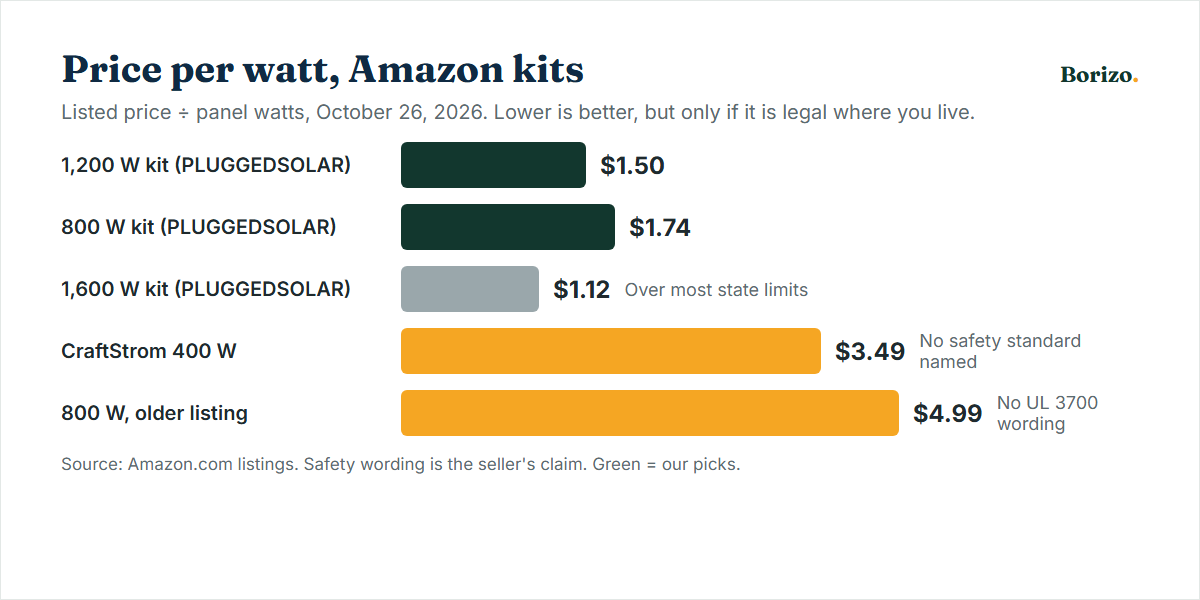
PLUGGEDSOLAR 1,200 W 6-panel kit, $1,795. About $1.50 per watt. Only where your state allows 1,200 W. Check price on Amazon
Small balcony: no clear Amazon pick
The smallest Amazon kit names no safety standard. A small kit sold outside Amazon is covered below.
How we chose (and what we did not do)
We read every Amazon.com listing that came up for plug-in, balcony and plug-and-play solar searches on October 26, 2026, and kept only complete grid-tied kits for a 120 V outlet: panels, a microinverter and a plug-in cord in one purchase. Then we compared what each listing states:
- Safety wording. Does the listing name a recognized standard, such as UL 3700 (plug-in solar) or UL 1741 (grid-connected inverters), and does it name the inverter maker?
- Size against state law. Most state plug-in solar laws cap a system at 1,200 W. Maine allows only 420 W without a licensed electrician, and Colorado allows 1,920 W. A kit you are not allowed to plug in is not a good buy. See wattage limits.
- Price per watt of panel capacity, from the listed price on that date.
- Claims that do not add up, such as output estimates far above what a kit that size can make, or tax credits that no longer exist.
We did not buy, install or measure any kit, and Amazon star ratings were not shown for most of these listings, so they played no part. Commissions did not decide the order; see our editorial policy.
Comparison table
| Kit (Amazon listing) | Size | Price, Oct 26, 2026 | Price per watt | Safety wording on listing | Our take |
|---|---|---|---|---|---|
| PLUGGEDSOLAR 800 W, 4-panel | 4 × 200 W panels, APsystems microinverter, 50 ft cord | $1,395 | $1.74 | “UL-3700 certified for Plug-in”; “complies with UL 1741” | Best fit for most homes |
| PLUGGEDSOLAR 1,200 W, 6-panel | 6 × 200 W panels, 2 microinverters | $1,795 | $1.50 | Same as 800 W kit | Yards in 1,200 W states |
| PLUGGEDSOLAR 1,600 W, 8-panel | 8 × 200 W panels, 2 microinverters | $1,795 | $1.12 | Same as 800 W kit | Skip, unless you are in Colorado (1,920 W cap) |
| CraftStrom 400 W | 2 bifacial panels | $1,395 | $3.49 | No standard named; “Never backfeed to the grid” | Skip unless the seller shows a listing |
| PLUGGEDSOLAR 800 W (older listing) | 4 × 200 W panels, microinverter | $3,995 | $4.99 | “complies with UL 1741”; no UL 3700 wording | Skip: same size as the $1,395 kit |
Best for most homes: PLUGGEDSOLAR 800 W 4-panel kit
What you get: four 200 W panels (listed at 4.5 × 2.2 ft each), an APsystems grid-tie microinverter with built-in Wi-Fi monitoring, and a 50 ft cord for a 110/120 V outlet. The listing says it ships in three packages: the inverter and cord, the panels, and the wires.
Why it stands out: it is the only 800 W complete kit we found on Amazon that names both the inverter brand and a plug-in solar standard. The listing says the microinverter “complies with UL 1741 code for anti-islanding safety protection” and is “UL-3700 certified.” APsystems, the inverter maker, announced in July 2026 that its EZ1 plug-in microinverter is “CSA Certified to UL3700 standards.” The Amazon listing does not give the inverter’s model number, so ask the seller to confirm it is that model before you rely on it. At 800 W it stays under the 1,200 W cap that most state laws set. Maine is an exception: it allows only 420 W without a licensed electrician.
What to watch:
- Space. Four panels cover roughly 40 square feet. That is a large railing or a patio, not a small balcony.
- “Approved for Plug-in across US states.” No such national approval exists. About ten states have plug-in solar laws, and rules differ. Check your state first.
- “Stackable up to 3 systems for one dedicated Plug.” Three kits on one outlet would be 2,400 W, double the usual 1,200 W limit. Do not do this. See why outlet limits exist.
- The output estimate. The listing claims about 1,500 kWh a year. Our own example for an 800 W kit with 4 peak sun hours comes to roughly 960 kWh. Run your ZIP code in our payback calculator rather than trusting a listing number.
Best for a yard in a 1,200 W state: PLUGGEDSOLAR 1,200 W 6-panel kit
What you get: six 200 W panels, two APsystems microinverters and the same 50 ft plug-in cord setup, for $1,795, about $1.50 per watt. It carries the same UL 3700 and UL 1741 wording as the 800 W kit.
Who it suits: a house with a sunny yard, fence or ground mount, in a state whose law allows 1,200 W. Six panels need about 60 square feet of unshaded space. Most balconies cannot hold this.
What to watch:
- Your state’s limit. 1,200 W is the most that most state laws allow, so you are at the ceiling. If your state or utility sets a lower number, this kit is too big.
- Two inverters. Ask the seller whether the two inverters share one cord and outlet or need two outlets, and check that against your state’s rule and your circuit. See wattage limits and circuit safety.
- “Stackable up to 2 systems.” That would be 2,400 W on one outlet. Again, do not.
- Output claim: the listing says about 2,200 kWh a year. Check your own estimate with our kit size calculator.
Check the 1,200 W kit on Amazon
Small balcony or renter: what is available
This is where Amazon falls short right now. The only small complete kit we found there was the CraftStrom 400 W kit ($1,395 for two bifacial panels, about $3.49 per watt). Its listing says it will “Never backfeed to the grid” but names no safety standard or testing lab, and it says the system can be expanded to 2,000 W, well past most state limits. We would not buy it until the seller shows a certification listing you can look up.
Outside Amazon, Bright Saver, a nonprofit, sells a small kit built around a Hoymiles HiFlow Pro 360 W microinverter. Hoymiles calls the HiFlow Pro “UL 3700-compliant”; InsideEVs corrected an earlier report to say it was designed to meet the standard rather than certified by UL Solutions. Bright Saver’s site has listed member pricing from about $285 and a non-member price of $499, and has shown the kit as sold out at times. We do not earn anything from Bright Saver; it is mentioned because it is one of the few small options.
Renters also need the landlord’s rules and their state’s tenant protections. See plug-in solar for renters and HOAs, and use the kit size calculator to see what a smaller system would make.
Listings to skip
- Kits above your state’s limit. The PLUGGEDSOLAR 1,600 W kit has the lowest price per watt on paper, but 1,600 W is above the 1,200 W cap in most state laws (Colorado, at 1,920 W, is the exception we know of). If you cannot legally plug it in, the low price does not matter.
- Loose “plug and play” microinverters. Several Amazon inverters sold for balcony kits name no standard at all, and two Y&H listings say outright “The inverter is not UL1741 certified,” listing only a CE mark (a European self-declaration). A 240 V inverter that says “ONLY supports 240V” will not work on a standard outlet.
- The older $3,995 PLUGGEDSOLAR listing. Same 800 W size as the $1,395 kit, nearly three times the price, and no UL 3700 wording.
- Portable “solar panels for power stations.” They charge a battery, not your home circuit, and do not lower your bill. See plug-in solar vs portable power station.
Five checks before you buy any kit
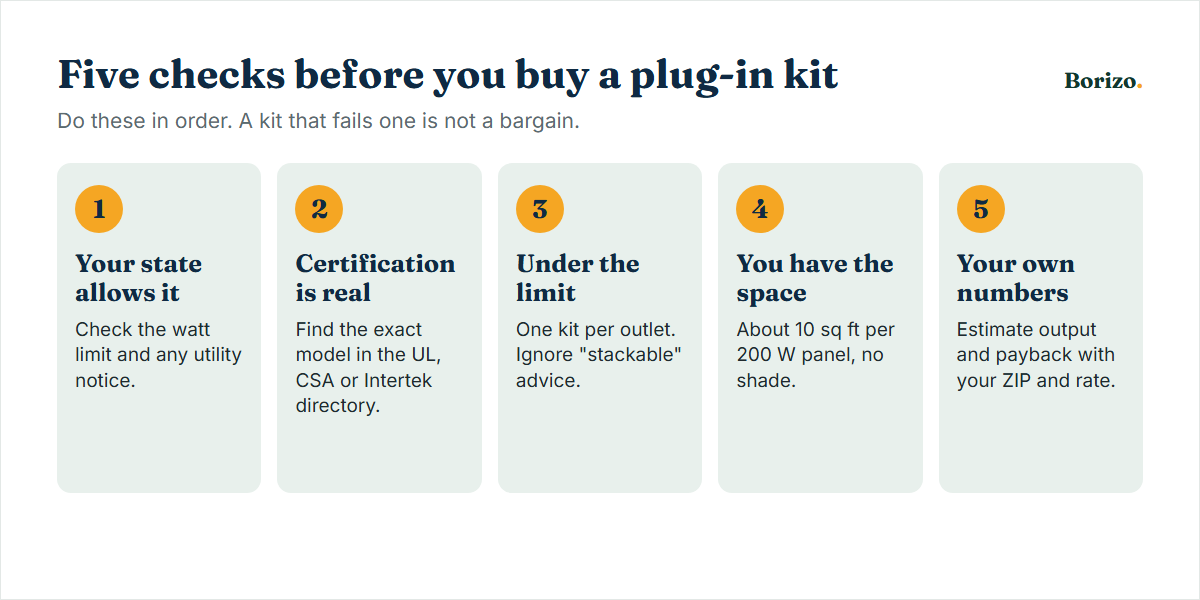
- Your state and utility. Is plug-in solar allowed where you live, up to what size, and do you have to notify the utility? Start at the State Laws hub.
- The certification, in the lab’s own directory. Search the exact model in UL Solutions’ Product iQ, CSA’s or Intertek’s directory. “Compliant” and “designed to meet” are not the same as certified. See our certification guide.
- Size under the limit, one kit per outlet. Ignore “stackable” advice that puts more on one outlet than your state allows.
- Space and shade. A 200 W panel of this type is about 10 square feet. Shade on one panel cuts output.
- Your own numbers. Use the payback calculator with your electric rate. Payback depends far more on your rate and sun than on the brand. See savings and payback explained.
What about the 30% federal tax credit?
One listing says the kit “Qualifies for 30% Federal Tax Credit.” For a purchase today, that is out of date. The IRS says the residential clean energy credit (section 25D) “will not be allowed for any expenditures made after December 31, 2025,” and that an expenditure counts as made when installation is completed. Some states and utilities have their own incentives, so check locally. This is general information, not tax advice.
Frequently asked questions
What is the best plug-in solar kit on Amazon?
Based on listing specs on October 26, 2026, the PLUGGEDSOLAR 800 W 4-panel kit is the best fit for most homes: it names an APsystems microinverter and UL 3700, and 800 W stays under the 1,200 W cap in most state laws (Maine allows only 420 W without an electrician). We have not tested it, and the certification claim should be checked in the lab’s directory.
Are any plug-in solar kits UL 3700 certified?
Reports differ. APsystems says its EZ1 microinverter is CSA certified to UL 3700, and some Amazon kits that use APsystems inverters claim UL 3700. Whole-kit certification was still rare in 2026. Treat any listing claim as unverified until you find the exact model in UL, CSA or Intertek’s public directory.
Can I buy a 1,600 W or larger plug-in kit?
You can buy one, but most state plug-in solar laws cap systems at 1,200 W, so a larger kit usually cannot be legally plugged into an outlet. Larger systems generally need a standard permitted installation by a licensed electrician.
Do plug-in solar kits still qualify for the 30% federal tax credit?
Not for new purchases. The IRS says the residential clean energy credit is not allowed for expenditures made after December 31, 2025, with the expenditure counted when installation is completed. Check for state or utility incentives instead.
Sources
- Amazon.com listings, read October 26, 2026: PLUGGEDSOLAR 800 W, PLUGGEDSOLAR 1,200 W, PLUGGEDSOLAR 1,600 W (B0HLWSCXTH), CraftStrom 400 W (B0CZ15137Y), PLUGGEDSOLAR 800 W older listing (B09D61CP1T), Y&H microinverters (B09N8X1Z71, B09N8T2741). Quotes are the sellers’ wording.
- APsystems USA, “EZ1. Proven. Portable Solar. UL 3700.”, July 15, 2026 (“CSA Certified to UL3700 standards”).
- Hoymiles, HiFlow Pro product release, July 15, 2026, and InsideEVs, report with correction on its certification status.
- Bright Saver, balcony solar kits page (price and stock), and Canary Media, coverage of the Bright Saver kit.
- Internal Revenue Service, FAQs on the modification of section 25D (FS-2025-05) and the Residential Clean Energy Credit page.
- Our guides on wattage limits, UL 3700 certification (state law sources), renters and HOAs, savings and payback and how many panels.

Borizo is an independent guide to plug-in and balcony solar in the US. We track state laws, check certification claims against official sources, and compare kits using published specifications. Laws change often, so every state page shows a “last updated” date and links to its sources. We earn a commission when you buy through our Amazon links, at no extra cost to you. Our content is for information only and is not legal or electrical advice.