How to Clean Balcony Solar Panels Safely (and How Often)
A balcony solar panel lives outdoors: dust, pollen, city grime, bird droppings and the odd leaf all land on it. A light film costs a little output; a single bird dropping over a cell can cost more than you would expect. Cleaning is simple, but a balcony adds two risks rooftop owners rarely face in the same way: you are often working at height next to a railing, and the panel is plugged into your home. This guide explains how much dirt really matters, how to tell when a panel needs cleaning, a safe step-by-step method, what to avoid so you do not damage the panel or void the warranty, and how often to bother. It draws on NREL research on soiling and PVWatts’ loss assumptions. We have not tested any cleaning product or kit.
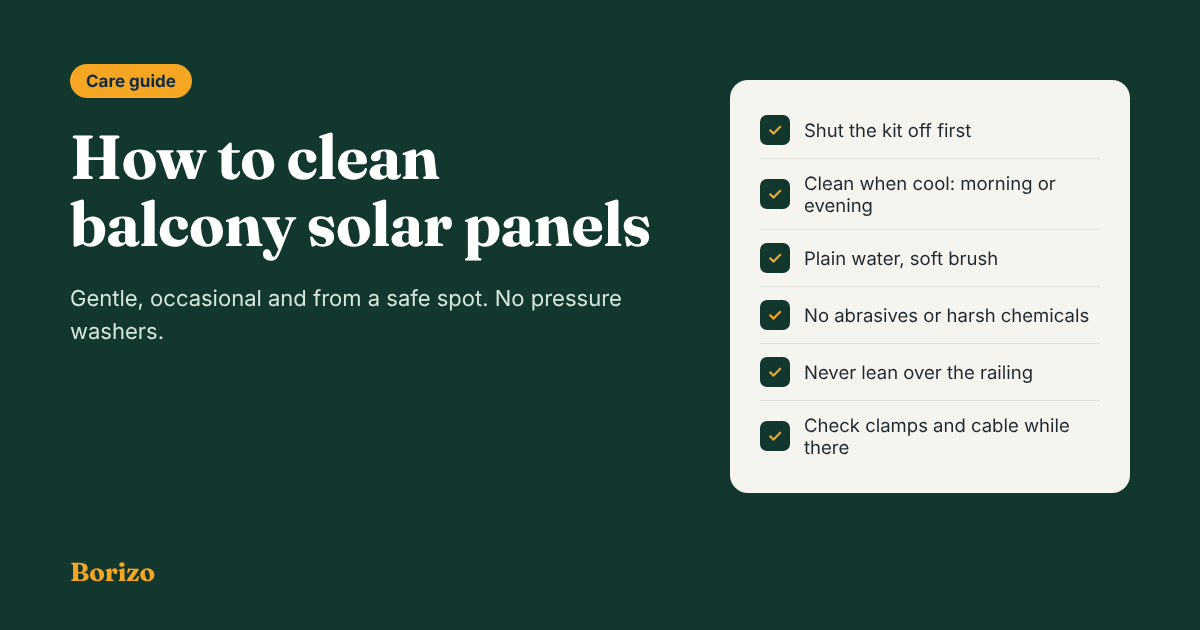
Clean a balcony panel when you can see dirt, droppings or leaves on it, or when your app shows output dropping on clear days. Unplug the kit first, clean in the early morning or evening when the glass is cool, use plain water and a soft brush or sponge, and never use a pressure washer, abrasive pads or harsh chemicals. Do not lean over the railing; if you cannot reach the panel safely, leave it or take it down to clean.
- General dust costs a few percent. NREL’s PVWatts calculator assumes a default 2% loss from soiling.
- Spot dirt matters more. A dropping or leaf that shades part of a cell can cut output far more than a light, even film, because of how cells are wired.
- NREL’s soiling guidance: use soft, thin-bristle brushes if contact cleaning is needed, use water near the panel’s temperature, and clean in low- or no-light conditions.
- Rain helps but is not a full cleaning. NREL notes growth on panels even where rain should clean.
- Safety first. Unplug following the manual, because plug blades can be energized in sunlight, and never lean over a balcony railing.
How much does dirt cost you?
NREL’s PVWatts calculator, the free tool many solar estimates use, assumes a default soiling loss of 2%. That is a reasonable starting point for a panel that gets occasional rain and normal dust. Losses can be higher near busy roads, construction, farmland, in dry climates with little rain or under trees that drop sap and pollen.
Spot soiling behaves differently. A solar panel is a string of cells wired together, and a patch of shade on one cell can hold back the whole string, as our guide to how shade affects balcony solar explains. A bird dropping or a stuck leaf is a small shadow that never moves, so removing it can matter more than removing an even layer of dust.
NREL researchers presenting on soiling mitigation also warned that skipping cleaning, or relying only on dry brushing, can lead to lost output and, over time, faster degradation. For a balcony kit, that is an argument for occasional gentle cleaning, not frequent scrubbing.
How to tell when it needs cleaning
- Look at it. Visible droppings, leaves, a grey film or streaks are the clearest sign.
- Compare clear days. If your app or energy monitor shows lower output on a cloudless day than a similar day a few weeks earlier, and nothing new is casting shade, dirt is a likely cause. Our monitoring guide covers the tools.
- After events. Pollen season, a dust storm, nearby construction or wildfire smoke can all leave a film quickly.
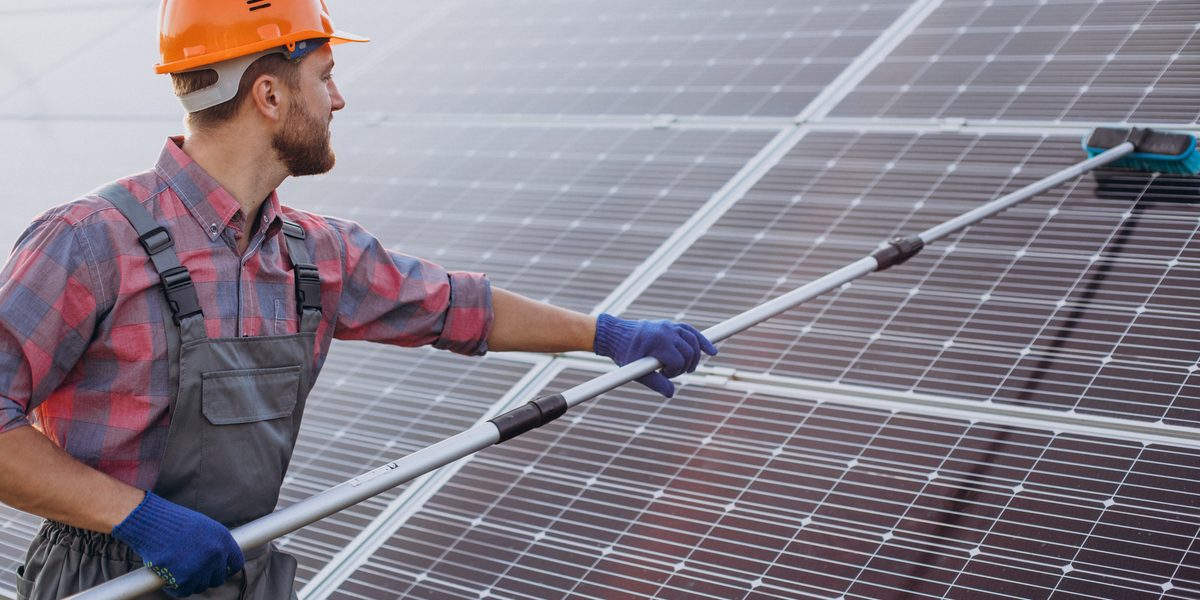
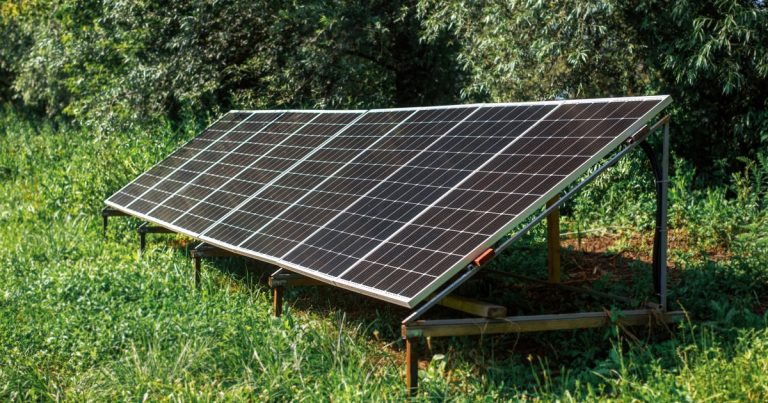
Stock photo (Freepik) for illustration only. It is not a Borizo installation, and we have not tested any product shown.
Step by step: cleaning a balcony panel safely
- Check the manual. Some manufacturers specify cleaning methods or products, and using the wrong ones can affect the warranty.
- Pick a cool, dim time. Early morning or evening, or a cloudy day. NREL’s guidance is to clean in low- or no-light conditions and to use water near the panel’s temperature; cold water on hot glass can stress it.
- Shut the kit off. Follow the manual, which usually means unplugging from the outlet or using the kit’s disconnect. UL Solutions warns that plug blades can be energized when the panels are in sunlight, so handle the plug by its body and keep it dry.
- Stay on your side of the railing. Work only on surfaces you can reach while standing on the balcony floor with both feet. If you cannot, use a soft brush on an extension pole or take the panel down following the mount’s instructions.
- Rinse loose dirt. Use a watering can, a spray bottle or a gentle hose setting. Avoid letting water run onto the plug, the outlet or a neighbor’s balcony below.
- Wipe gently. Use a soft sponge or a soft, thin-bristle brush with plain water. For stubborn spots, a little mild dish soap in water, then rinse. Soak droppings first rather than scraping them.
- Rinse and let dry. Clean water helps avoid spots. NREL recommends deionized water in its research setting; distilled water is a home equivalent if your tap water is hard.
- Check while you are there. Look for cracks, loose clamps, a damaged cable or a corroded connector, then plug back in following the manual’s order.
What not to do
| Avoid | Why |
|---|---|
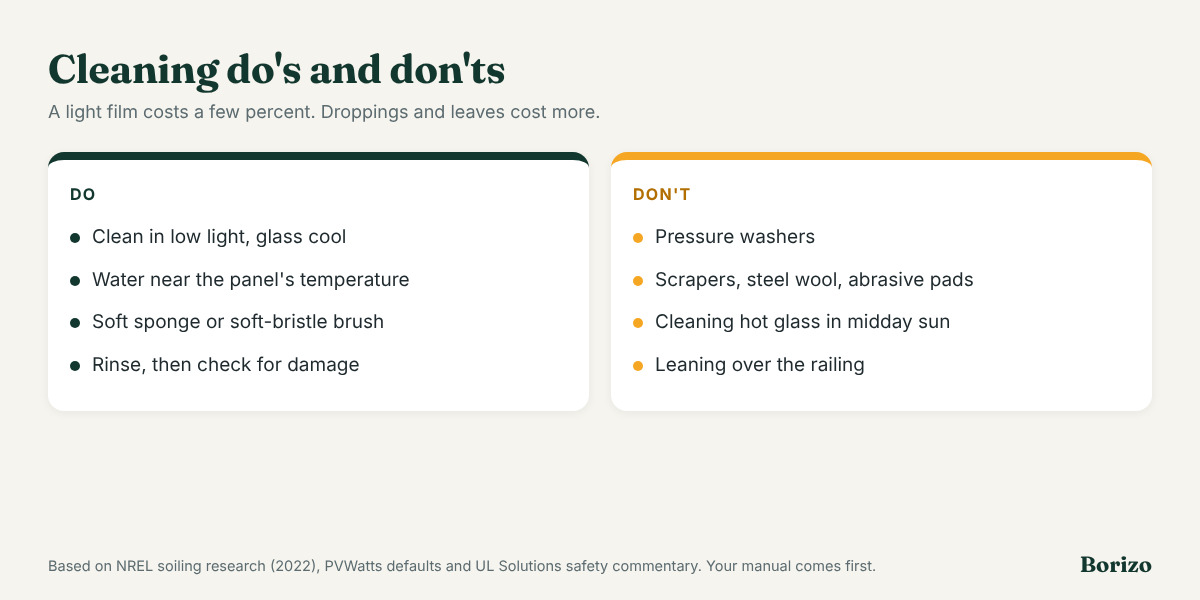
| Pressure washers | High-pressure water can force its way into seals and connectors. NREL notes that water overspray during cleaning can cause shorting. |
| Abrasive pads, scrapers, steel wool | They scratch the glass and its anti-reflective coating, which reduces light reaching the cells permanently. |
| Harsh chemicals and solvents | They can damage coatings, seals and frames. Use plain water or a mild soap unless the manual says otherwise. |
| Cleaning in full midday sun | The glass is hot, water evaporates into spots, and the kit is producing power. |
| Standing on chairs or leaning over the railing | A fall from a balcony can be fatal. No amount of extra output is worth it. |
| Frequent heavy scrubbing | NREL notes repeated cleaning can cause abrasion. Gentle and occasional beats hard and often. |
How often should you clean?
There is no single schedule. NREL’s researchers called for site-specific cleaning frequency based on cost and benefit, which for a home kit means: clean when it is worth it. For most balcony kits in places with regular rain, a gentle clean a few times a year, plus spot-cleaning droppings when you see them, is plenty. Dry, dusty or polluted locations may need more.
A useful test: clean the panel once and compare output on the next clear day with the clear day before. If the gain is a few percent or less, you can clean less often. If it is large, check what made it so dirty. A tree branch, a bird perch on the railing above or a nearby dust source may be worth dealing with directly.
For a sense of what a few percent is worth, a kit that makes about 2.6 kWh on a typical day, roughly the 960 kWh a year in our savings example, loses around 0.05 kWh a day at a 2% soiling loss. That is a cent or so a day at typical residential prices. Cleaning is about keeping the panel in good condition and catching damage early as much as recovering output.
Seasonal notes
- Spring: pollen can leave a yellow film. A rinse after the worst of it usually does the job.
- Summer: clean early in the morning when the glass is cool. Check for nests behind the panel.
- Fall: clear leaves from the panel and from the gap between panel and railing, where they trap moisture.
- Winter: do not chip ice or scrape snow; see our guide to winter and cloudy days.
Frequently asked questions
Do balcony solar panels need cleaning?
Occasionally. A light film of dust usually costs only a few percent, and NREL’s PVWatts assumes a 2% soiling loss by default. Spot dirt such as bird droppings or leaves can cost more, so remove it when you see it.
What is the best way to clean a balcony solar panel?
Shut the kit off following the manual, then use plain water and a soft sponge or soft-bristle brush in the early morning or evening when the glass is cool. Rinse with clean water and avoid pressure washers, abrasives and harsh chemicals.
Can I use a pressure washer on solar panels?
It is best avoided. High-pressure water can push into seals and connectors, and NREL notes that water overspray during cleaning can cause shorting. Check your manual, as some manufacturers prohibit it.
Should I unplug the kit before cleaning?
Yes. Follow your manual’s shutdown steps. UL Solutions warns that a kit’s plug blades can be energized when the panels are in sunlight, so keep the plug dry and handle it by its body.
Sources
- Lin J. Simpson (NREL), Matthew Brandt and Ryo Huntamer, Photovoltaic Module R&D Considerations for Soiling Mitigation, PVSC-49, June 2022 (soft brushes; water near module temperature; low-light cleaning; overspray shorting; abrasion; site-specific frequency).
- NREL, PVWatts Version 5 Manual (default soiling loss 2%) and the PVWatts Calculator.
- UL Solutions, “Question Corner,” IAEI Magazine, July 1, 2026 (plug blades can be energized in sunlight).
- Photos: stock images from Freepik, used for illustration only.

Borizo is an independent guide to plug-in and balcony solar in the US. We track state laws, check certification claims against official sources, and compare kits using published specifications. Laws change often, so every state page shows a “last updated” date and links to its sources. We earn a commission when you buy through our Amazon links, at no extra cost to you. Our content is for information only and is not legal or electrical advice.