How Many Solar Panels Does a Plug-in Kit Need? A Sizing Guide
“How many panels do I need?” has a shorter answer for plug-in solar than for a rooftop system, because the law and the equipment set a ceiling. In most states with a plug-in solar law, the kit may put out at most 1,200 watts. Within that ceiling, the number of panels depends on three things: how many watts each panel makes, the size of the inverter, and how much of the power your home can actually use while the sun is out. This guide walks through the sizing in plain steps, shows the arithmetic, and says where the numbers come from.
- The inverter, not the panels, sets the legal size. Check your state’s cap and the inverter’s AC output rating first (limits by state).
- Panel count is just division: target panel watts divided by watts per panel, rounded up. Listings we read show 200 W panels, while a utility-impact report describes units of 300 to 400 W.
- A rough yearly estimate is panel watts × sun hours × 0.30 in kWh. An 800 W kit with 4 sun hours a day lands near 960 kWh a year, about 9% of an average US home’s purchases.
- A bigger kit does not always save more. Power your home is not using at that moment flows out to the grid, and what you are paid for it depends on the utility.
- Estimates are for a clear, south-facing setup. Shade, direction and balcony railings reduce output. Use NREL’s free PVWatts tool for your address.
Step 1: Start with the legal and electrical ceiling
The size limit is written into state law, and it is usually measured at the inverter. New Hampshire’s text sets a maximum inverter output of 1,200 W AC, and Vermont counts the combined inverter capacity. Colorado allows 1,920 W, and Maine splits its rule at 420 W (see our wattage limit guide for the table and sources). So the first question is not “how many panels” but “how big an inverter may I plug in, and can my circuit take it?” A kit’s headline wattage may describe the panels, the inverter or both, so find the inverter’s rated AC output on the listing or label.
Step 2: Turn watts into panels
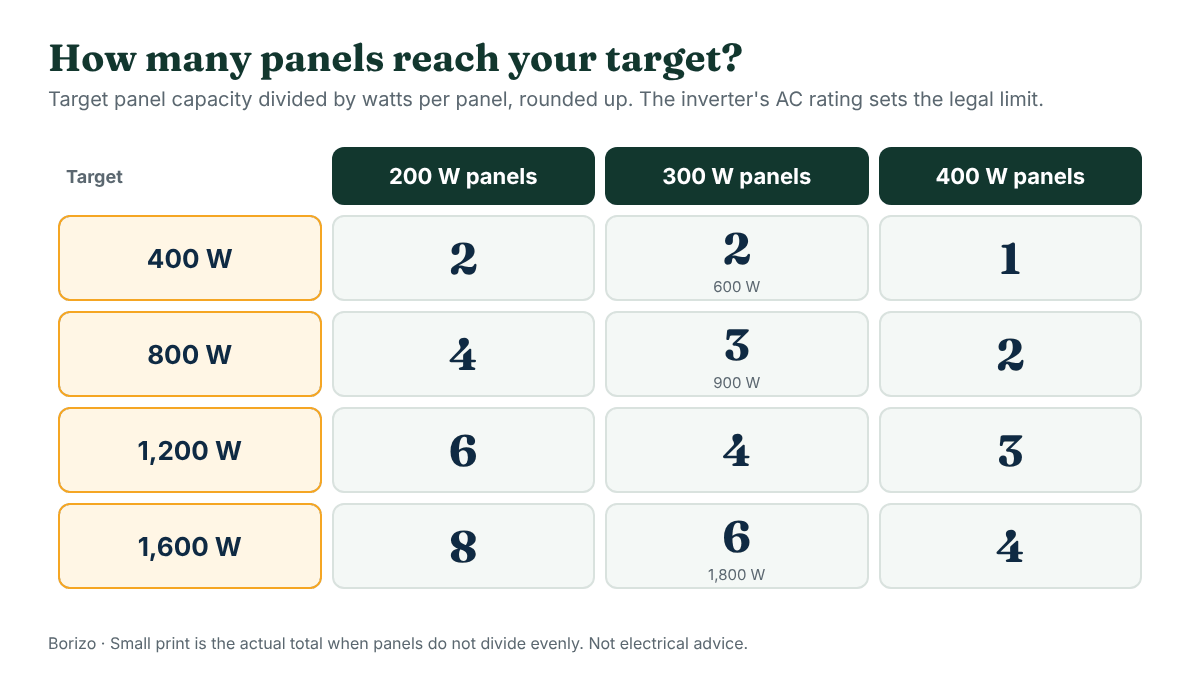
Panels are sold by their rated wattage under standard test conditions. To reach a target, divide and round up. The listings we read on Amazon on October 26, 2026 showed kits built from 200 W panels (a 4-panel kit rated 800 W, a 6-panel kit rated 1,200 W). A utility-impact report by Brooks Engineering for the nonprofit Bright Saver describes plug-in units of 300 to 400 W each, with three or four making a full 1.2 kW system. Both are real configurations, so work from the wattage printed on the panel you plan to buy.
| Target panel capacity | 200 W panels | 300 W panels | 400 W panels |
|---|---|---|---|
| 400 W | 2 | 2 (600 W) | 1 |
| 800 W | 4 | 3 (900 W) | 2 |
| 1,200 W | 6 | 4 | 3 |
| 1,600 W | 8 | 6 (1,800 W) | 4 |
Numbers in parentheses are the actual total when the panel size does not divide evenly. Also check the physical size in the listing. Bigger panels need more balcony, fence or ground space, and a rental or condo may restrict where they can go (see our guide for renters and HOAs).
Step 3: Panels versus inverter
You can have more panel watts than inverter watts. NREL’s PVWatts model assumes a DC-to-AC ratio of 1.1 by default, meaning panels rated about 10% above the inverter, and it clips output at the inverter’s AC rating. Extra panel capacity helps on cloudy mornings and evenings but wastes some midday output when the inverter is already at its limit. The practical point for plug-in solar: the legal cap applies to the inverter, so a 1,200 W inverter with 1,300 W of panels is a common design choice, while a 400 W inverter with 800 W of panels will clip often. Check that your state’s text and your kit’s certification allow the combination.
Step 4: Estimate what a kit produces
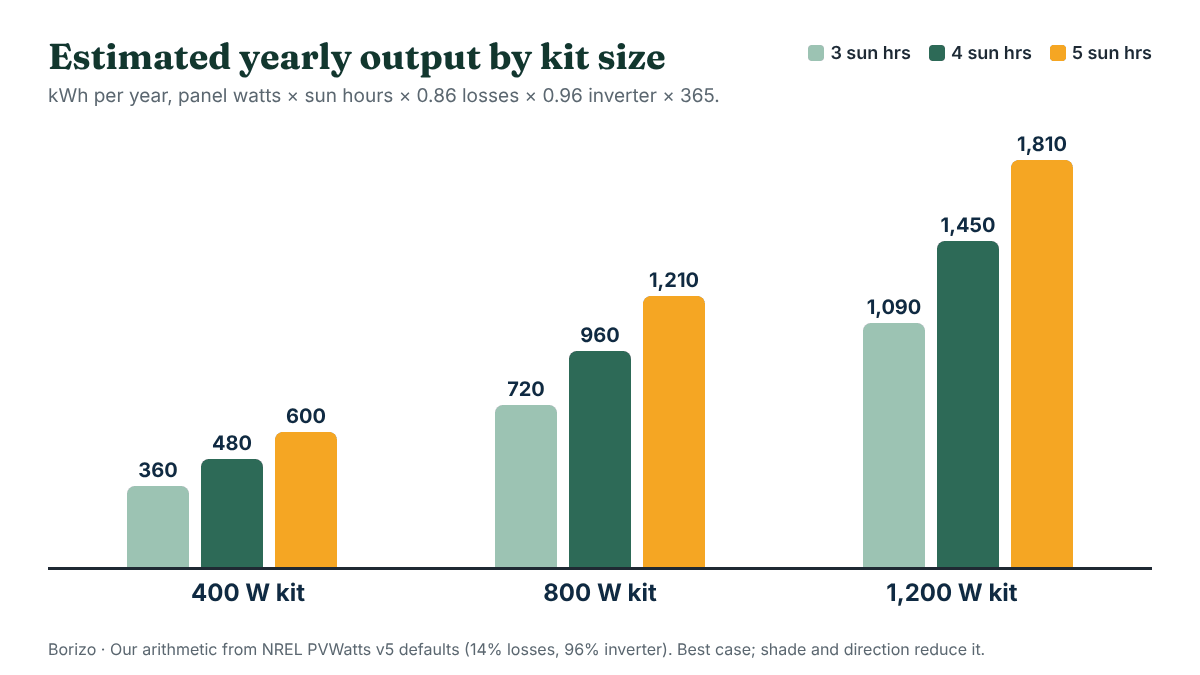
Solar output depends on “peak sun hours,” the number of hours per day with sunlight equal to 1,000 watts per square metre. A simple estimate uses two NREL PVWatts defaults: 14% system losses (soiling, shading, wiring, mismatch, aging and downtime combined) and a nominal inverter efficiency of 96%.
Formula: panel watts × peak sun hours × 0.86 × 0.96 ÷ 1,000 = kWh per day. Multiply by 365 for a year, or use watts × sun hours × 0.30 as a quick yearly kWh figure.
The table below uses 3, 4 and 5 sun hours a day as illustrative values. Your location, tilt, direction and shade decide your real number, so use PVWatts with your address before you buy.
| Kit (panel watts) | 3 sun hours | 4 sun hours | 5 sun hours |
|---|---|---|---|
| 400 W | about 360 kWh a year | about 480 kWh | about 600 kWh |
| 800 W | about 720 kWh | about 960 kWh | about 1,210 kWh |
| 1,200 W | about 1,090 kWh | about 1,450 kWh | about 1,810 kWh |
Step 5: Compare with how much your home can use
The US Energy Information Administration reports that the average US residential customer bought 10,791 kWh from the utility in 2022, about 899 kWh a month. By that yardstick an 800 W kit at 4 sun hours would cover roughly 9% of the average home’s purchases, and a 1,200 W kit at 5 sun hours about 17%. Those percentages are an upper bound, because they assume you use every kilowatt-hour the kit makes.
That is the catch with sizing. Plug-in solar feeds your home’s circuits, so it first covers whatever is running at that moment: the refrigerator, internet gear, standby loads and daytime appliances. Whatever your home is not using flows out to the grid. In the Brooks Engineering report for Bright Saver, the most a single 1.2 kW system exported in the cities modeled was under 0.76 kWh a day (Boston), and at 40% adoption the report found that all the energy would be consumed locally. The report’s illustrative example of a $0.20 per kWh retail price and $0.05 per kWh export payment shows why the gap matters: exported energy is worth less than energy you use yourself, where it is paid at all. We did not find a promise of export payment in the state texts we read, so ask your utility.
In practice, a home that is empty all day, with few daytime loads, benefits less from an oversized kit than a home with someone working there. If you are unsure, start smaller, or use our kit size calculator and the savings and payback calculator to test the trade-off.
Step 6: A simple sizing checklist
- Find your cap. Look up your state’s limit and how it is counted (per meter, customer, address or outlet) in the wattage limit guide.
- Check your circuit. Know the breaker rating and what else is on the circuit before choosing the biggest kit allowed.
- Pick the inverter AC size. Stay at or below the cap, and read its certification wording (how to check it).
- Choose panels. Divide your target panel watts by watts per panel, rounding up, and keep the panel total close to the inverter size (NREL’s default assumption is 1.1 times).
- Estimate output. Run PVWatts for your address, direction and tilt, then compare the result with your daytime use.
- Check where it goes. Confirm the space, your lease or HOA rules and any utility notice requirements.
Frequently asked questions
How many solar panels do I need for a 1,200 W plug-in kit?
It depends on the panel wattage: six 200 W panels, four 300 W panels or three 400 W panels reach 1,200 W of panel capacity. What matters legally is the inverter’s AC output, which most states cap at 1,200 W.
Can I connect more panel watts than my inverter’s rating?
Often yes, technically. NREL’s PVWatts assumes panels about 10% above the inverter by default and clips output at the inverter’s limit. Check your kit’s instructions and your state’s wording before oversizing.
How much electricity does an 800 W plug-in kit make?
Our estimate using NREL’s default losses is about 720 to 1,210 kWh a year at 3 to 5 peak sun hours a day, for a clear, south-facing setup. Real output depends on your location, direction and shade. Use PVWatts for your address.
Is a bigger plug-in solar kit always better?
No. Power your home is not using flows to the grid, where compensation varies and may be low or zero. A kit sized to your daytime use can make more sense per dollar than the largest one allowed.
Sources
- NREL, PVWatts Version 5 Manual: default system losses (14%), nominal inverter efficiency (96%), DC-to-AC ratio (1.1) and output clipping at the inverter rating.
- NREL, PVWatts Calculator (free tool for location-specific estimates).
- US Energy Information Administration, How much electricity does an American home use?, 2022 data.
- Brooks Engineering for Bright Saver, “Plug-In Solar Utility Impact in the United States,” December 3, 2025 (submitted to the Vermont legislature).
- State inverter-output wording: New Hampshire SB 540 and Vermont Act 149. Other states: see our wattage limit guide.
- Panel wattages in kit listings: Amazon product pages read on October 26, 2026. Listings change and are the sellers’ own wording.

Borizo is an independent guide to plug-in and balcony solar in the US. We track state laws, check certification claims against official sources, and compare kits using published specifications. Laws change often, so every state page shows a “last updated” date and links to its sources. We earn a commission when you buy through our Amazon links, at no extra cost to you. Our content is for information only and is not legal or electrical advice.