Is Plug-in Solar Worth It? Savings and Payback Explained
Is plug-in solar worth buying? The honest answer is “it depends on three numbers you can look up”: how much electricity the kit makes, what you pay per kilowatt-hour, and what the kit costs. This guide gives you a simple formula, shows payback for a range of electricity prices and kit costs, and explains the two things that most often make the real result worse than the simple math: sunlight you cannot use at the moment it is produced, and a site with less sun than the example. It is general information, not a promise of savings, and every input is something you can replace with your own number.
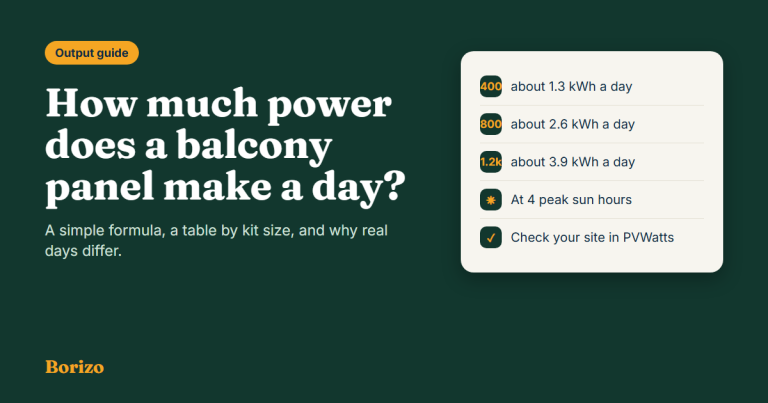
- Yearly savings = kWh you actually use from the kit × your price per kWh. An 800 W kit with 4 peak sun hours a day makes about 960 kWh a year (see our sizing guide).
- At 20¢ per kWh that is about $190 a year if you use every kilowatt-hour. At 10¢ it is about $96, and at 40¢ about $384.
- Payback is cost divided by yearly savings. An $800 kit pays back in about 4 years at 20¢, a $1,600 kit in about 8 years. At 10¢ they take 8 and 17 years.
- Electricity price is the biggest lever, so payback varies far more between states than between brands.
- Power your home is not using flows out to the grid, where it may earn little or nothing. Real savings can be below the simple math.
- These are illustrations from our own arithmetic. They are not product tests or guarantees.
The formula
There are only three steps:
- Estimate yearly output. Panel watts × peak sun hours × 0.30 gives kWh per year, a shortcut built from NREL’s PVWatts defaults (14% system losses and a 96% inverter). Our sizing guide shows where it comes from. For an exact figure at your address, use the free PVWatts calculator.
- Value it. Multiply the kWh you use from the kit by your price per kWh. Find the price on your bill: divide the electricity charges by the kWh used, and note whether your plan has time-of-use rates.
- Divide the cost. Payback in years = total cost (kit, any electrician, shipping, tax) ÷ yearly savings.
Savings by electricity price
Prices vary a lot across the country. EIA’s Electric Power Annual shows 2025 average residential prices from 11.82¢ per kWh in North Dakota, the lowest state, to 40.40¢ in Hawaii, with a US average of 17.23¢. Texas averaged 15.40¢, Utah 13.02¢ and California 31.35¢. Your own rate can differ from your state’s average, so look at your bill. The table below uses five round numbers to show the effect.
| Your price per kWh | Yearly savings, 800 W kit (960 kWh) |
|---|---|
| 10¢ | about $96 |
| 15¢ | about $144 |
| 20¢ | about $192 |
| 30¢ | about $288 |
| 40¢ | about $384 |
Payback by price and kit cost
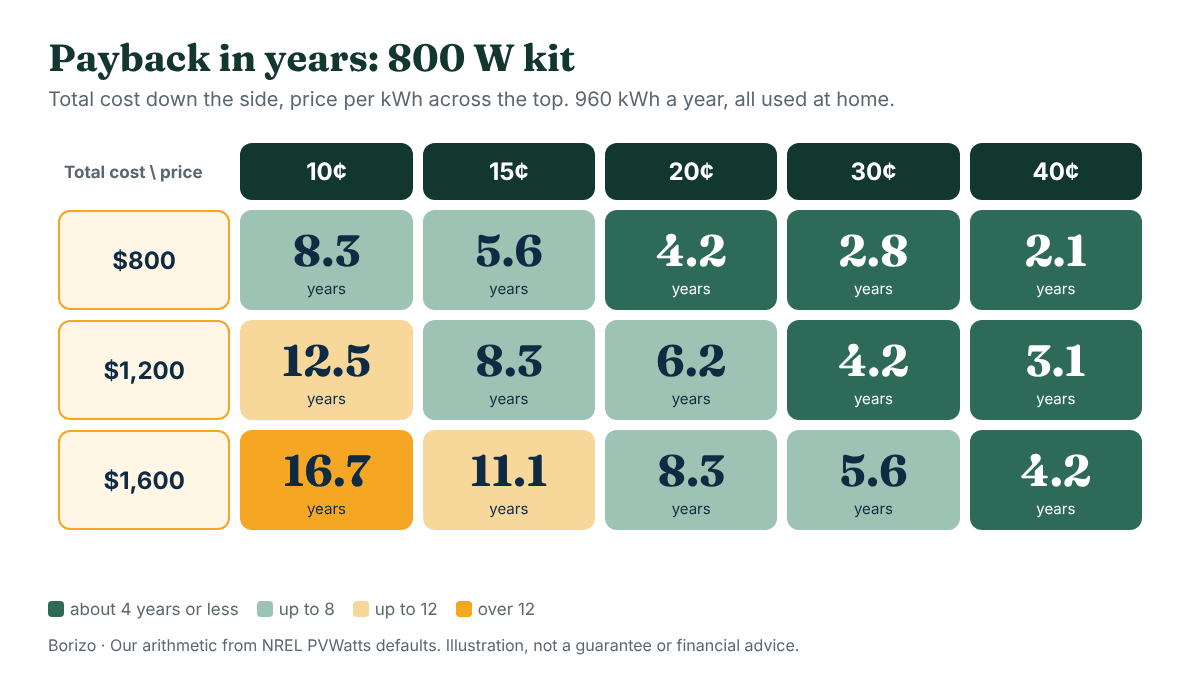
Here is the same 800 W example with three possible total costs. We use round numbers instead of product prices because prices change often and differ by seller. Put your own total in the savings and payback calculator.
| Total cost | 10¢ | 15¢ | 20¢ | 30¢ | 40¢ |
|---|---|---|---|---|---|
| $800 | 8.3 yrs | 5.6 | 4.2 | 2.8 | 2.1 |
| $1,200 | 12.5 yrs | 8.3 | 6.2 | 4.2 | 3.1 |
| $1,600 | 16.7 yrs | 11.1 | 8.3 | 5.6 | 4.2 |
Why real savings can be lower
Not every kilowatt-hour is used at home
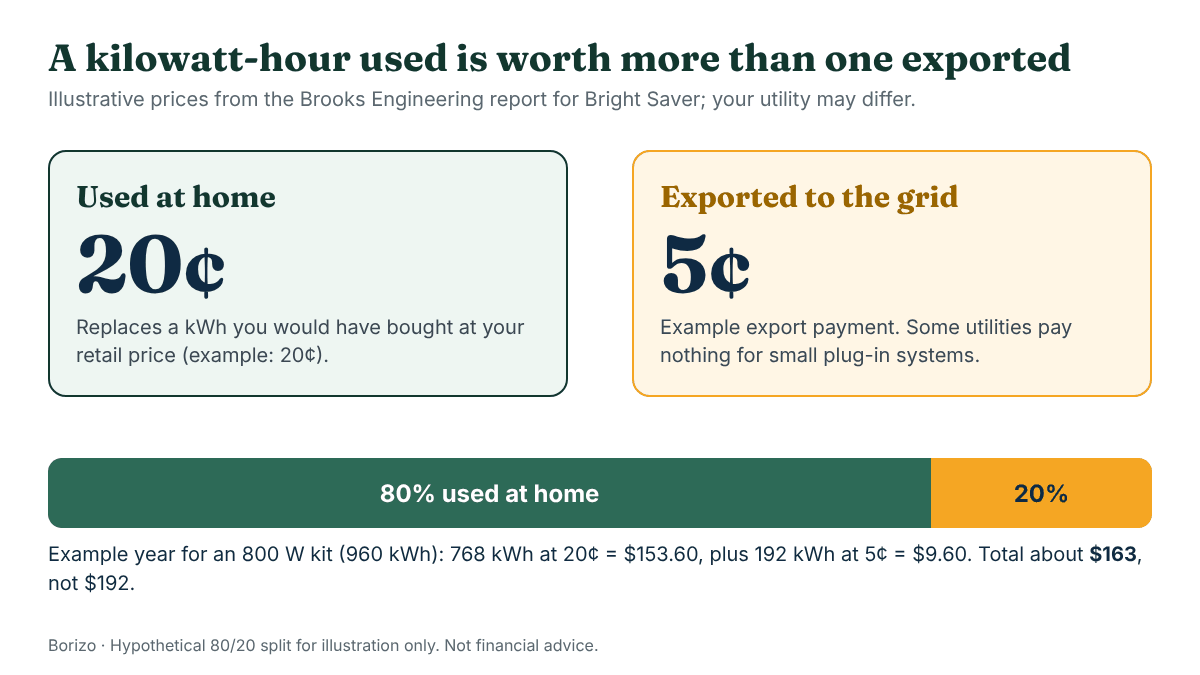
Plug-in solar feeds the circuit it is plugged into, so it first covers whatever is running. If your home uses less than the kit produces at that moment, the extra flows out to the grid. A report by Brooks Engineering for the nonprofit Bright Saver used an example of a $0.20 retail price and a $0.05 payment for exported energy. If, say, 20% of the 960 kWh were exported at that rate and 80% used at home, yearly value would be about $163 rather than $192. We have not found a promise of export payment in the state texts we read, so ask your utility.
If at-home use is only 70% and the rest earns little, the payback in the $1,200 row at 20¢ moves from about 6.2 years to about 8.9 years. Daytime loads matter: working from home, a fridge, a router, a dehumidifier and a pool pump all help.
Your site has less sun than the example
The table assumes 4 peak sun hours a day and a clear, well-aimed setup. NREL’s default allowances for shading and soiling are 3% and 2%, but a railing-mounted panel that faces east or west, or sits in partial shade, can produce much less. Run PVWatts for your address and orientation before you buy.
Other costs and time
- Total cost, not sticker price. Add shipping, tax, mounting hardware and any electrician visit. Our circuit safety guide explains why a check of the circuit can be worth paying for.
- Lifespan and warranty. A payback of 8 years only makes sense if the equipment lasts longer. Read the warranty terms in the listing and keep proof of purchase. We have not verified how long any plug-in kit lasts.
- Rates change. If your price per kWh rises, payback shortens, and if you move, you may take the kit with you (see renters and HOAs).
- Certification. A cheaper kit without a clear certification may cost more if it cannot be used where you live. See how to check a claim.
A worked example
Say your bill shows 20¢ per kWh, you buy an 800 W kit for a total of $1,200 and your balcony gets about 4 peak sun hours a day. Output is roughly 800 × 4 × 0.30 = 960 kWh a year. If you use 80% of it at home, that is 768 kWh worth $153.60. If the other 192 kWh are exported at an example 5¢, add $9.60, for about $163 a year. Payback is $1,200 ÷ $163, or about 7.4 years. If the same balcony only gets 3 sun hours, output drops to about 720 kWh, and payback stretches to roughly 9.8 years. Swap in your own numbers to see where you land, and notice how much the sun hours and the self-use share move the answer.
Is a bigger kit worth it?
Output scales with watts, so a 1,200 W kit makes about 1,450 kWh a year at 4 sun hours versus 960 for 800 W. At 20¢ that is about $290 versus $192. But the extra output is the part most likely to exceed your daytime use, and a larger kit costs more. Compare the extra yearly savings with the extra cost, not just the totals.
Frequently asked questions
How much does an 800 W plug-in solar kit save a year?
Under our assumptions (about 960 kWh a year, all used at home), about $96 at 10¢ per kWh, $192 at 20¢ and $384 at 40¢. Your bill price and sun hours change the result.
How long does plug-in solar take to pay for itself?
Cost divided by yearly savings. For an $800 kit that is about 4 years at 20¢ per kWh and 8 years at 10¢. For $1,600 it is about 8 years at 20¢ and 17 years at 10¢, with all output used at home.
Do I get paid for extra electricity my kit sends to the grid?
Not necessarily. We did not find a promise of export payment in the state texts we read, and one report used an example of $0.05 per kWh for exports. Ask your utility how it treats small plug-in systems.
Which states have the best payback?
Where electricity is expensive and sunny, payback is shortest. Because payback depends mostly on your price per kWh, check your own bill and use the calculator rather than relying on a state average.
Sources
- NREL, PVWatts Version 5 Manual (default 14% losses, 96% inverter efficiency, shading 3%, soiling 2%) and the PVWatts Calculator.
- US Energy Information Administration, Electric Power Annual, Table 2.10, Average Price of Electricity to Ultimate Customers by End-Use Sector, by State: residential prices, 2025 data. Check the Electric Power Monthly table 5.6.A for the latest monthly residential prices by state.
- Brooks Engineering for Bright Saver, “Plug-In Solar Utility Impact in the United States,” December 3, 2025 (illustrative $0.20 retail and $0.05 export example).
- Our own guides on sizing, wattage limits, certification and renters and HOAs.

Borizo is an independent guide to plug-in and balcony solar in the US. We track state laws, check certification claims against official sources, and compare kits using published specifications. Laws change often, so every state page shows a “last updated” date and links to its sources. We earn a commission when you buy through our Amazon links, at no extra cost to you. Our content is for information only and is not legal or electrical advice.