Plug-in Solar vs Rooftop Solar: Cost, Size and Which Fits You
Plug-in solar and rooftop solar use the same kind of panels, but they solve different problems. A rooftop system is a home improvement: a contractor designs it, wires it into your electrical panel and aims to cover most of your bill. A plug-in kit is closer to an appliance: you buy it, set it up and plug it in, and it covers a slice of your daytime use. This guide compares the two on cost, size, paperwork, savings, ownership and flexibility, with a worked cost-per-kilowatt-hour example, and helps you decide which fits your home. It is based on US Department of Energy and EIA data, state law text and Amazon listings we read. We have not installed or tested any system.
Choose rooftop solar if you own a home with a good roof and want to offset most of your electricity use. Choose plug-in solar if you rent, live in a condo, cannot use a roof, or want a small, movable start. Plug-in kits cost much less up front, but they cover much less of your bill.
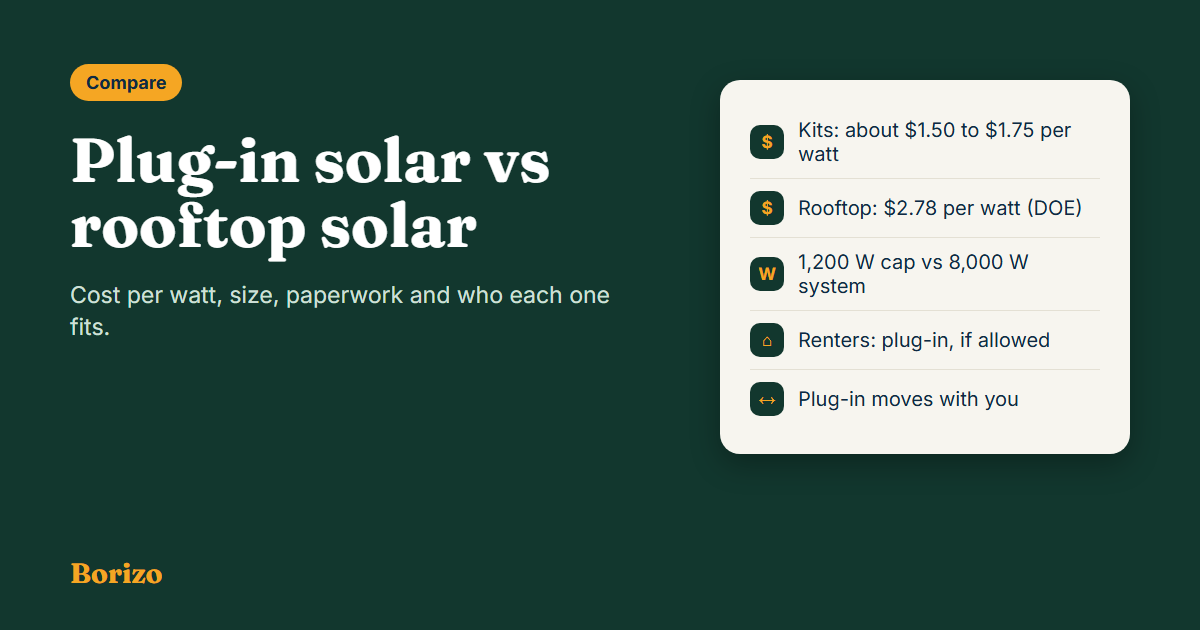
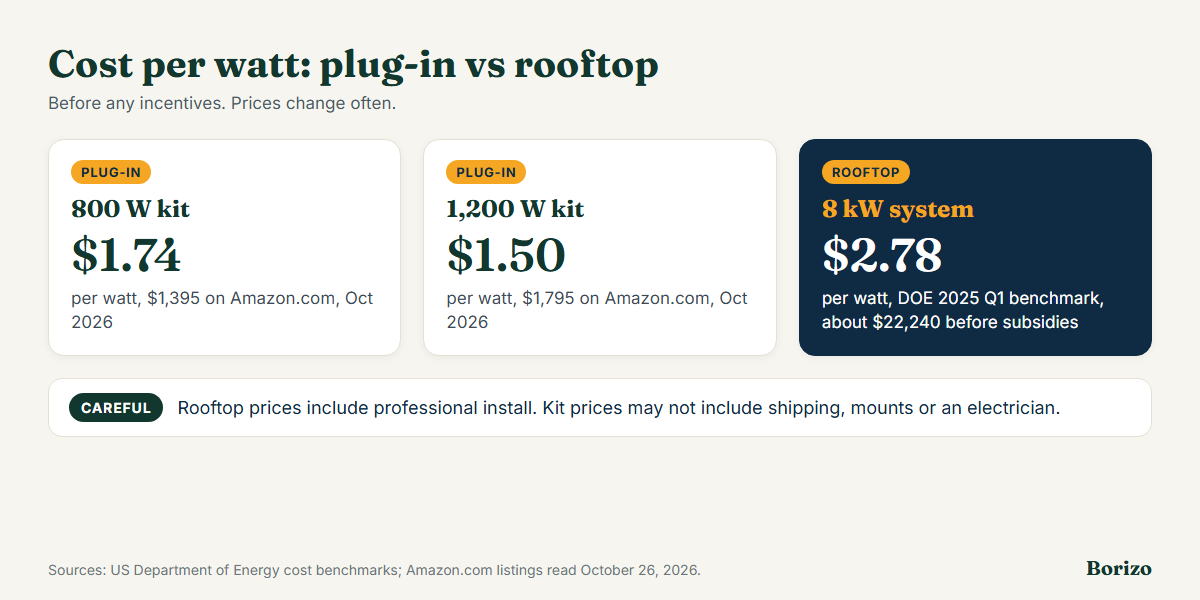
- Price per watt is lower for a plug-in kit in our example: about $1.50 to $1.75 per watt for complete kits on Amazon in October 2026, against DOE’s $2.78 per watt benchmark for a rooftop system installed in 2025. The comparison has caveats, explained below.
- Size is the big difference. Most US plug-in laws cap output at 1,200 W. DOE’s residential benchmark system is 8,000 W.
- Paperwork is lighter for plug-in solar where a state law allows it, but not zero: some states require landlord or utility notice.
- Neither works in a blackout unless it is paired with a battery system designed for backup.
- Incentives have changed recently, and we have not verified whether plug-in kits qualify for any. Check IRS, Energy.gov and your state before counting on one.
Side by side
| Plug-in solar | Rooftop solar | |
|---|---|---|
| Typical system | 400 to 1,200 W, 1 to 6 panels | DOE’s benchmark is 8 kW DC; NREL analyses use an average near 7 kW |
| Up-front price | About $1,395 to $1,795 for complete kits we found on Amazon.com in October 2026 | About $22,000 before subsidies for the DOE 8 kW benchmark ($2.78 per watt, PV only) |
| Who installs it | You, following the manual; an electrician for some setups (Maine above 420 W) | A licensed contractor |
| Connection | Standard wall outlet | Wired into your electrical panel |
| Permits and utility | Depends on the state: possibly landlord notice or a utility form; see the State Laws hub | Usually a permit, inspection and utility interconnection agreement |
| Share of your use | A slice, a few hundred to about 1,000 kWh a year per kit in our examples | Can cover most or all of a home’s use |
| Roof needed | No: railing, wall, patio, yard stand | Yes, usually |
| Renters | Often, where state law gives a path | Rarely |
| Moves with you | Yes | No; it stays with the house |
| Outage | Shuts off | Shuts off unless built with battery backup |
Cost per watt and cost per kilowatt-hour
Dividing the price by the size gives a price per watt. DOE’s 2025 residential benchmark is $2.78 per watt for a PV-only system, which comes to about $22,240 for 8,000 W, before any subsidies that reduce the owner’s cost. The complete plug-in kits we found on Amazon.com in October 2026 were $1,395 for 800 W (about $1.74 per watt) and $1,795 for 1,200 W (about $1.50 per watt). Prices change often, so check before you buy.
A fairer test is cost per kilowatt-hour you can expect each year. Using our shortcut (watts × peak sun hours × 0.30 = kWh per year) with 4 peak sun hours:
| System | Price | Yearly output (4 sun hours) | Price per yearly kWh |
|---|---|---|---|
| 800 W plug-in kit | $1,395 | about 960 kWh | about $1.45 |
| 1,200 W plug-in kit | $1,795 | about 1,440 kWh | about $1.25 |
| 8 kW rooftop (DOE benchmark) | about $22,240 before subsidies | about 9,600 kWh | about $2.32 |
On these round numbers, the plug-in kits are cheaper per unit of yearly output. Several things make the real comparison less simple:
- What the prices include. The DOE benchmark covers a professional installation, including the inverter, wiring, labor and soft costs. A kit price may not include shipping, tax, mounting hardware or an electrician.
- Subsidies. The benchmark is before subsidies. Federal and state incentives for rooftop systems have changed recently, and we have not verified whether plug-in kits qualify for any. We do not quote credit rates here; check Energy.gov’s homeowner’s guide, the IRS and your state.
- How much you use at home. A small kit’s output is usually used almost entirely at home during the day. A large rooftop system produces much more than you use at noon, and the surplus is paid according to your utility’s rules. Our payback guide shows how exported power changes the math.
- Lifespan and warranty. We have not verified how long any plug-in kit lasts. Read the warranty terms, and compare them with a rooftop installer’s.
How much of your bill each can cover
EIA reports that US residential customers averaged 10,791 kWh per year in 2022, about 899 kWh a month. By our round numbers, an 800 W kit at 4 peak sun hours makes about 960 kWh a year, roughly 9% of that average. A 1,200 W kit makes about 1,440 kWh, roughly 13%. The 8 kW example, at about 9,600 kWh, is close to 90%. Your own use and sun will differ, so run NREL’s free PVWatts calculator for your address. If you want to cover most of your bill, a plug-in kit alone will not do it. If you want a modest cut, it can.
Process and paperwork
Plug-in solar
You buy a certified kit, check your state’s rule, tell your landlord or utility where required, and plug it in. Virginia’s law, for example, adds a state form for the utility from January 1, 2027, and tenant notice in Virginia, Vermont and New Jersey (in the bill text we read) runs from 7 to 31 days. See the installation checklist for all 12 steps.
Rooftop solar
A contractor surveys the roof, designs the system, pulls permits, installs it and arranges inspection and the utility’s interconnection agreement. That adds weeks or months before the system turns on. Be careful with offers described as “free solar,” a model the Department of Energy warns about in its consumer article; compare total cost and read any lease or power purchase agreement closely.
Which fits you?
| Your situation | Better fit |
|---|---|
| Own a house, good roof, high electricity use | Rooftop, or both |
| Rent or live in an apartment with a balcony or patio | Plug-in, if your state and lease allow |
| Condo or HOA | Plug-in, subject to your state’s association rules; see renters and HOAs |
| Might move within a few years | Plug-in |
| Want to test solar before a big purchase | Plug-in |
| Need backup power | Neither alone; see plug-in solar in a power outage |
| Shaded roof, sunny balcony | Plug-in |
It is not always either-or. Some homeowners with a rooftop system could still add a small kit elsewhere, but caps and notice rules may count your total solar at one address, so check your state’s wording and your utility’s rules before you do.
Frequently asked questions
Is plug-in solar cheaper than rooftop solar?
Up front, yes: kits cost a small fraction of a rooftop system. Per unit of yearly output, the kits we compared also looked cheaper, though prices, subsidies and how much power you use at home change the result.
Can plug-in solar replace rooftop solar?
Not for most homes. State caps of 1,200 W in most laws limit output to a slice of typical use. A kit works as a small supplement or a starter system, not a full replacement.
Do I need permits for plug-in solar?
Most plug-in laws are written to avoid the standard utility interconnection process for small, certified devices, but some require notice. Local rules on mounting, height or historic districts may still apply, so ask your city or building department.
Which is better for renters?
Plug-in solar, where your state and lease allow it. Rooftop systems belong to the building and are rarely an option for tenants.
Sources
- US Department of Energy, Solar Photovoltaic System Cost Benchmarks (2025 Q1: 8 kW residential, $2.78 per watt PV-only, before subsidies).
- US Department of Energy, Homeowner’s Guide to Solar and Free Solar Panels? Don’t Get Burned.
- US Energy Information Administration, How much electricity does an American home use? (10,791 kWh in 2022).
- NREL, PVWatts Calculator.
- Amazon.com listings for complete plug-in kits, read October 26, 2026 (prices change often).
- State laws: State Laws hub, with the bill text for each state.

Borizo is an independent guide to plug-in and balcony solar in the US. We track state laws, check certification claims against official sources, and compare kits using published specifications. Laws change often, so every state page shows a “last updated” date and links to its sources. We earn a commission when you buy through our Amazon links, at no extra cost to you. Our content is for information only and is not legal or electrical advice.