Best Angle for a Balcony Solar Panel: Tilt, Direction and Railings
A solar panel hung straight down a balcony railing is not pointed at the sky, and that matters. The tilt angle (how far the panel leans from flat) and the direction it faces both change how much sunlight it catches. The good news from government research is that you do not need a perfect angle: output is forgiving. The bad news is that a panel fixed vertically on a railing is a long way from the usual rule of thumb. This guide explains the best angle for balcony solar, how latitude changes it, how tilt compares with direction, and how to test your own railing in a free NREL tool before you buy. It is based on NREL, Department of Energy and EIA sources. We have not tested any mount or kit.
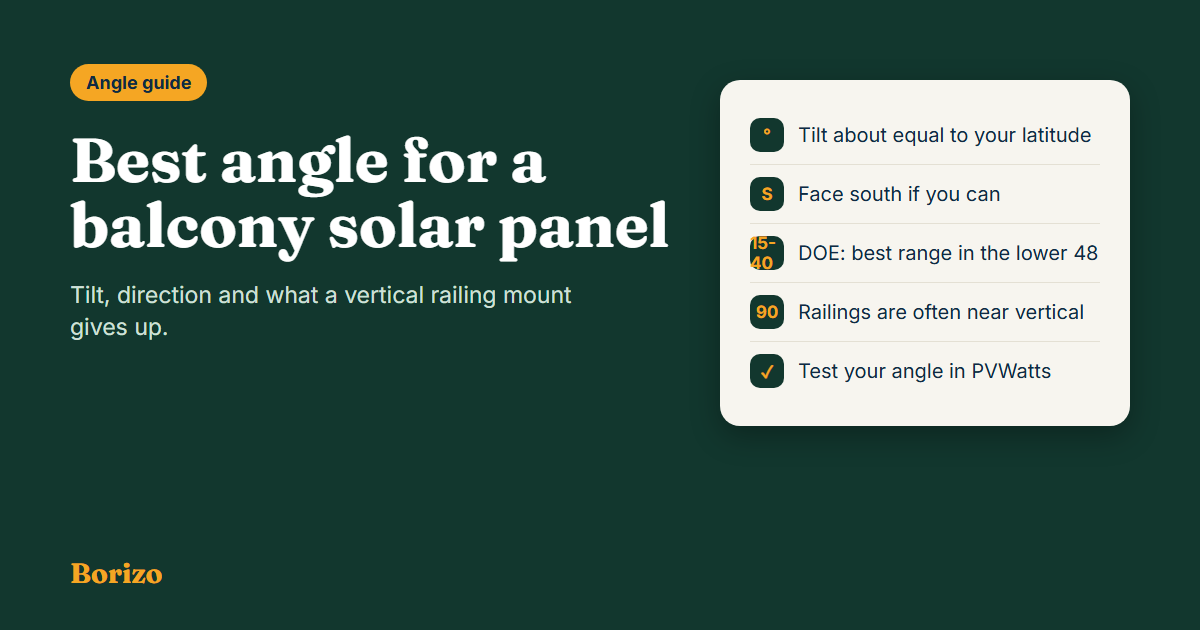
For a fixed south-facing panel in the US, a tilt about equal to your latitude gives the most sunlight over a year, and anything between 15° and 40° facing south works well across the continental US. Tilting toward the sun matters more than most people expect, so a flat-against-the-railing mount usually gives up some output. Use NREL’s PVWatts with your exact tilt and direction to see how much.
- Rule of thumb: tilt about equal to your latitude, facing south (Northern Hemisphere).
- It is forgiving: DOE gives a broad 15° to 40° range as best for the continental US, so you do not need a perfect angle.
- Seasons: a common rule of thumb is to add about 15° to favor winter output and subtract about 15° to favor summer. We could not confirm this in a primary source, so test it in PVWatts.
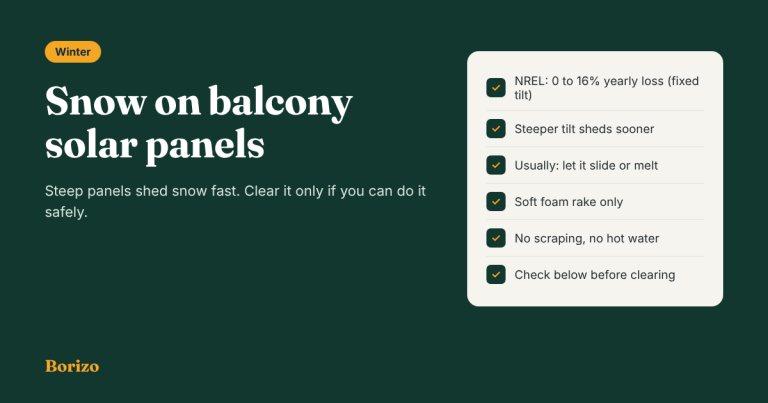
- Steeper tilt sheds snow and hail better but adds wind load. Check the mount’s wind rating.
- Railings are usually vertical (90°). That is far from the best annual angle in most of the US, so test it before you buy.
What “tilt” and “azimuth” mean
Tilt is the angle between the panel and the ground: 0° is lying flat, 90° is standing straight up. Azimuth is the compass direction the panel faces: 180° is due south. In the Northern Hemisphere the sun sits mostly in the southern sky, so a fixed panel generally does best facing south. EIA says the simplest way to maximize the total annual output of a fixed-tilt system in the Northern Hemisphere is to tilt the panels south, and that the farther you are from the equator, the higher the tilt should be.
The latitude rule
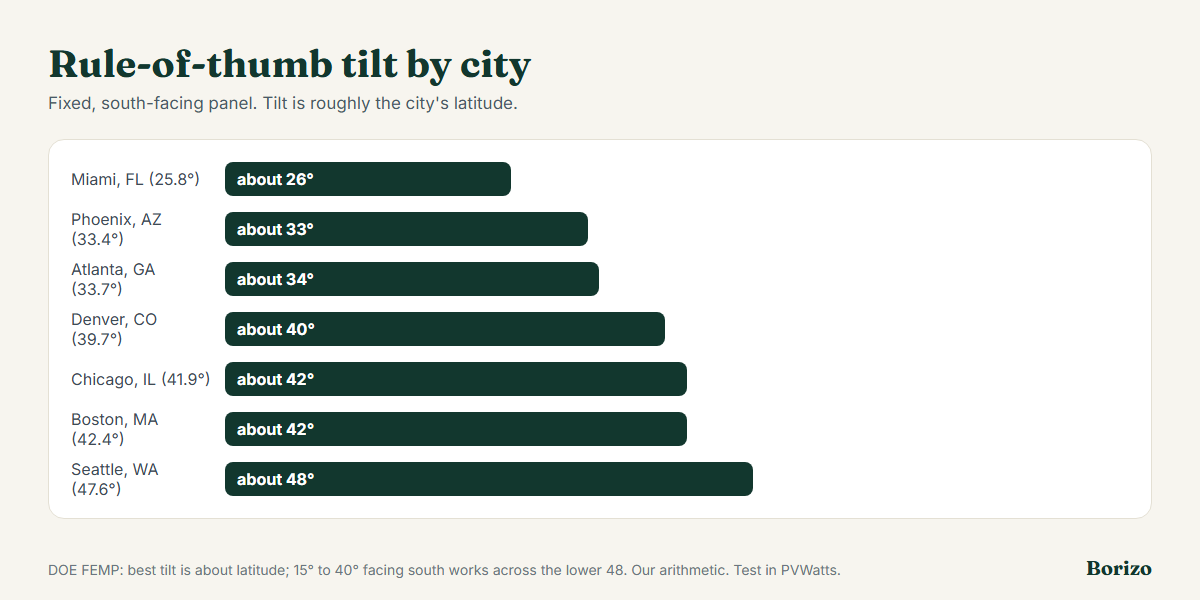
The Department of Energy’s Federal Energy Management Program says the optimal tilt for solar exposure equals the local latitude, and that in the continental US a tilt between 15° and 40° facing south gives the best production. The table below applies the latitude rule to a few cities. Latitudes are rounded. The winter and summer columns use a common rule of thumb (add or subtract 15°) that we could not confirm in a primary source, so treat them as starting points to test in PVWatts. All ranges are our arithmetic, not measurements.
| City | Latitude | Year-round tilt (≈ latitude) | Winter-biased (+15°, rule of thumb) | Summer-biased (−15°, rule of thumb) |
|---|---|---|---|---|
| Miami, FL | 25.8° | about 26° | about 41° | about 11° |
| Phoenix, AZ | 33.4° | about 33° | about 48° | about 18° |
| Atlanta, GA | 33.7° | about 34° | about 49° | about 19° |
| Denver, CO | 39.7° | about 40° | about 55° | about 25° |
| Chicago, IL | 41.9° | about 42° | about 57° | about 27° |
| Boston, MA | 42.4° | about 42° | about 57° | about 27° |
| Seattle, WA | 47.6° | about 48° | about 63° | about 33° |
The winter-biased column matters if your electricity use or rates peak in winter, or if a low winter sun is what your site gets. The summer-biased column suits sunny, cooling-driven regions. The all-year column is the safe default.
Tilt matters more than direction, within reason
A Department of Energy guide finds that annual production from PV systems is generally more sensitive to the tilt angle than to azimuth. That does not mean direction is unimportant. EIA notes that west-facing panels can have an advantage over south-facing ones where demand peaks in the afternoon or evening, because they are tilted toward the setting sun, though customers on net metering generally do not gain from timing unless they are on time-of-use rates. For plug-in solar, where your own use is what counts, a west or east balcony can still be a reasonable choice. We will cover direction in more detail in a separate guide on east, west and south-facing balconies.
What this means for a balcony railing
Most railing mounts hold the panel close to vertical, around 90° from the ground, or let it hang flat against the rail. Many kits sold for balconies include adjustable brackets that angle the panel outward. A vertical panel meets the high summer sun at a poor angle, so it tends to shift output toward the low winter sun and away from midday summer. EIA notes that real installs often use shallower tilts than latitude would suggest because of height limits, shading and layout, and that these constraints can outweigh the gain from an ideal angle.
| Mount type | Typical tilt | What to know |
|---|---|---|
| Flat against the railing | Near 90° | Simple and low wind load, but far from the usual annual best angle in most of the US |
| Angled railing bracket | Adjustable, often 20° to 60° | Lets you move closer to your latitude. Check the maker’s wind and attachment limits |
| Wall mount | Fixed by the bracket | Check the wall type and permission rules if you rent |
| Ground or patio stand | Adjustable | Easiest to set at your target tilt; check wind ballast |
The typical angles in the table are examples of how products are described, not tested figures. Read each product’s specification sheet. We have not measured any mount.
Wind, snow and safety
The Department of Energy’s guidance notes that steeper tilts (up to 60°) shed snow and hail better, while lower tilts reduce wind load, and steeper tilts also increase it. On a balcony, the wind side is the safety side. A panel that catches wind can fall and hurt someone. Use the maker’s mounting hardware, follow its wind and attachment instructions, and do not drill into a structure you do not own without permission. Our installation checklist covers securing the panels (step 9).
Test your own angle in PVWatts
Rather than trust a rule, check your site. NREL’s free PVWatts calculator lets you enter your address, system size, tilt and azimuth, and shows estimated monthly and yearly output.
- Enter your address and a system size, for example 0.8 kW for an 800 W kit.
- Set tilt to the angle you can actually mount, and azimuth to 180° for south (or your real direction).
- Record the yearly kWh.
- Change the tilt to your latitude and compare. The gap is what a better mount might add.
- Repeat for the winter and summer months if your usage changes through the year.
Then put the yearly figure into our savings and payback calculator. If an adjustable bracket adds output worth more than its cost, it may pay for itself; if the gain is small, a simple mount may be enough. See also how many panels you need.
Frequently asked questions
What is the best angle for a balcony solar panel?
For a fixed south-facing panel, about your latitude, which is roughly 25° to 48° across the continental US. The Department of Energy gives 15° to 40° facing south as the best range for most of the continental US, so you do not need to hit one exact number.
Is a vertical panel on a railing bad?
It is usually not the best angle for annual output in most of the US, and it shifts production toward winter. How much you lose depends on your location and direction, so test it in PVWatts. A vertical mount can still be worth it if it is the only spot you have.
Should I change the angle with the seasons?
You can: a common rule of thumb is to add about 15° to your latitude in winter and subtract about 15° in summer. For a balcony kit that is plugged in and left alone, one year-round angle is usually enough, and adjusting is only practical on adjustable mounts.
Does direction matter more than tilt?
For annual output, DOE says production is generally more sensitive to tilt than azimuth. Still, a south-facing panel is the simplest way to maximize annual output, and west or east can suit your daily use pattern.
Sources
- US Department of Energy FEMP, Install and Commission a Photovoltaic System (optimal tilt equals latitude; 15° to 40° facing south in the continental US; steeper tilts shed snow and hail but add wind load).
- US Energy Information Administration, Solar photovoltaic output depends on orientation, tilt, and tracking (south-facing tilt; higher tilt with latitude; west-facing and time-of-use; real installs).
- NREL, PVWatts Calculator (estimates output for your address, tilt and azimuth).
- Department of Energy, On-Site Commercial Solar PV Decision Guide (production generally more sensitive to tilt than azimuth).

Borizo is an independent guide to plug-in and balcony solar in the US. We track state laws, check certification claims against official sources, and compare kits using published specifications. Laws change often, so every state page shows a “last updated” date and links to its sources. We earn a commission when you buy through our Amazon links, at no extra cost to you. Our content is for information only and is not legal or electrical advice.