Which Outlet Can a Plug-in Solar Kit Use? Circuits, GFCI and Cords
“Just plug it into any outlet” is the pitch for plug-in solar, but not every outlet is a good choice. The outlet decides which circuit your kit feeds, what else is on that circuit, and whether protective devices like a ground-fault (GFCI) outlet behave the way they were designed to. This guide explains how to pick the outlet and circuit for a plug-in kit: how to tell 15 A from 20 A, why one kit per outlet matters, what to do about GFCI and outdoor outlets, and why extension cords and power strips are a question for the manual and an electrician. It is based on UL Solutions’ safety commentary, state law text and manufacturer information. We have not installed or tested any kit, and this is general information, not electrical advice.
Use a standard, grounded wall outlet on a circuit you have identified, with no heavy loads and no other solar kit, and plug in only with the cable the maker supplies. Avoid guessing about GFCI, outdoor outlets, extension cords and power strips; check the manual and ask a licensed electrician.
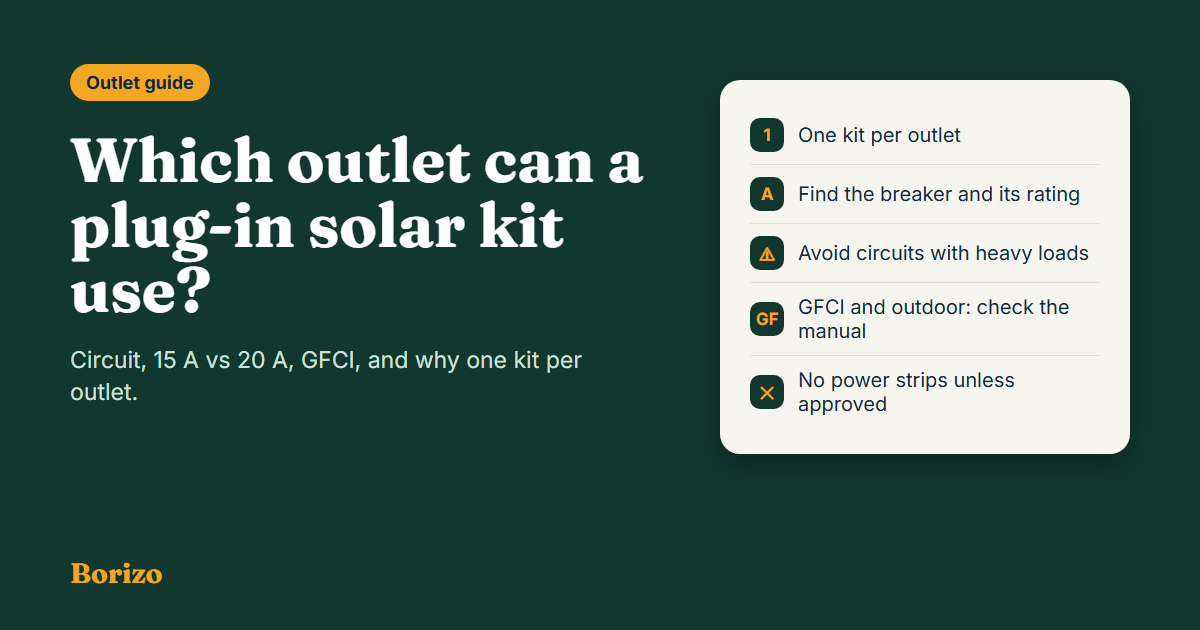
- The circuit matters more than the outlet. Everything on the same breaker shares the wire your kit feeds.
- One kit per outlet. Colorado’s law says so directly, and it is a sensible rule everywhere.
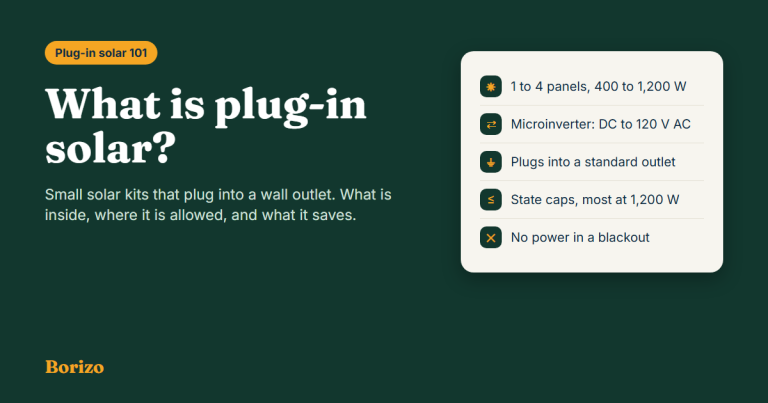
- Know your breaker. A 1,200 W kit at 120 V is about 10 A of current, a large share of a 15 A circuit.
- GFCI and outdoor outlets are special cases. UL says ground-fault devices assume one-way current flow and may not work as intended with a kit feeding power back.
- Extension cords and power strips: none of the official sources we read cover them. Use the maker’s cable and ask an electrician before using anything else.
Why the circuit matters more than the outlet
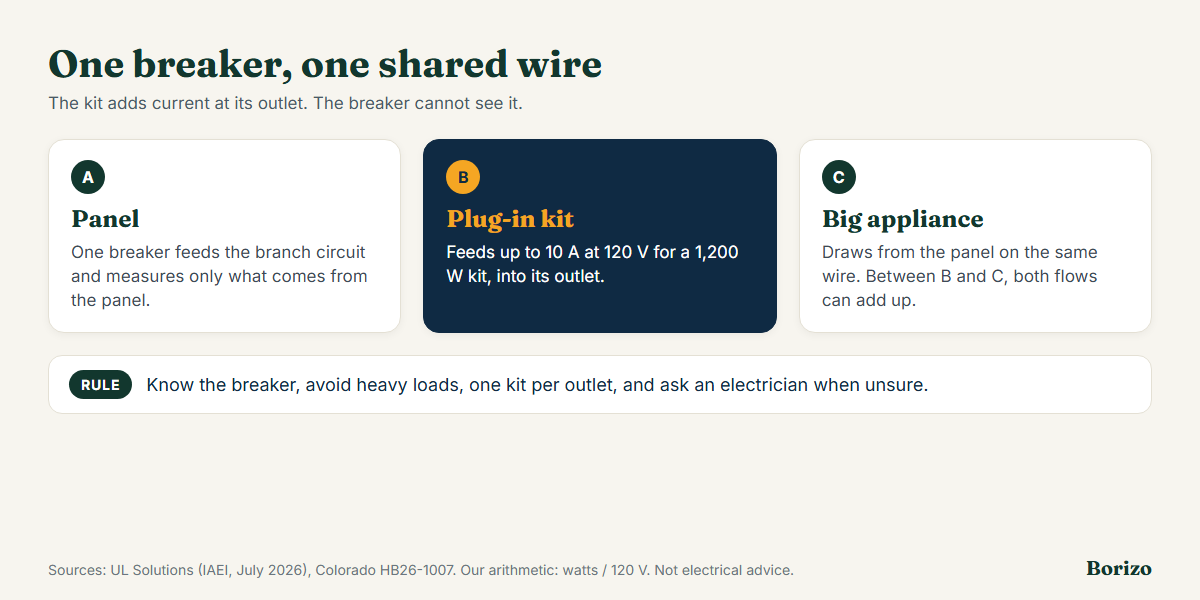
A wall outlet is not a separate power source. It is a point on a branch circuit: one breaker in your panel feeds a run of wire that connects several outlets, and sometimes lights. When you plug in a solar kit, its power joins that wire. UL Solutions, which wrote the UL 3700 standard, explains that branch circuits are designed for one-way power flow from the panel to the load. A kit adds current at the outlet, and the breaker only measures what comes from the panel. On the stretch of wire between the kit and a big appliance on the same circuit, the two flows can add up past the wire’s rating without the breaker tripping. That overload risk is why safety experts focus on circuits, as we explain in our wattage limit and circuit safety guide.
So choosing an outlet really means choosing a circuit. Before you plug in, find out which breaker feeds that outlet, what its rating is, and what else is on it.
15 A or 20 A: how to tell
Most home outlets are on 15 A or 20 A branch circuits at 120 V. The breaker’s rating is printed on its switch in your panel. The outlet itself gives a hint: a 15 A receptacle has two vertical slots, and many 20 A receptacles have a T-shaped slot on one side, but a 15 A outlet can also be installed on a 20 A circuit, so the faceplate alone is not proof. Look at the breaker, and if you cannot tell which breaker feeds the outlet, an electrician or a simple circuit tracer can map it.
| Kit AC output | Current at 120 V | Share of a 15 A circuit | Share of a 20 A circuit |
|---|---|---|---|
| 400 W | about 3.3 A | about 22% | about 17% |
| 800 W | about 6.7 A | about 44% | about 33% |
| 1,200 W | 10 A | about 67% | 50% |
These are our own arithmetic (watts ÷ 120 V), not a code compliance calculation. The share of the breaker rating tells you how much of the circuit’s capacity the kit’s current could use at full output, on top of whatever the appliances on that circuit draw. APsystems says that two of its EZ1 microinverters can together provide up to 1,800 W on a standard 15 A circuit; that is a manufacturer claim, and most state caps are lower. Maine requires a dedicated circuit and a licensed electrician for systems above 420 W.
A good habit is to pick a circuit with light loads: avoid ones that also feed a space heater, window air conditioner, microwave or other large appliance. Our kit size calculator helps you size the kit itself.
One kit per outlet, one circuit at a time
Colorado’s HB26-1007 says one device per wall outlet. Even where a law does not say so, plugging two kits into the same outlet, or into outlets on the same circuit, stacks their output on the same wire. Several state caps also count total output per meter, customer or address, so a second kit may push you over the limit. See how the 1,200 W caps are counted.
GFCI, outdoor and balcony outlets
A GFCI outlet (the kind with “test” and “reset” buttons) trips when it detects current leaking where it should not. UL Solutions notes that ground-fault devices are designed around the assumption that current flows in one direction and may not work as intended when a kit feeds power back into the circuit. That matters most for outdoor and balcony outlets, which are often GFCI-protected. Practical advice:
- Read your kit’s manual for what it says about GFCI-protected and outdoor outlets.
- If the outlet keeps tripping, do not bypass the GFCI. Ask an electrician.
- Do not move the plug to a different outlet to “get around” protection without understanding why it tripped.
- Ask an electrician about the best outlet for a balcony or patio kit, which may include a dedicated one.
We found no official source that says plug-in kits are always fine, or never fine, on GFCI outlets, so treat this as an open question to settle with the manufacturer and an electrician.
Extension cords and power strips
People often want to run the kit’s cable to a nearby outlet. The official sources we read do not address extension cords or power strips for plug-in solar. Our advice is conservative:
- Use only the cable that comes with the kit, or one the manufacturer approves in writing.
- Never plug a kit into a power strip or surge protector unless the manual allows it.
- Do not daisy-chain cords or run a cord under a rug or through a closed door or window.
- If the supplied cable is too short, ask the maker or an electrician about a longer approved cable or a new outlet.
A quick outlet checklist
- Identify the breaker that feeds the outlet and note its rating.
- List what else is on that circuit; avoid heavy loads.
- Make sure it is a standard, grounded outlet in good condition: not loose, cracked, discolored or warm.
- Confirm one kit per outlet and that your total stays under your state’s cap.
- Check your manual for GFCI and outdoor guidance, and ask an electrician if unsure.
- Use the maker’s cable, and do not use a power strip or extension cord unless approved.
- Plug in following the manual’s order, and keep the plug’s prongs covered or out of reach, since UL warns the blades can be energized in sunlight.
This is step 7 and 8 of our installation checklist, and it follows from how balcony solar works.
Frequently asked questions
Can I plug a solar kit into a regular wall outlet?
Yes, that is how plug-in kits are meant to connect, as long as the kit is certified and your state allows it. Pick a grounded outlet on a circuit you have identified, without heavy loads or another solar kit.
Do I need a dedicated circuit?
Maine requires a dedicated circuit and a licensed electrician for systems above 420 W. Other states we read do not, but a dedicated circuit is the simplest way to avoid overloading shared wiring, so ask an electrician if you are unsure.
Can I use a GFCI outlet?
UL says ground-fault devices assume one-way current and may not work as intended with a kit feeding power back. Follow your manual and ask an electrician rather than assuming either way.
Is it safe to use an extension cord?
The official sources we read do not cover it. Use the cable the maker supplies, and ask the manufacturer and a licensed electrician before using an extension cord or power strip.
Sources
- UL Solutions, “Question Corner,” IAEI Magazine, July 1, 2026 (one-way branch circuits, GFCI and ground-fault devices, energized plug blades).
- APsystems, EZ1 for consumers (two units up to 1,800 W on a standard 15 A circuit), read October 26, 2026.
- State laws: Colorado HB26-1007 (one device per wall outlet) and Maine LD 1730 (dedicated circuit and licensed electrician above 420 W), read October 26, 2026. All states: State Laws hub.

Borizo is an independent guide to plug-in and balcony solar in the US. We track state laws, check certification claims against official sources, and compare kits using published specifications. Laws change often, so every state page shows a “last updated” date and links to its sources. We earn a commission when you buy through our Amazon links, at no extra cost to you. Our content is for information only and is not legal or electrical advice.