How Much Does a Plug-in Solar Kit Cost? Prices and Hidden Extras
How much does a plug-in solar kit cost? The honest answer is a range, and the sticker price is only part of it. When we read Amazon.com listings in October 2026, complete kits ran from $1,395 to $1,795 for most sizes, one 800 W kit was listed at $3,995, and inverter-only products ranged from under $80 to over $370. This guide breaks down what is in the price, shows the cost per watt, lists the extras people forget, and explains why the cheapest listing is not always the best value. It is based on listings we read on October 26, 2026 and on US Department of Energy cost data. Prices change often, and we have not bought or tested any product.
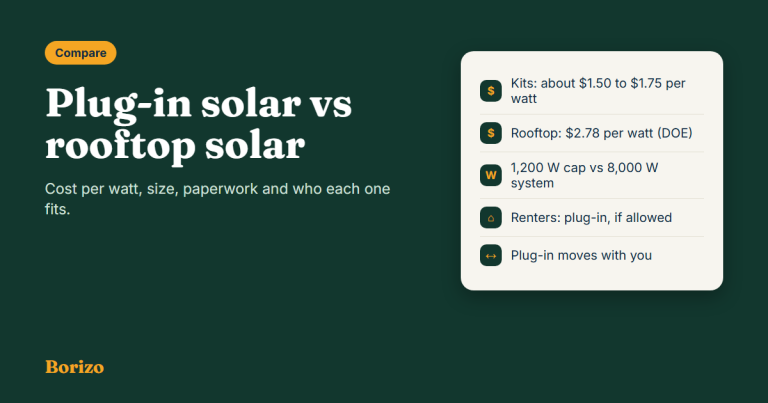
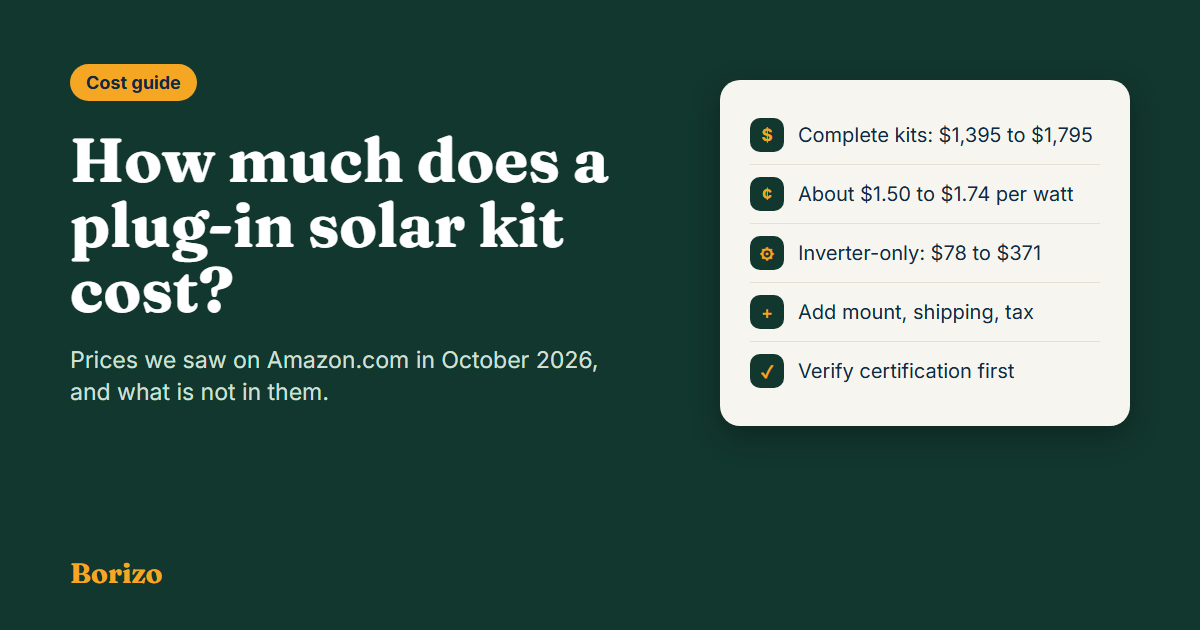
Expect roughly $1,400 to $1,800 for a complete 800 W to 1,200 W kit from the Amazon.com listings we read, about $1.50 to $1.75 per watt. Add shipping, tax, a mount and any electrician visit. Very cheap inverter-only listings may lack the certification your state requires.
- Complete kits (October 2026, Amazon.com): $1,395 for 800 W, and $1,795 for 1,200 W and 1,600 W; a 400 W kit was $1,395 too, so check the price per watt.
- Cost per watt: about $1.74 for the 800 W kit and $1.50 for the 1,200 W kit. DOE’s 2025 rooftop benchmark is $2.78 per watt before subsidies.
- Inverter-only listings are not kits. You still need panels, mounting and a cable, and many showed no certification.
- Extras add up: shipping, tax, mounting hardware, a longer approved cable, and possibly an electrician.
- Cheap can be costly if the device is not certified for your state or the warranty is weak.
What we found on Amazon.com
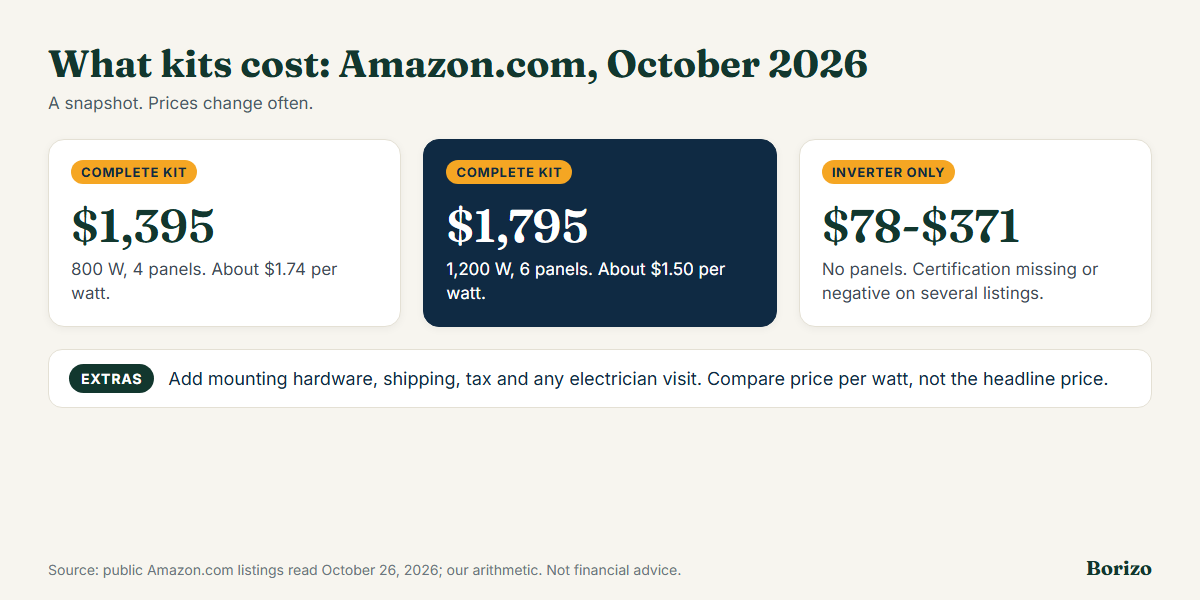
We read 15 public Amazon.com listings on October 26, 2026, without logging in or buying anything. The shipping estimate shown to us was for another country, so we could not confirm who sold and shipped several kits. Treat all numbers as a snapshot, and check the live listing before you decide.
| Type | Size | Price seen | Cost per watt | What we noted |
|---|---|---|---|---|
| Complete kit, 4 panels, APsystems microinverter | 800 W | $1,395 | about $1.74 | Listing says UL 3700 certified for plug-in and complies with UL 1741 |
| Complete kit, 6 panels, 2 microinverters | 1,200 W | $1,795 | about $1.50 | Same certification wording |
| Complete kit, 8 panels, 2 microinverters | 1,600 W | $1,795 (check) | about $1.12 | Above the 1,200 W cap in most states; same price as the 1,200 W kit, so verify |
| Complete kit, 2 bifacial panels | 400 W | $1,395 | about $3.49 | No UL or ETL wording found in the listing |
| Complete kit, 800 W panels plus 800 W inverter | 800 W | $3,995 | about $5.00 | UL 1741 anti-islanding wording; no UL 3700 wording found |
| Inverter only (various sellers) | 500 to 2,800 W | $77.99 to $370.99 | n/a | No panels included; certification wording missing or negative on several; one 2,000 W unit supports only 240 V |
Two things stand out. First, the price per watt of complete kits varies by a factor of three or more, so a bigger or cheaper-looking listing can still be worse value. Second, the lowest prices are for inverters, not kits. An inverter alone is only part of a system, and some of those listings showed no certification or said outright that they were not UL 1741 certified. Under state laws that require UL 3700 or a comparable standard, that is a red flag.
What is in the price, and what is not
| Item | Usually included in a complete kit? | What to check |
|---|---|---|
| Panels | Yes | Rated watts, size and weight against your space |
| Microinverter(s) | Yes | AC rating at or under your state’s cap; certification; 120 V output |
| AC cable and plug | Yes, length varies | One listing mentions a 50 ft cord; confirm the length and that it is approved for use |
| Mounting hardware | Sometimes | Many listings do not say; see mounting without drilling |
| Monitoring app | Often free | Wi-Fi or Bluetooth needs; warranty registration |
| Shipping and tax | No | Check at checkout; large panels may ship by freight |
| Electrician | No | Maine requires one above 420 W; ask one to check your circuit if unsure |
| Permits or notices | No | Virginia’s law says the utility cannot charge a fee, but the form and review take time; see the checklist |
Cost per watt: plug-in vs rooftop
The Department of Energy’s 2025 residential benchmark is $2.78 per watt for a PV-only system installed by a contractor, before subsidies. The complete plug-in kits above work out to about $1.50 to $1.74 per watt before extras. A plug-in kit is not the same product as a rooftop installation, so the comparison has limits; we explain them in plug-in solar vs rooftop solar.
Cost per kilowatt-hour you can expect
What you pay is only half the question. What the kit gives back is the other half. With our shortcut (watts × peak sun hours × 0.30 = kWh per year) at 4 peak sun hours, an 800 W kit makes about 960 kWh a year, so $1,395 is about $1.45 per yearly kWh. The savings depend on your rate: at 20¢ per kWh, 960 kWh is worth about $192 a year if you use it all, which gives a payback of about 7 years on the kit price alone. Shipping, a mount or an electrician would lengthen that. Use our savings and payback calculator with your own price, and see is plug-in solar worth it and how much a panel makes per day.
Ways to avoid overpaying
- Size to your cap and your use. A kit larger than your state’s cap is wasted. See how many panels you need.
- Compare price per watt, not the headline price. Divide the price by the AC and DC ratings.
- Confirm the certification before you pay. A cheap, uncertified device may not be legal where you live. See the UL 3700 guide.
- Read the warranty and the return policy. Large panels are costly to ship back.
- Price the extras. Add a mount, a tether, shipping, tax and any electrician visit.
- Re-check the price. Prices on these listings change.
- Look for the seller. Check who sells and ships the product and what the return process is.
When a higher price is justified
A lower price is not always the better deal, and a higher one is not always a rip-off. Reasons to pay more include a certification you have confirmed in the lab’s directory, a clear warranty with a US contact, a microinverter that tracks each panel independently, a longer approved cable, mounting hardware that suits your railing or stand, and an app that is maintained. Reasons to be wary include a price that is far below similar kits with no explanation, no certification wording, a seller you cannot identify, or a size above your state’s cap. Our buying guide lists the kits we found with their specifications, and what a microinverter does explains the part that matters most.
Frequently asked questions
How much does a plug-in solar kit cost?
The complete 800 W to 1,200 W kits we saw on Amazon.com in October 2026 were $1,395 to $1,795, about $1.50 to $1.74 per watt. Prices change often, and extras like a mount, shipping, tax or an electrician add to the total.
Is a cheap inverter on Amazon okay?
Not necessarily. Some inverter-only listings showed no certification, or said the unit was not UL 1741 certified. State laws require UL 3700 or a comparable standard, so confirm certification in the lab’s directory before buying.
Do I need to pay an electrician?
Not always, but Maine requires a licensed electrician above 420 W, and having one check the circuit is a good idea in any state if you are unsure.
Is it cheaper than rooftop solar?
Per watt, the complete kits we saw were cheaper than DOE’s 2025 rooftop benchmark of $2.78 per watt, but kits are smaller and cover less of your bill.
Sources
- Amazon.com listings for complete plug-in kits and inverter-only products, read October 26, 2026 (prices, sizes and certification wording as shown in the listings).
- US Department of Energy, Solar Photovoltaic System Cost Benchmarks (2025 Q1, $2.78 per watt PV-only, before subsidies).
- State laws on size caps, certification and the electrician requirement: State Laws hub and Maine LD 1730.
- NREL, PVWatts Calculator (method behind our output shortcut).

Borizo is an independent guide to plug-in and balcony solar in the US. We track state laws, check certification claims against official sources, and compare kits using published specifications. Laws change often, so every state page shows a “last updated” date and links to its sources. We earn a commission when you buy through our Amazon links, at no extra cost to you. Our content is for information only and is not legal or electrical advice.