Plug-in Solar and Time-of-Use Rates: How to Get More Value
More US households are being moved onto time-of-use electricity rates, where the price of a kilowatt-hour depends on the hour you use it. That changes how much a plug-in solar kit saves, and not always in the direction people expect. A kit makes most of its power around midday, when time-of-use power is usually cheap, and very little during the evening peak, when power is expensive. This guide explains how time-of-use rates work, why they can make a small kit’s savings look smaller, how to work out what your kit is worth on your plan, and the practical ways to get more out of it: shifting chores, facing panels west and, in some cases, adding storage. It uses a real state regulator’s rate table as the example. We have not tested any kit.
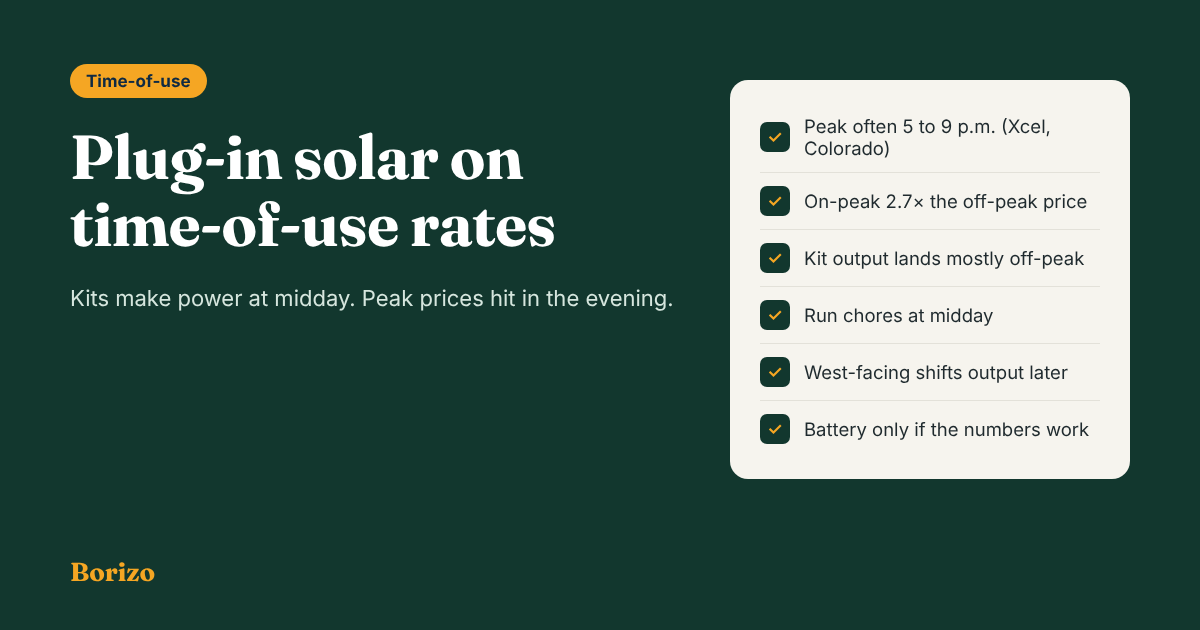
On a time-of-use rate, plug-in solar mostly offsets cheaper off-peak power, because it produces most around midday and little in the evening peak. Its dollar savings depend on your off-peak and mid-day prices, not your average price. You can raise the value by running dishwashers, laundry and other flexible loads while the sun is up, by aiming panels toward the west if your peak is late afternoon, and, if the numbers work, by adding a battery.
- Peak hours are usually late afternoon and evening. Colorado’s regulator lists Xcel Energy’s on-peak window as 5 p.m. to 9 p.m. on non-holiday weekdays.
- The price gap can be large. On that rate, on-peak power costs 2.7 times the off-peak price.
- Solar and the peak barely overlap. A balcony kit makes most of its energy around midday, so on many plans it offsets off-peak power.
- Move flexible chores into sunny hours. That uses your own solar and avoids peak prices at the same time.
- West-facing panels shift output later. That can help on a plan with a late-afternoon peak, though total output is usually lower than facing south.
How time-of-use rates work
On a flat rate, every kilowatt-hour costs the same no matter when you use it. On a time-of-use (TOU) rate, the day is split into periods with different prices, typically a short, expensive on-peak window and cheaper off-peak hours. Some plans add a mid-peak or “shoulder” period, and many change by season.
Colorado’s Public Utilities Commission says TOU rates are “designed to reflect the true cost of generating and delivering electricity across the day.” Its page for Xcel Energy customers gives a clear example:
| Season | On-peak (5 to 9 p.m., non-holiday weekdays) | Off-peak (all other hours) |
|---|---|---|
| Summer (June to September) | $0.21277 per kWh | $0.07884 per kWh |
| Non-summer (October to May) | $0.18331 per kWh | $0.06792 per kWh |
The PUC notes that on-peak rates “will be 2.7 times higher than Off-Peak.” Your utility’s hours may differ; some peaks start at 4 p.m., some run into the night, and some apply on weekends. Look for “TOU” or the plan name on your bill, then find the schedule on your utility’s website. Our guide to kit costs and the payback method both start from the price you actually pay.
When a plug-in kit makes its power
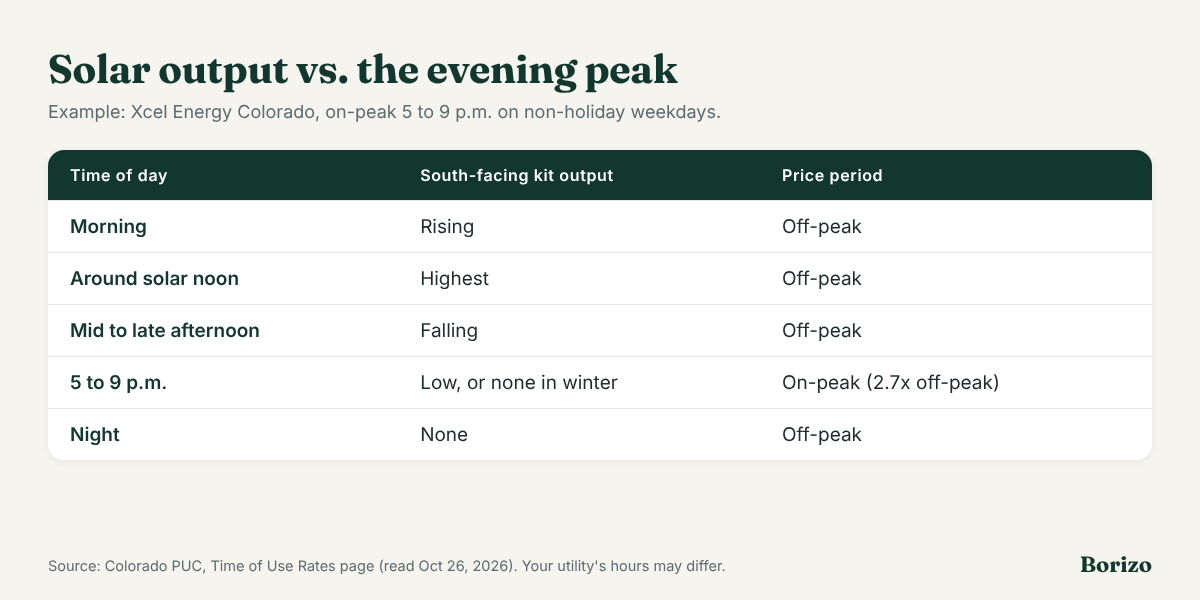
Solar output follows the sun. A south-facing panel produces most around solar noon and tapers off toward morning and evening. By 5 p.m. in winter, the sun is low or down across much of the US, and even in summer the last hours before sunset produce only a small share of the day’s energy. Our daily output guide explains how to estimate production through the day.
Put that next to a 5 p.m. to 9 p.m. peak and the overlap is small. On a plan like Xcel’s, most of what a south-facing kit makes lands in off-peak hours.
What that means for savings
Savings from plug-in solar come from the electricity you no longer buy. On a TOU plan, each kilowatt-hour the kit offsets is worth the price of the period it was used in. Here is an illustration using our savings example from the payback guide, where an 800 W kit makes roughly 960 kWh a year, and the Xcel base rates above:
- If nearly all of that energy offsets off-peak power at about $0.068 to $0.079 per kWh, it is worth roughly $65 to $76 a year in base energy charges.
- If some of it, say 10%, landed in the peak window at about $0.18 to $0.21, the value rises by only a few dollars a year.
That is our arithmetic with base rates only. Real bills include other per-kWh charges and riders that also scale with usage, so actual savings per kWh are often higher than the base rate alone. The point is relative: on a TOU plan, the kit’s value tracks your off-peak price. Compare that with a flat-rate customer, whose kit offsets every kWh at the same average price.
The Colorado PUC also describes TOU rates as revenue neutral for most customers, meaning bills should stay about the same overall for typical usage. So a TOU plan is not automatically worse; it just rewards different habits.
Five ways to get more from your kit on TOU
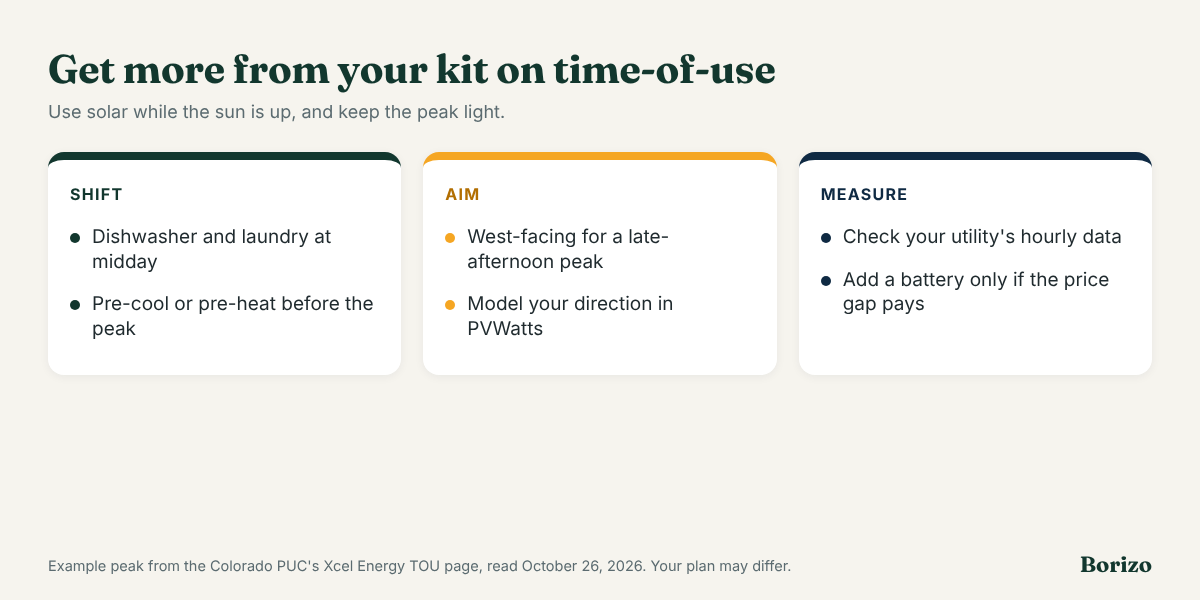
1. Run flexible loads while the sun is up
Dishwashers, washing machines, dryers, pool pumps and EV charging can often run at midday instead of in the evening. On a sunny day that energy comes partly from your kit, and on a TOU plan you also avoid peak prices. This is the cheapest improvement and works with any kit. Many appliances have delay-start timers.
2. Pre-cool or pre-heat
If you use a window air conditioner or electric heat, running it a little harder in the early afternoon and easing off during the peak shifts load out of the expensive window. Keep the circuit question in mind: a big air conditioner on the same circuit as the kit adds to the overload risk explained in our wattage limit guide.
3. Consider a west-facing spot
A west-facing panel produces more in the afternoon and less in the morning. On a plan whose peak starts at 4 or 5 p.m., that can move a little more output into higher-priced hours, at the cost of some total yearly energy compared with facing south. Our east, west and south guide explains the trade-off, and NREL’s free PVWatts tool can model your exact direction.
4. Use your utility’s hourly data
Many utilities with smart meters show hour-by-hour usage online. Compare your midday use with your kit’s expected output. If your home uses less than the kit makes at midday, the extra flows out to the grid, and what it earns depends on your utility’s export rules. See our monitoring guide for ways to measure the kit itself.
5. Add storage only if the numbers work
A battery can move midday solar into the peak window, earning the gap between peak and off-peak prices on each stored kWh, minus losses. On the Xcel rate that gap is about $0.12 to $0.13 per kWh. Whether that justifies the cost of a battery depends on how much you can shift each day and the battery’s price and lifespan. Compare it with the alternative of buying a bigger kit or doing nothing, and see our power station comparison for the safety points.
Should you switch to or from a TOU plan?
Where your utility lets you choose, the right plan depends on when your household uses power, not mainly on the solar kit. A small kit changes your midday use only modestly. Households that can keep evening use low often do well on TOU; households that cook, do laundry and run heating or cooling mostly between 5 and 9 p.m. may pay more. Many utilities offer a bill comparison tool based on your actual hourly use. Run it before you switch, and run it again a few months after installing your kit.
Frequently asked questions
Is plug-in solar worth it on a time-of-use rate?
It can be, but its savings depend on your off-peak and midday prices, because a kit produces most around midday. Shifting dishwashers, laundry and other flexible loads into sunny hours raises the value of every kWh the kit makes.
Does plug-in solar help during peak hours?
Only a little on most plans. Peak windows usually run in the late afternoon and evening, when solar output is low or zero. A west-facing panel shifts some output later, and a battery can store midday solar for the peak.
What are typical time-of-use peak hours?
They vary by utility. Colorado’s regulator lists Xcel Energy’s on-peak hours as 5 p.m. to 9 p.m. on non-holiday weekdays. Check your bill or your utility’s website for your plan’s hours and prices.
Sources
- Colorado Public Utilities Commission, Time of Use Rates (definition; Xcel Energy on-peak 5 to 9 p.m. weekdays; seasonal rate table; on-peak 2.7 times off-peak; revenue neutral for most customers), read October 26, 2026.
- NREL, PVWatts Calculator (hourly output by tilt and direction).
- Our guides on savings and payback, daily output and panel direction.

Borizo is an independent guide to plug-in and balcony solar in the US. We track state laws, check certification claims against official sources, and compare kits using published specifications. Laws change often, so every state page shows a “last updated” date and links to its sources. We earn a commission when you buy through our Amazon links, at no extra cost to you. Our content is for information only and is not legal or electrical advice.