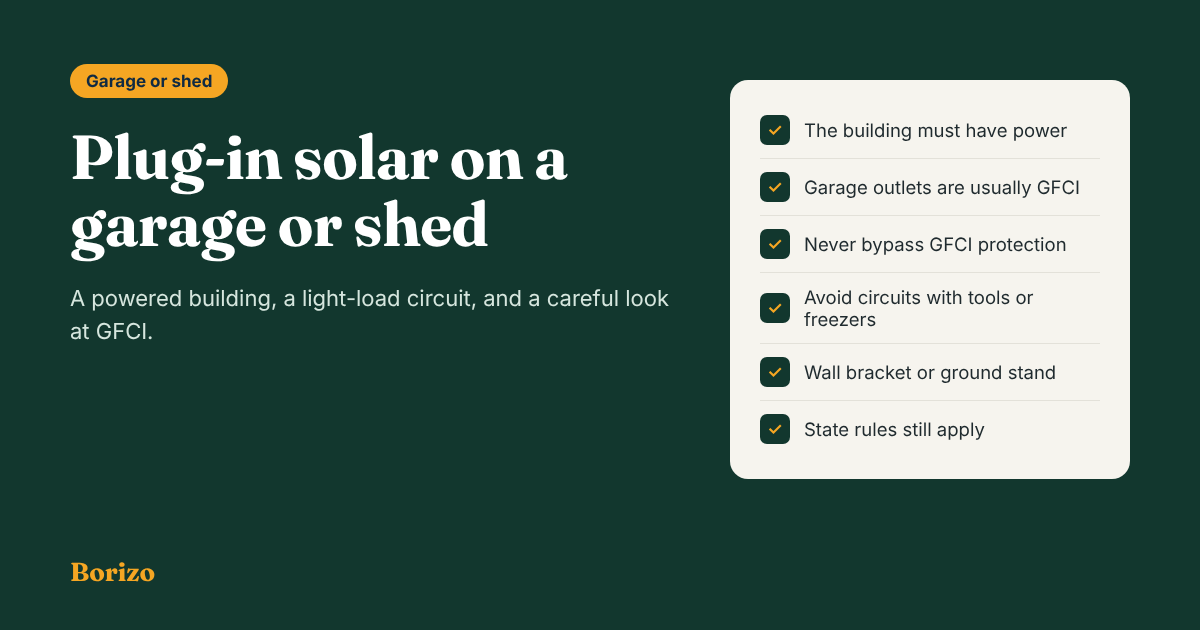
Plug-in Solar on a Garage or Shed: Outlets, GFCI and Mounting
A garage or shed often has the sunniest wall or roof on the property and a spare outlet inside, which makes it an obvious spot for a plug-in solar kit. It can work well, but these buildings come with their own quirks. Garage outlets are usually GFCI-protected by code, which interacts awkwardly with plug-in kits. Garage circuits often run freezers, tools and door openers. And a shed with no power at all cannot host a grid-tied kit, because the kit needs the grid to run. This guide explains how to tell whether your garage or shed is a good candidate, the outlet and circuit questions to settle, where to mount the panels, and what to do if the building has no power. It is based on National Electrical Code commentary, UL Solutions’ safety guidance and state law text. We have not tested any kit.
A garage or powered shed can host a plug-in kit if it has a sunny wall, roof edge or patch of ground, and an outlet on a circuit without heavy tools or appliances. Garage outlets usually have GFCI protection, so check your kit’s manual and ask an electrician about the right outlet. A shed with no electrical service cannot use a grid-tied plug-in kit; use an off-grid panel with a battery instead.
- No power, no plug-in solar. A grid-tied kit only produces when it senses the grid, so an unpowered shed needs an off-grid setup.
- Garage outlets are usually GFCI. The 2020 NEC requires GFCI protection for receptacles in dwelling garages, accessory buildings and outdoors.
- That creates a question. UL Solutions says ground-fault devices assume one-way current and may not work as intended with a kit.
- Garage circuits can be busy. Freezers, compressors, power tools and door openers can share the circuit a kit would feed.
- Mounting is like a wall or ground setup: secure, rated for wind, and with permission if you rent or have an HOA.
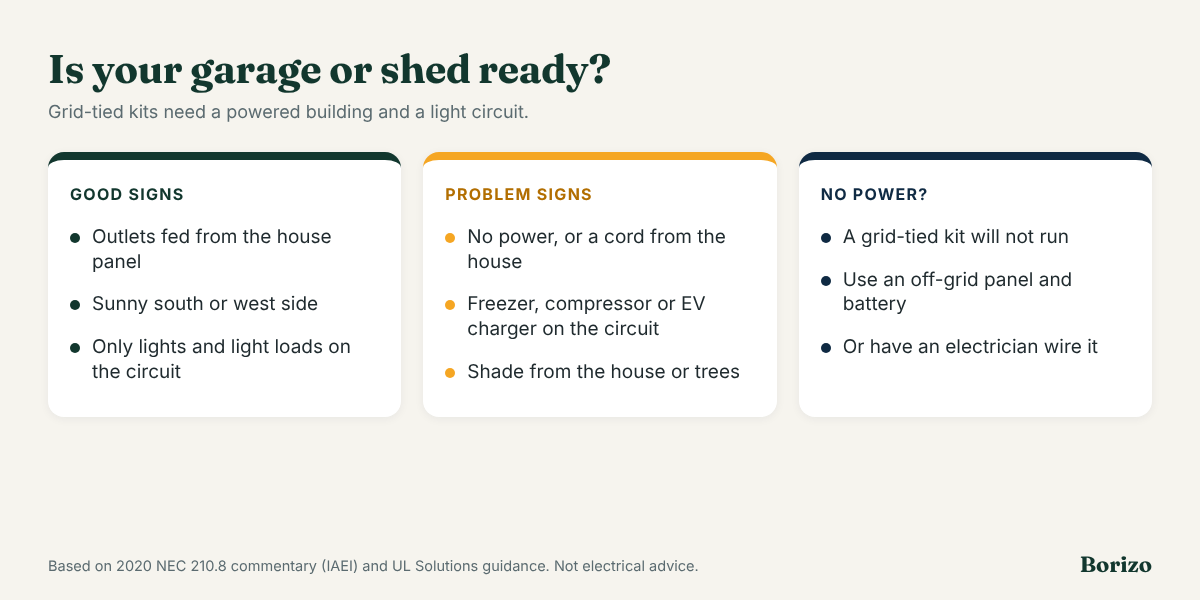
Is your garage or shed a good candidate?
| Question | Good sign | Problem sign |
|---|---|---|
| Does it have electrical service? | Outlets fed from the house panel or its own subpanel | No power at all, or only an extension cord from the house |
| Is there sun? | South, southwest or west wall or roof edge with midday sun | Shaded by the house, trees or a fence |
| What else is on the circuit? | Lights and a few light loads | Freezer, air compressor, table saw, space heater, EV charger |
| Who uses the power? | The building is on your home’s meter | A separate meter or a shared building |
| Are you allowed? | You own it, or have written permission | Rental or HOA rules not yet checked |
Why an unpowered shed will not work
Plug-in kits are grid-tied. Their microinverter matches its output to the grid and must stop when grid power is absent; that is the anti-islanding safety behavior that protects line workers, explained in our guide to plug-in solar in a power outage. If a shed has no electrical connection to the home, there is no grid for the kit to sync with, and it will not produce.
Running an extension cord from the house to power a shed outlet and then plugging a solar kit into that is not a solution. The official sources we read do not cover extension cords for plug-in solar, and a long cord adds connections, voltage drop and weather exposure. If you want power in an unpowered shed, the usual options are:
- An off-grid solar setup: a panel, a charge controller and a battery, or a portable power station with a solar input, powering lights and tools inside the shed only. See plug-in solar vs a power station.
- Proper wiring to the shed, installed by a licensed electrician, usually with a permit. After that, a plug-in kit becomes possible.
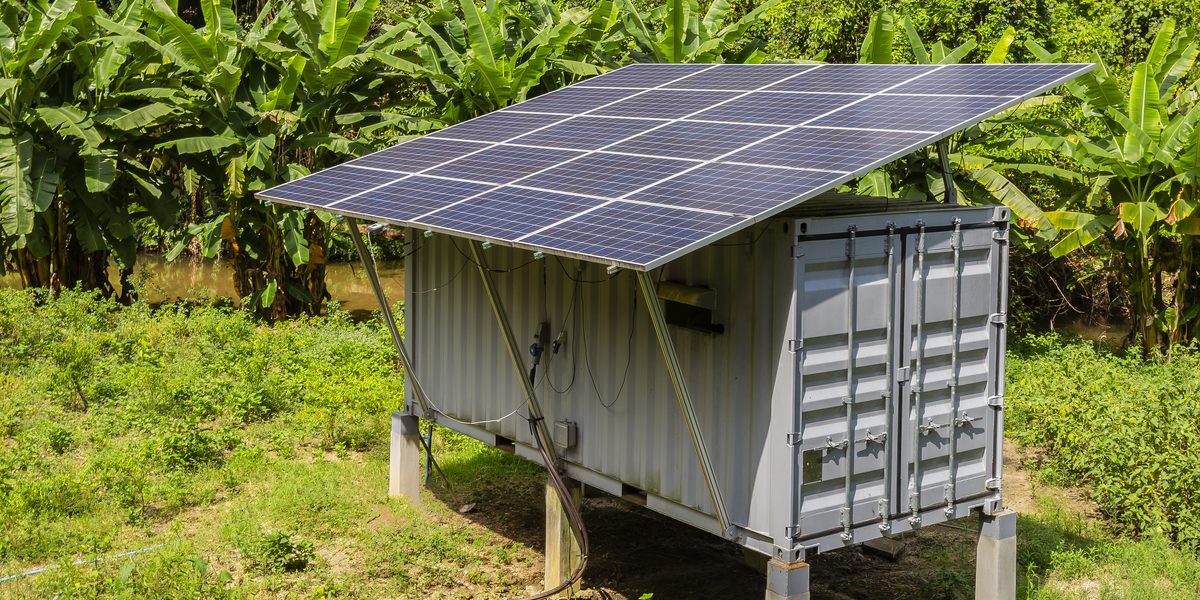
Stock photo (Freepik) for illustration only. It is not a Borizo installation, and we have not tested any product shown.
Garage outlets and GFCI protection
The National Electrical Code requires GFCI protection for personnel on receptacles in several locations in homes. An IAEI Magazine article on the 2020 NEC lists dwelling-unit garages and accessory buildings under section 210.8(A)(2) and outdoor receptacles under 210.8(A)(3). Your local code edition may differ, but in practice, most garage and shed outlets in newer or updated homes are GFCI-protected, either by a GFCI outlet or a GFCI breaker.
That collides with a known issue. UL Solutions, which wrote the UL 3700 plug-in solar standard, notes that ground-fault devices are designed around current flowing one way and may not work as intended when a kit feeds power back, “potentially blinding GFCIs.” What that means for you:
- Read the manual. Some manufacturers address GFCI outlets directly. Follow what yours says.
- Do not remove or bypass GFCI protection to make a kit work. It exists to protect people in damp places like garages.
- If the GFCI trips repeatedly, stop and ask an electrician rather than resetting it over and over.
- Ask an electrician about the best outlet, which might be a different circuit or a dedicated outlet suited to the kit.
We found no official source that says plug-in kits are always fine, or never fine, on GFCI outlets. Our outlet guide covers this in more detail.
Busy garage circuits
A plug-in kit’s current joins the circuit at the outlet, and the breaker only measures what comes from the panel. UL Solutions warns that the combined current “can exceed conductor ratings without tripping the circuit breaker.” In a garage, the loads that make this a real concern are common: chest freezers, refrigerators, air compressors, saws, welders, space heaters and EV chargers on shared circuits.
Find the breaker that feeds the garage outlet, note its rating, and list everything on it. If big tools or appliances share it, choose another circuit or ask an electrician about a dedicated one. Our wattage limit guide shows the arithmetic: a 1,200 W kit at 120 V adds about 10 A, a large share of a 15 A circuit.
Where to mount on a garage or shed
- Wall brackets: a sunny garage wall works like any wall mount. A tilting bracket usually beats a flat one. See our mounting guide for hardware categories.
- Ground stand beside the building: lets you set the ideal tilt and keeps the panel off the structure. See the ground-mount guide.
- Roof: putting panels on a garage or shed roof raises roof-load, leak and code questions, and some states treat roof mounting differently from plug-in devices. Check your state’s rule and local permit requirements before considering it.
Whatever you choose, use a mount rated for the panel’s weight and your wind exposure, keep the cable short and protected, and keep the panel and plug away from where cars, mowers and bikes move.
Rules that still apply
A garage or shed does not change your state’s plug-in rules: the size cap, the certification and any utility notice. Use the state rule checker or the State Laws hub. If you rent, a garage or shed is part of the rented property, so your lease and landlord’s permission apply; if you are in an HOA, exterior changes may need approval. Our renters and HOA guide covers both.
Frequently asked questions
Can I plug a solar kit into a garage outlet?
Often, if the outlet is on a circuit without heavy tools or appliances and your state allows plug-in solar. Garage outlets are usually GFCI-protected, and UL says ground-fault devices may not work as intended with a kit, so follow your manual and ask an electrician about the best outlet.
Will plug-in solar work on a shed with no electricity?
No. A grid-tied plug-in kit needs to sense the grid before it produces power, so it will not work in a shed with no electrical service. Use an off-grid panel with a battery or a portable power station, or have an electrician wire the shed first.
Can I power my shed by running an extension cord from the house and adding a solar kit?
That is not a safe or supported setup. The official sources we read do not cover extension cords for plug-in solar, and a long outdoor cord adds risk. Have an electrician install proper wiring, or use an off-grid setup for the shed.
Do garage outlets need GFCI protection?
Under the 2020 NEC, receptacles in dwelling garages, accessory buildings and outdoors need GFCI protection, according to an IAEI Magazine summary. Local adoption varies, so ask an electrician about your home.
Sources
- Laura Hildreth, NEC requirements for GFCI protection, Section 210.8, IAEI Magazine, February 6, 2020 (garages and accessory buildings 210.8(A)(2); outdoors 210.8(A)(3); 2020 NEC).
- UL Solutions, “Question Corner,” IAEI Magazine, July 1, 2026 (GFCIs and one-way current; combined current can exceed conductor ratings).
- US Department of Energy, Solar and Resilience Basics (grid-connected solar switches off when grid power cuts out).
- State laws: see the State Laws hub for official texts.
- Photos: stock images from Freepik, used for illustration only.

Borizo is an independent guide to plug-in and balcony solar in the US. We track state laws, check certification claims against official sources, and compare kits using published specifications. Laws change often, so every state page shows a “last updated” date and links to its sources. We earn a commission when you buy through our Amazon links, at no extra cost to you. Our content is for information only and is not legal or electrical advice.