Plug-in Solar in Hot Weather: How Heat Cuts Output and What Helps
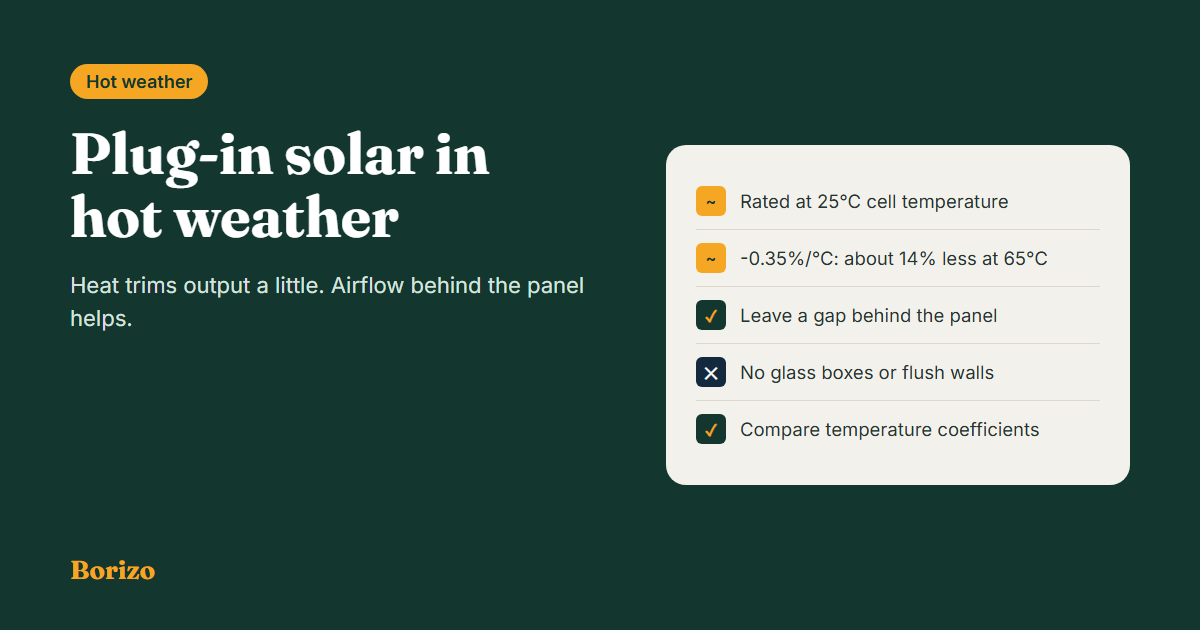
Plug-in solar keeps working in hot weather, but heat lowers how much power each panel makes. Panels are rated at a cell temperature of 25°C (77°F), and they lose a small, fixed share of output for every degree hotter, usually listed on the datasheet as the temperature coefficient. With a coefficient of -0.35% per °C, a panel whose cells reach 65°C makes about 14% less than its rating at that moment. Good airflow behind the panel is the main thing you can do about it. These figures are spec-based math, not hands-on tests.
Heat trims midday output, for example by about 10% when the cells reach 55°C on a typical panel, but long summer days usually still make summer a strong season overall. Mount panels with an open gap behind them, keep them out of glass enclosures, and compare kits by their temperature coefficient: a smaller number, such as -0.30% per °C, loses less in heat.
- Heat lowers voltage. The Department of Energy notes that solar cells generally work best at low temperatures.
- Cell temperature is not air temperature. Panels in strong sun run much hotter than the air around them.
- The datasheet tells you the rate. Look for “temperature coefficient of Pmax” in % per °C.
- Airflow is the fix you control. A gap behind the panel lets heat escape.
Why heat lowers solar output
Much of the sunlight hitting a panel turns into heat, not electricity. The Department of Energy’s solar performance basics explains that higher temperatures slightly raise a cell’s current but cause a much larger drop in voltage, so power falls. That is normal for every silicon panel. A lower reading on a hot afternoon does not mean your kit is faulty.
What the temperature coefficient means
Panel ratings come from Standard Test Conditions (STC): strong, steady light and a cell temperature of 25°C. On a real balcony, the cells are almost always warmer than that in daylight. The temperature coefficient of maximum power (Pmax) says how much output drops per degree above 25°C. Many current datasheets list values somewhere around -0.3% to -0.4% per °C, but the number varies by panel, so read yours.
The math has three steps:
- Cell temperature minus 25°C = degrees above STC.
- Degrees above STC × coefficient = percent lost.
- Rated watts × (100% – percent lost) = watts left, before other losses.
Example: cells at 65°C, coefficient -0.35% per °C. That is 40 degrees above STC. 40 × 0.35% = 14%. A 400 W panel would make about 344 W from the heat effect alone.
Cell temperature is not air temperature
A forecast of 90°F (about 32°C) describes the air. A dark panel in direct sun absorbs energy and runs considerably hotter, more so on still days or when it is pressed against a warm wall. Many datasheets list a “nominal module operating temperature” (NMOT or NOCT), which shows how hot that panel runs under a set of moderate test conditions. On a hot, sunny, windless day, real cell temperatures can be well above it.
How much a balcony kit loses in heat
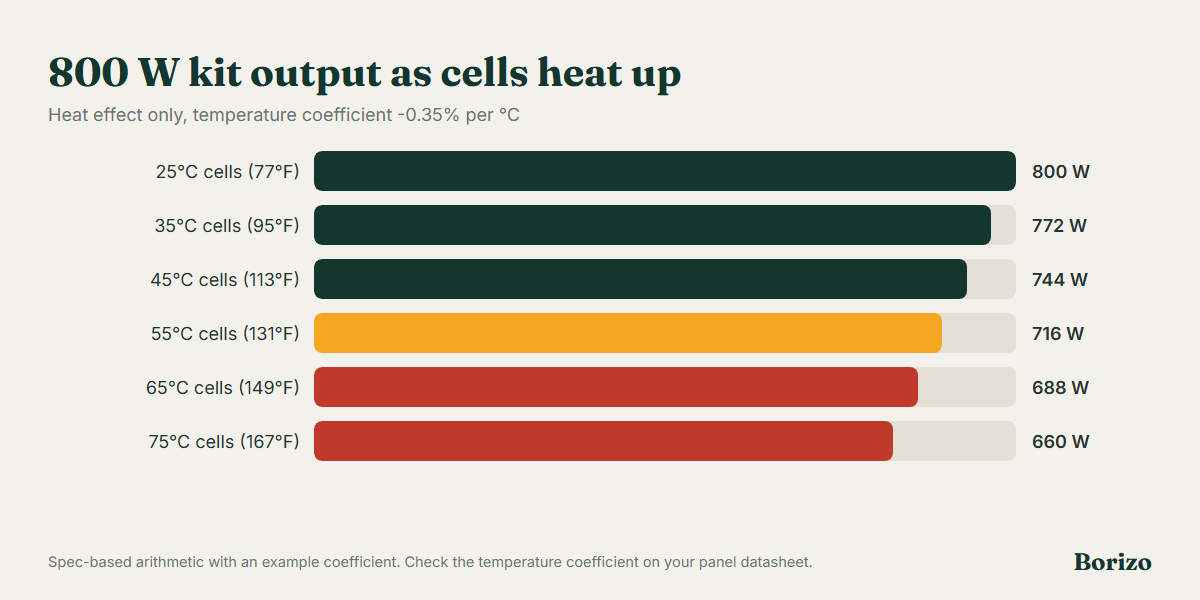
This table uses a -0.35% per °C coefficient and shows the heat effect alone, with no shade or other losses.
| Cell temperature | Degrees above 25°C | Loss at -0.35%/°C | One 400 W panel | 800 W kit (two panels) |
|---|---|---|---|---|
| 25°C (77°F) | 0 | 0% | 400 W | 800 W |
| 35°C (95°F) | 10 | 3.5% | 386 W | 772 W |
| 45°C (113°F) | 20 | 7.0% | 372 W | 744 W |
| 55°C (131°F) | 30 | 10.5% | 358 W | 716 W |
| 65°C (149°F) | 40 | 14.0% | 344 W | 688 W |
| 75°C (167°F) | 50 | 17.5% | 330 W | 660 W |
Why the coefficient is worth comparing
At a 65°C cell temperature, a 400 W panel with a -0.30% per °C coefficient loses 12% (about 352 W left). One with -0.40% per °C loses 16% (about 336 W left). That 16-watt gap per panel matters more in Phoenix than in Seattle, so if you live somewhere hot, compare coefficients when two kits are otherwise similar.
Summer is still usually a good season
Heat trims the peak, but summer days are long and the sun is high. In our PVWatts runs for Phoenix, a 1,200 W kit modeled about 208 kWh in June against about 141 kWh in December, even though June is far hotter. PVWatts includes a temperature effect in its simulation, which is one reason its Phoenix yearly estimate (about 2,120 kWh) is lower than a simple formula that ignores heat (about 2,340 kWh). See sun hours by region for the full table.
How to reduce heat loss
You cannot change a panel’s coefficient, but you can change how hot it gets.
Leave a gap behind the panel
- Use the kit’s brackets to hold the panel off the wall or railing, so air can rise behind it.
- Do not fill the space behind the panel with storage, cushions or boards.
- Do not seal the panel edges against a wall to make it look tidy.
A panel mounted flat against a sun-baked wall gets heat from both sides and has no airflow. The same panel held a few inches off the surface usually runs cooler. Our guides to mounting without drilling and wall and window mounting cover safe options.
Keep panels in open air
Glass balcony screens, sunrooms and clear plastic covers trap heat. If a panel would sit behind glass, it will run hotter and lose more of the light. Open air is better for both.
Use a modest tilt
A slight tilt lets warm air rise along the back and escape. Do not pick an extreme angle just for cooling, because the angle also decides how much sun the panel catches. See best angle for a balcony panel.
Keep panels clean, the safe way
Dust lowers output a little all year. Clean only as the manual says, and do it when the panel is cool, such as early morning, not by spraying cold water on a hot panel. Our cleaning guide has the steps.
Reading your app on a hot day
If your monitoring app shows higher watts at 10 a.m. than at 1 p.m. on a hot, clear day, heat is a likely reason: the cells warm up as the day goes on. If output drops sharply and stays low in all weather, look for shade, a loose connector or a fault instead, and follow the manufacturer’s troubleshooting steps. See how to monitor plug-in solar output.
Common mistakes
- Mounting flush against a wall or solid railing. No airflow means hotter cells.
- Putting panels behind glass. Enclosures trap heat.
- Judging a kit by its hottest midday reading. Look at daily kWh, not one moment.
- Expecting the STC rating in July. STC assumes 25°C cells; summer cells are much warmer.
- Comparing forecast air temperature with the coefficient. The coefficient applies to cell temperature.
- Cooling hot panels with cold water. Follow the manual, and clean only when the panel is cool.
Check your state before you buy
In the US, plug-in solar is generally limited to about 1,200 watts and is clearly allowed only in some states. Check our state laws hub or the state rule checker, then your utility and, if you rent, your landlord. Choose a kit certified by a nationally recognized testing laboratory with anti-islanding protection.
Frequently asked questions
Does hot weather damage plug-in solar panels?
Normal summer heat mainly lowers efficiency while the panel is hot; output recovers as it cools. The Department of Energy notes that extreme heat can shorten a panel’s life, so stay within the operating temperature range on the datasheet and avoid heat-trapping enclosures.
How much power does a solar panel lose in heat?
It depends on the temperature coefficient and the cell temperature. With -0.35% per °C, a panel loses about 10.5% at a 55°C cell temperature and about 14% at 65°C, compared with its rating.
What is a good temperature coefficient?
Closer to zero is better. At a 65°C cell temperature, -0.30% per °C loses 12% while -0.40% per °C loses 16%. Check the “temperature coefficient of Pmax” on each kit’s datasheet.
Why does my kit make less at noon than in the morning?
On hot, clear days the cells heat up through the morning, so midday output can dip even though the sun is stronger. If the drop happens in all weather, check for shade or a connection problem.
Is plug-in solar worth it in a hot climate?
Often, yes. Hot, sunny places also tend to have high sun hours. In our PVWatts runs, a 1,200 W kit in Phoenix modeled about 2,120 kWh a year, the most of the ten cities we checked, even with heat losses included.
Sources
- US Department of Energy, Solar Photovoltaic Performance and Efficiency Basics (cells work best at low temperatures; higher temperature lowers voltage; extreme heat can shorten lifetimes), read October 27, 2026.
- PVWatts Calculator, pvwatts.nlr.gov (Phoenix, AZ run, October 27, 2026, default inputs scaled to 1.2 kW).
- Panel temperature coefficients and NMOT/NOCT values come from each manufacturer’s datasheet; the -0.35% per °C figure here is an example for the arithmetic.

Borizo is an independent guide to plug-in and balcony solar in the US. We track state laws, check certification claims against official sources, and compare kits using published specifications. Laws change often, so every state page shows a “last updated” date and links to its sources. We earn a commission when you buy through our Amazon links, at no extra cost to you. Our content is for information only and is not legal or electrical advice.