Plug-in Solar for a Mobile or Manufactured Home
Manufactured and mobile homes seem like a natural fit for plug-in solar: rooftop systems can be hard to put on them, many owners rent the lot they sit on, and a kit you can take with you suits a home that can, in theory, move too. They also bring questions a site-built house does not: a federal construction code, park rules on top of state law, roofs not designed for extra weight, and, in some older homes, wiring that needs a closer look before you add anything. This guide explains where a kit can go, what to check about the home’s electrical system, the rules that can apply in a park, and a practical setup plan. It is based on HUD, CPSC and state law sources. We have not tested any kit, and this is general information, not electrical advice.
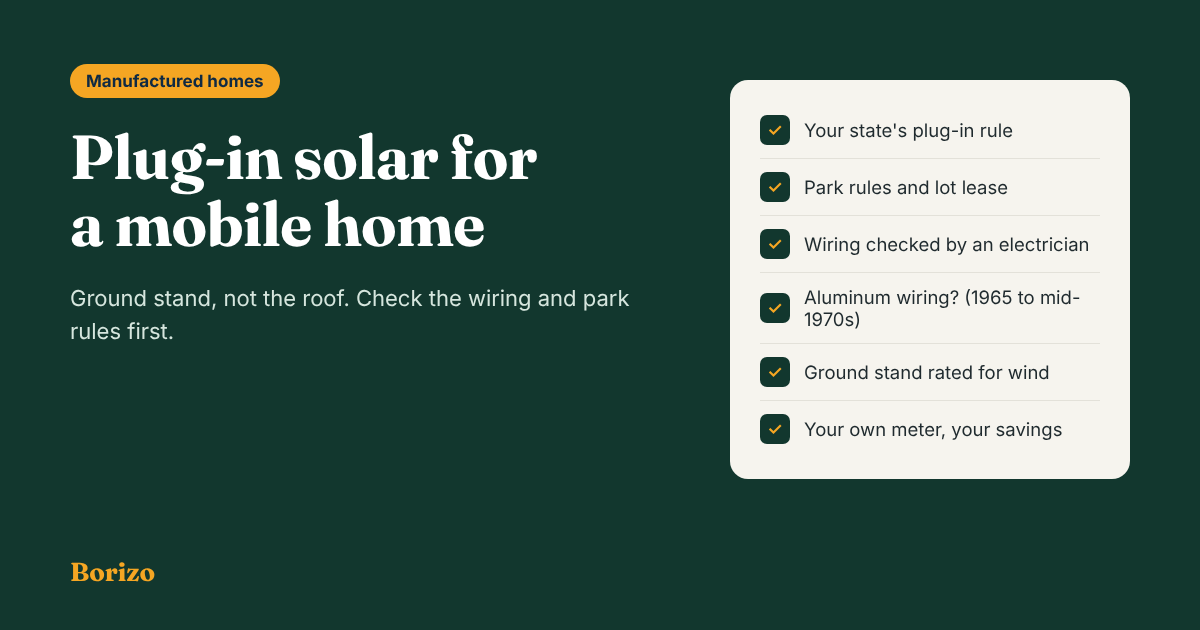
Plug-in solar can work on a manufactured home, usually on a ground stand, deck or porch rather than the roof. Check your state’s plug-in rule, your park’s rules or lease if you rent the lot, and the home’s wiring, especially in older homes. Use a certified kit on a light-load circuit you have identified, keep the cable protected and have a licensed electrician look at the outlet and circuit first.
- Manufactured homes are built to a federal code. HUD enforces the Manufactured Home Construction and Safety Standards, directly and through state agencies.
- Avoid the roof. A ground stand, deck or porch railing is easier and avoids loading a roof not designed for it.
- Older homes may have aluminum wiring. CPSC says homes wired between 1965 and the mid-1970s may contain aluminum branch wiring, whose connections can overheat.
- Park rules apply too. If you rent the lot, the park’s rules and lease work much like a landlord’s or HOA’s.
- The plug-in rules are the same as anywhere in your state: size cap, certification and utility notice where required.
Manufactured, mobile and modular: why it matters
People use “mobile home” for several kinds of factory-built housing, but the rules differ. Homes built to the federal HUD Code are manufactured homes. HUD’s Office of Manufactured Housing Programs enforces the federal construction and safety standards and “authorizes a certification label for each section of a compliant home.” It enforces those standards “both directly and through state agencies,” and owners can take complaints to a State Administrative Agency or HUD. Older homes built before the federal code, and modular homes built to state or local building codes, sit under different rules.
For plug-in solar, the label matters mostly as a clue to the home’s age and wiring. Look for the red HUD certification label on the outside of each section and the data plate inside, often in a kitchen cabinet or bedroom closet. They tell you the manufacturer and date, which helps an electrician know what to expect.
Where to put the panels
| Location | Pros | Cautions |
|---|---|---|
| Ground stand in the yard or lot | Easy to aim south at a good tilt; no load on the home | Park rules; mowing and foot traffic; wind ballast |
| Deck or porch railing | Close to an outlet; similar to a balcony | Railing strength; wind; permission if the deck is not yours |
| Leaning against or strapped to a shed | Uses an existing structure | Only a structure you own; check its strength |
| Roof of the home | Out of the way | Roofs may not be designed for added load; leaks; usually not a plug-in kit’s intended use |
For most owners, a ground stand is the simplest choice. Our ground-mount guide covers tilt, ballast and placement, and our angle guide has a latitude table. Manufactured homes are often sited in open, exposed places, so take wind seriously and choose a stand rated for your exposure.
Check the home’s wiring first
A plug-in kit adds current to a branch circuit from the outlet end. UL Solutions explains that the combined current from the utility and the kit “can exceed conductor ratings without tripping the circuit breaker.” That risk exists in any home, but it is worth extra care in older homes and homes that have been modified over the years.
Aluminum branch wiring in older homes
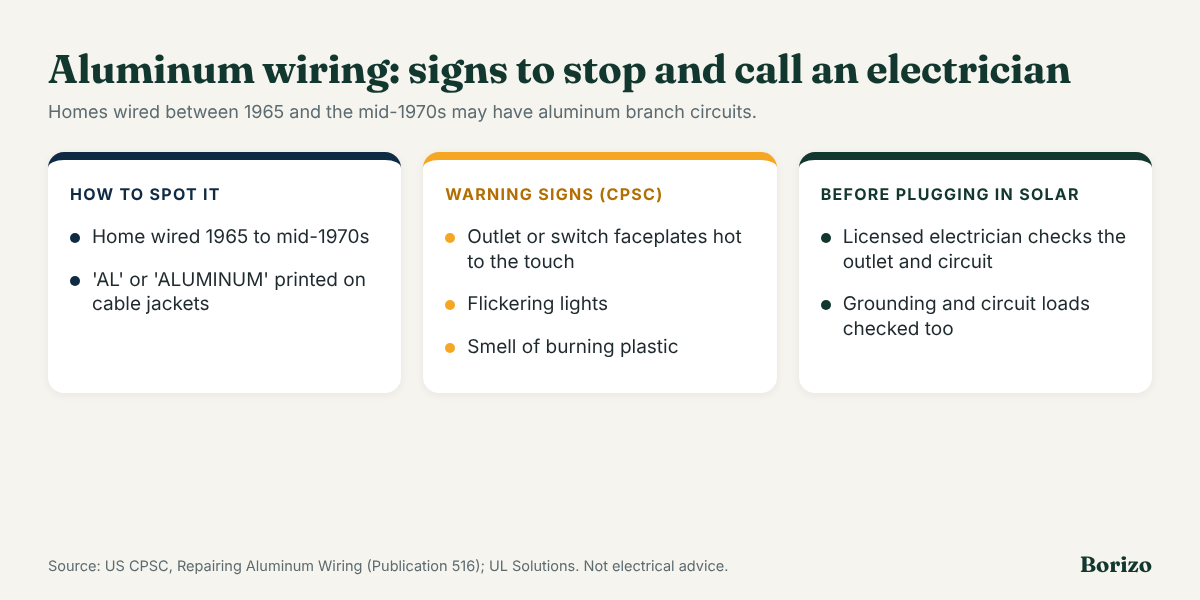
The CPSC says electrical cables installed in new homes between 1965 and the mid-1970s may contain aluminum branch circuit wiring. Its guidance warns that aluminum connections can overheat, that “increased resistance causes overheating, sometimes at hazardous levels,” and that they “have been reported to fail and overheat without any prior indications.” Warning signs it lists include hot-to-the-touch faceplates on outlets or switches, flickering lights and the smell of burning plastic.
The CPSC publication covers homes in general, not manufactured homes specifically. If your home dates from that era, or you see “AL” or “ALUMINUM” printed on cable jackets, have a licensed electrician check the outlet and circuit before you plug in a solar kit. Adding current at an aged aluminum connection is exactly what you want to avoid.
Other things an electrician will look at
- Grounding: that the outlet is properly grounded and the home’s grounding system is intact.
- Circuit loads: which outlets share the circuit, and whether a space heater, window AC or other large load is on it.
- Outlet condition: loose, cracked or discolored outlets should be replaced first.
- Outdoor outlets: if you plan to use one, how it is protected. UL notes GFCI devices assume one-way current and may not work as intended with a kit.
Our outlet guide walks through 15 A and 20 A circuits and one kit per outlet.
Park rules, leases and state law
If you own your home but rent the lot, you live under two sets of private rules: your lot lease and the park’s community rules. They often cover what can sit in the yard, on porches and on the home’s exterior. Treat the park like a landlord or HOA: read the rules, then ask in writing, with the product details, location and how it is secured.
State plug-in laws are mostly about electricity, and few address parks directly. Vermont says covenants and similar agreements cannot prohibit plug-in devices; Colorado’s summary says covenants that unreasonably restrict them are unenforceable and limits association bans from 2027; New Jersey’s bill limits landlords and associations. Whether those provisions reach a particular park’s rules depends on the wording and your arrangement. Our renters and HOA guide covers what the texts say.
The power rules still apply in full: your state’s size cap, certification requirement and any utility notice. See the wattage limit guide or use the state rule checker.
Who is on the electric meter?
In some parks, each home has its own utility meter and account. In others, the park buys power and bills residents, or electricity is included in lot rent. That matters for plug-in solar: savings show up on your bill only if you pay for your own metered power. Virginia, for example, excludes tenants on ratio utility billing from its renter protection. If your power is submetered or included in rent, ask the park how a kit would be handled before you buy.
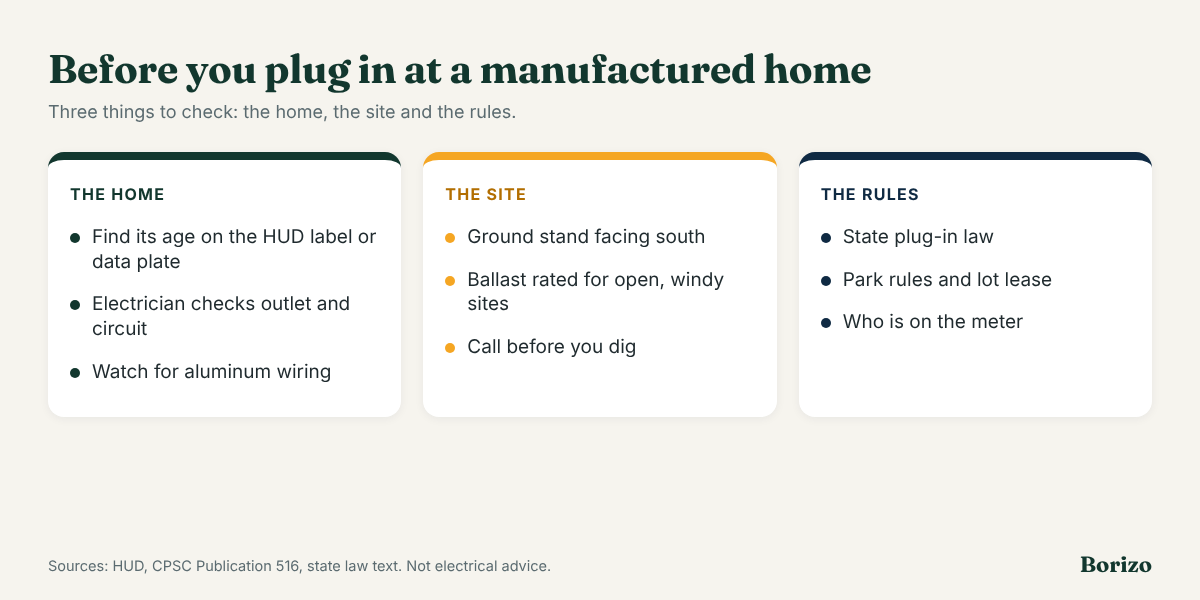
A setup plan
- Check the rules: state plug-in law, park rules and lot lease.
- Find your home’s age on the HUD label or data plate.
- Have an electrician check the outlet, the circuit and, in older homes, the wiring type.
- Choose a spot with midday sun, ideally a ground stand facing south.
- Pick a certified kit under your state’s cap; confirm the listing as our certification guide explains.
- Secure it for wind with ballast or anchors rated for your exposure, and call before you dig if you use ground anchors.
- Route the cable safely to the outlet, away from mowing and foot traffic.
- Notify the utility if your state requires it, then plug in following the manual.
Frequently asked questions
Can I use plug-in solar on a mobile home?
Often, yes, if your state allows plug-in solar and your park rules permit it. A ground stand, deck or porch usually works better than the roof. Have an electrician check the outlet and circuit first, especially in an older home.
Is it safe to put solar panels on a manufactured home roof?
Many manufactured home roofs are not designed for extra load, and roof work risks leaks. Plug-in kits are meant for railings, walls and ground stands, so a ground stand is usually the better choice. Ask a qualified professional before putting anything on the roof.
My mobile home has aluminum wiring. Can I use plug-in solar?
Have a licensed electrician check first. The CPSC warns that aluminum branch wiring connections, found in some homes wired between 1965 and the mid-1970s, can overheat, sometimes without warning. Adding current at an aged connection is a risk to avoid.
Will plug-in solar lower my bill if the park bills me for electricity?
Only if your bill is based on your own metered use. If power is included in lot rent or split among residents, your kit may not reduce what you pay. Ask the park how it bills before buying.
Sources
- US Department of Housing and Urban Development, Office of Manufactured Housing Programs (federal construction and safety standards; certification label; enforcement directly and through state agencies; State Administrative Agencies).
- US Consumer Product Safety Commission, Repairing Aluminum Wiring, Publication 516, June 2011 (1965 to mid-1970s; overheating connections; warning signs).
- UL Solutions, “Question Corner,” IAEI Magazine, July 1, 2026 (combined current can exceed conductor ratings; GFCI and one-way current).
- State laws, read October 26, 2026: Vermont Act 149, Colorado HB26-1007, New Jersey S2368 (third reprint), Virginia HB 395.
- Photos: stock images from Freepik, used for illustration only.

Borizo is an independent guide to plug-in and balcony solar in the US. We track state laws, check certification claims against official sources, and compare kits using published specifications. Laws change often, so every state page shows a “last updated” date and links to its sources. We earn a commission when you buy through our Amazon links, at no extra cost to you. Our content is for information only and is not legal or electrical advice.