Plug-in Solar for EV Charging: Can It Help?
Plug-in solar can help with EV charging, but only a little. A 1,200-watt kit makes about 3.9 kWh on an average day with 4 peak sun hours, which is enough energy for roughly 13 miles of driving in an EV that uses 30 kWh per 100 miles. That is useful for a short daily commute, but it will not replace your normal home charging. The figures here are spec-based estimates, not hands-on tests.
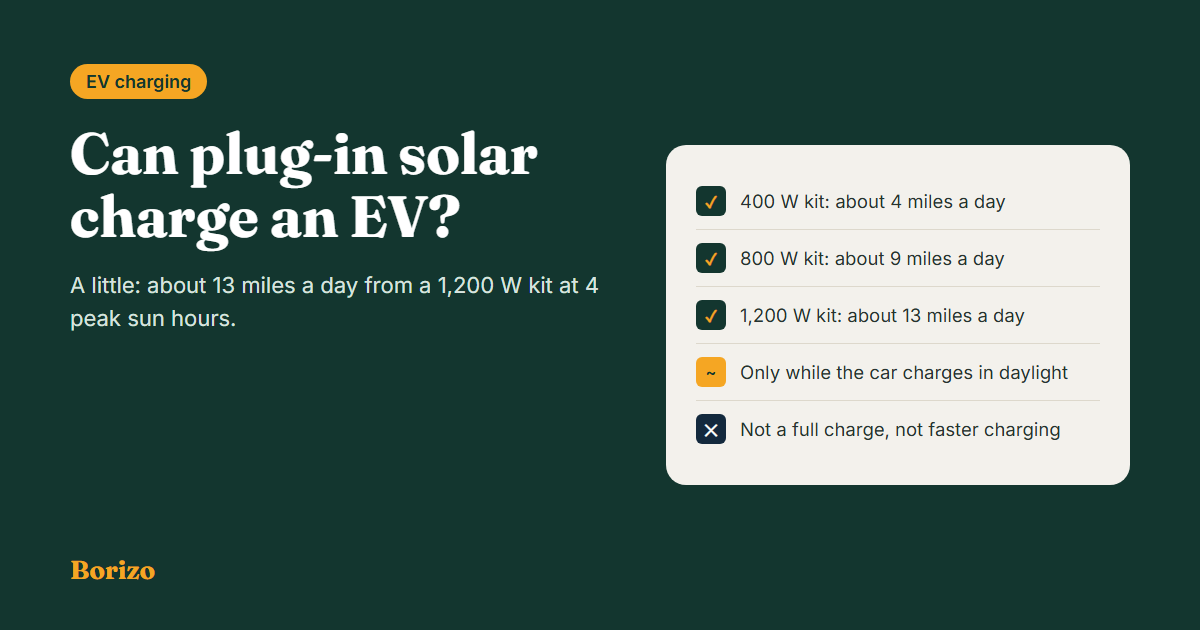
A plug-in kit offsets some of the grid electricity your car uses, mostly when the car charges in daylight. Expect about 4 miles a day from a 400 W kit, about 9 from 800 W and about 13 from 1,200 W at 4 peak sun hours. Even a slow Level 1 charger draws more than any plug-in kit can supply, so the grid always covers the rest.
- A kit does not charge the car directly. It feeds your home circuit, and whatever is running, including a charger, uses that power first.
- Timing is everything. Overnight charging gets no direct solar unless you add a battery.
- Level 1 is already bigger than the kit. The Department of Energy puts Level 1 at about 1.9 kW; a plug-in kit tops out near 1.2 kW.
- Keep the kit off the charger’s circuit. An EV charger is a long, heavy load; ask an electrician before sharing a circuit.
How plug-in solar and EV charging fit together
A plug-in kit has one or two panels, a microinverter and a cable that connects to a household outlet. The panels make direct current, the microinverter turns it into alternating current, and that power flows into your home wiring. Our guide to how balcony solar works walks through the path.
The kit never “talks” to your car. Its power goes to whatever is drawing electricity in your home at that moment. If your EV is charging at noon and the kit is making 900 watts, about 900 watts of the charging energy is coming from your panels and the rest from the grid. If the car charges at 1 a.m., the panels are making nothing, so all of that charge comes from the grid. Whatever the kit makes while the car is not plugged in goes to your other appliances, or out to the grid if nothing is using it (see what happens to extra power).
How many miles can a plug-in kit cover?
We use the same formula as our daily output guide: watts × peak sun hours × 0.82 ÷ 1,000 = kWh per day. The 0.82 factor comes from the PVWatts defaults of 14% system losses and a 96%-efficient inverter. For the car, we assume 30 kWh per 100 miles (0.30 kWh per mile). Many EVs are rated in that general range, but efficiency varies a lot by model, so look up your own car’s kWh per 100 miles on fueleconomy.gov and scale the miles.
| Kit size | Energy per average day (4 sun hours) | EV miles per day (0.30 kWh/mile) | Energy per year | EV miles per year |
|---|---|---|---|---|
| 400 W | About 1.3 kWh | About 4 | About 480 kWh | About 1,600 |
| 800 W | About 2.6 kWh | About 9 | About 960 kWh | About 3,200 |
| 1,200 W | About 3.9 kWh | About 13 | About 1,440 kWh | About 4,800 |
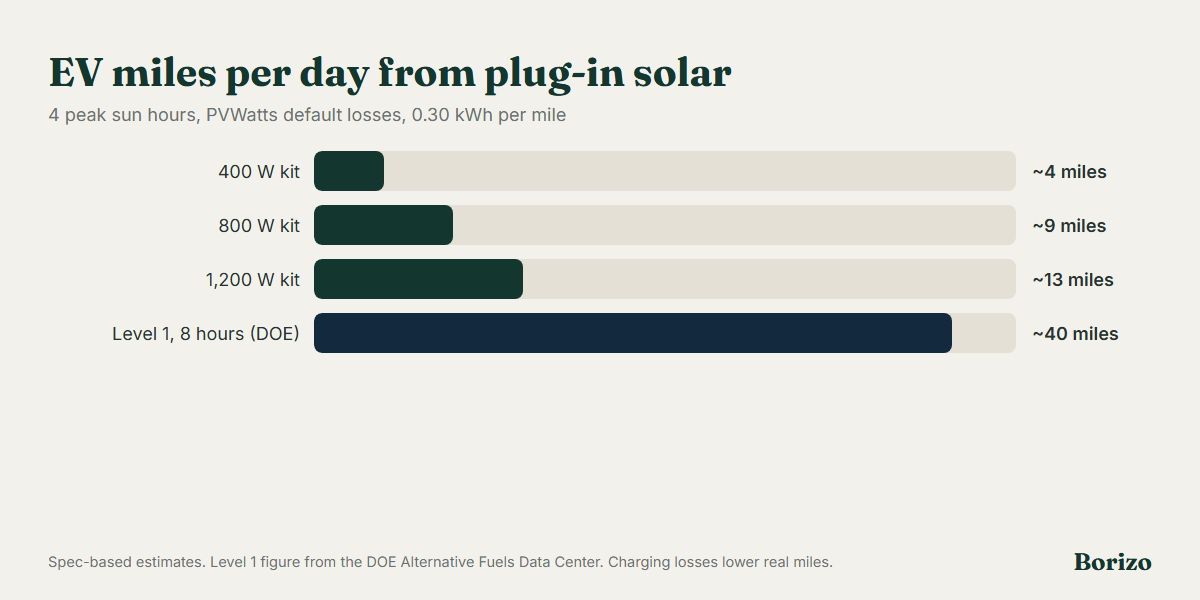
For scale, the Department of Energy’s Alternative Fuels Data Center says 8 hours of Level 1 charging at 120 volts can add about 40 miles of range to a mid-size EV. A 1,200 W kit covers about a third of that on an average day, and only if the car is plugged in while the sun is up.
Your location changes the picture. A sunny Southwest balcony can beat 4 peak sun hours on average, and a shaded or north-facing spot in the Pacific Northwest can fall well short. Our sun hours by region guide has PVWatts numbers for ten US cities.
Level 1, Level 2 and what a kit can actually cover
The Department of Energy’s charging overview gives two useful reference points:
- Level 1 (120 V): about 5 miles of range per hour of charging, assuming about 1.9 kW of charging power.
- Level 2 (240 V): about 25 miles of range per hour of charging.
Compare those with a plug-in kit’s output. At its very best, around a clear midday, a 1,200 W kit can supply most, but not all, of a 1.9 kW Level 1 charge. In the morning, evening or under clouds, it supplies far less. With Level 2, the charger draws several times what any plug-in kit can make, so solar becomes a small slice of each charging hour. That is not a reason to avoid Level 2. It just means the solar share is easier to think about in kWh per day than in charging speed.
The practical takeaway: plug-in solar trims the grid energy your car uses. It does not make charging faster, and it cannot charge the car on its own.
Daytime vs overnight charging
When your car charges matters more than which kit you buy.
- Car at home in daylight: If you work from home, drive a second car, or park at home on weekends, plugging in between about 10 a.m. and 3 p.m. lines up best with solar output.
- Car charges overnight: The kit’s daytime power goes to other appliances instead. That still lowers your bill, as long as you use it, but none of it lands in the car.
- Time-of-use plans: Many utilities price overnight hours lower to encourage night charging. If yours does, shifting charging to midday to chase solar can cost more than it saves. Read plug-in solar and time-of-use rates before you change your routine.
A battery can move daytime solar into the evening, but a battery large enough to matter for an EV is expensive, and a plug-in kit fills it slowly. Our plug-in solar with battery guide explains when that adds up.
Safety: outlets, circuits and EV chargers
An EV charger is a long, heavy load. The Department of Energy’s home charging guide says Level 1 charging works when an outlet on a dedicated branch circuit is available near where you park. Keep the solar kit on a different circuit from the charger, and do not run either through a household extension cord. If you are not sure which outlets share a circuit, see which outlet a plug-in kit can use and ask a licensed electrician. This is general information, not electrical advice for your home.
Is it worth buying a kit for your EV?
Treat EV charging as a bonus, not the reason to buy. The kit saves money on every kilowatt-hour you use at home, whether it goes into the car, the fridge or the laptop. A rough value check:
- Estimate yearly output. The table above gives about 1,440 kWh for a 1,200 W kit at 4 peak sun hours; PVWatts gives a figure for your address.
- Multiply by your price per kWh. The US average residential price was 18.16 cents per kWh in August 2026, according to EIA’s Electric Power Monthly, Table 5.6.A.
- At that average, 1,440 kWh is worth about $260 a year, but only if you use all of it at home. Exported power is often credited at a lower rate.
Run your own numbers in our savings and payback calculator, and see how electricity rates affect savings.
Common mistakes
- Expecting a full charge. A 1,200 W kit covers about 13 miles on an average day in our example, not a full battery.
- Charging only at night and counting it as solar. Without storage, overnight charging comes from the grid.
- Sharing a circuit with the charger. Keep the kit and the EV charger on separate circuits, and check with an electrician.
- Using the panel rating as daily energy. 1,200 W is a peak, not an hourly promise. Multiply by sun hours and losses.
- Ignoring time-of-use pricing. Moving charging to midday can raise your bill if night rates are much cheaper.
- Buying before checking rules. State law, your utility and your lease or HOA all matter.
Check your state before you buy
In the US, plug-in solar is generally limited to about 1,200 watts and is clearly allowed only in some states, with rules that keep changing. Check your state on our state laws hub or with the state rule checker, then confirm with your utility and, if you rent, your landlord. Choose a kit certified by a nationally recognized testing laboratory with anti-islanding protection, so it shuts off when the grid goes down.
Frequently asked questions
Can plug-in solar fully charge an electric car?
No. A 1,200 W kit makes about 3.9 kWh on an average day with 4 peak sun hours, enough for roughly 13 miles in a car that uses 30 kWh per 100 miles. Most EV batteries hold many times that.
Does plug-in solar work with a Level 1 charger?
It can offset part of a daytime Level 1 charge. The Department of Energy puts Level 1 at about 1.9 kW, which is more than any plug-in kit can supply, so the grid always covers the rest. Keep the kit on a different circuit from the charger.
Can I charge my EV at night with plug-in solar?
Not directly. Panels make no power at night. A battery can store some daytime solar for the evening, but a plug-in kit fills it slowly, and the stored energy is small next to an EV battery.
How many EV miles does an 800 W kit add per year?
About 3,200 miles in our example: roughly 960 kWh a year at 4 peak sun hours, divided by 0.30 kWh per mile. Your result depends on your sun, shade, car efficiency and whether the car charges in daylight.
Is plug-in solar for EV charging legal in my state?
It depends on your state and utility. Plug-in solar is generally limited to about 1,200 watts in the US and is only clearly allowed in some states. Check our state laws hub and your utility before you buy.
Sources
- US Department of Energy, Alternative Fuels Data Center, Electric Vehicle Charging Stations (Level 1 about 5 miles per hour at about 1.9 kW; Level 2 about 25 miles per hour; 8 hours of Level 1 adds about 40 miles), read October 27, 2026.
- US Department of Energy, Alternative Fuels Data Center, Charging Electric Vehicles at Home (Level 1 on a dedicated branch circuit).
- US Department of Energy and EPA, fueleconomy.gov (official kWh per 100 miles ratings by model).
- US Energy Information Administration, Electric Power Monthly, Table 5.6.A (US average residential price 18.16 cents per kWh, August 2026), read October 27, 2026.
- PVWatts Calculator, pvwatts.nlr.gov (default 14% system losses and 96% inverter efficiency; output estimates by address).

Borizo is an independent guide to plug-in and balcony solar in the US. We track state laws, check certification claims against official sources, and compare kits using published specifications. Laws change often, so every state page shows a “last updated” date and links to its sources. We earn a commission when you buy through our Amazon links, at no extra cost to you. Our content is for information only and is not legal or electrical advice.