What Does a Microinverter Do in Plug-in Solar?
The microinverter is the part of a plug-in solar kit that most buyers never look at, and it is the part that matters most. The panels make power; the microinverter decides whether that power is usable, legal and safe to put into your home’s wiring. This guide explains what a microinverter does, how it differs from a string inverter, what its ratings mean, why it carries the certification, how long it lasts, and what to check on the spec sheet before you buy. It is based on US Department of Energy and NREL sources, UL Solutions commentary, manufacturer information and Amazon listings we read in October 2026. We have not tested any inverter.
A microinverter is a small box that converts a solar panel’s DC power into the 120 V AC power your outlets use, keeps that power in step with the grid, and shuts off when the grid fails. In a plug-in kit it also sets the AC output that state laws count, and it is where the safety certification is meant to apply.
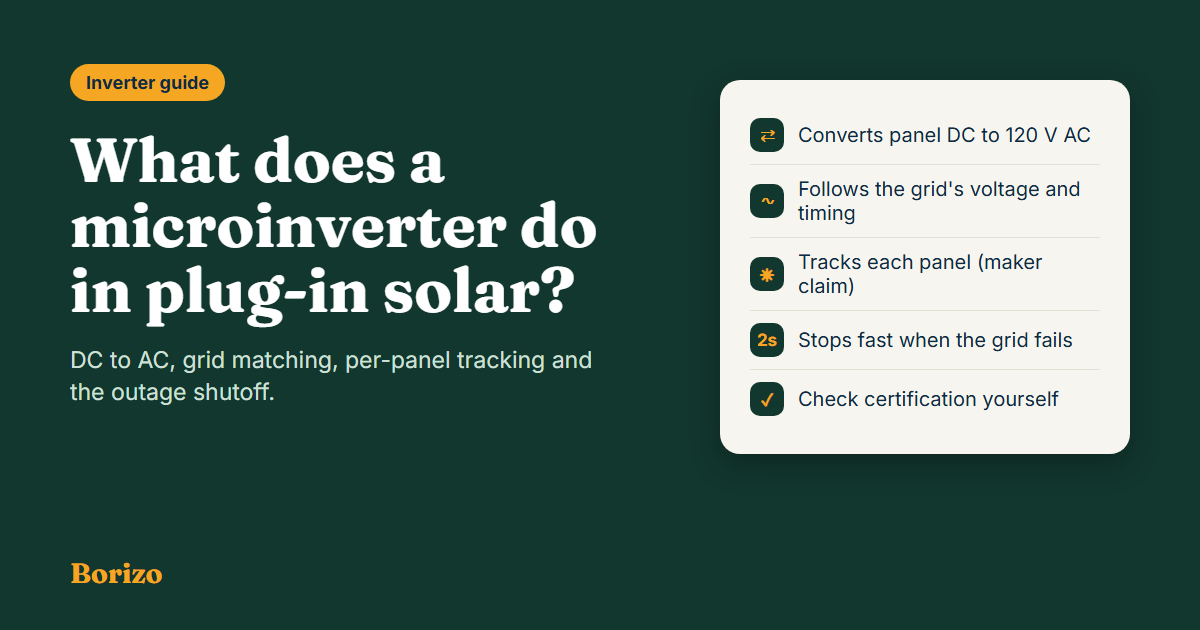
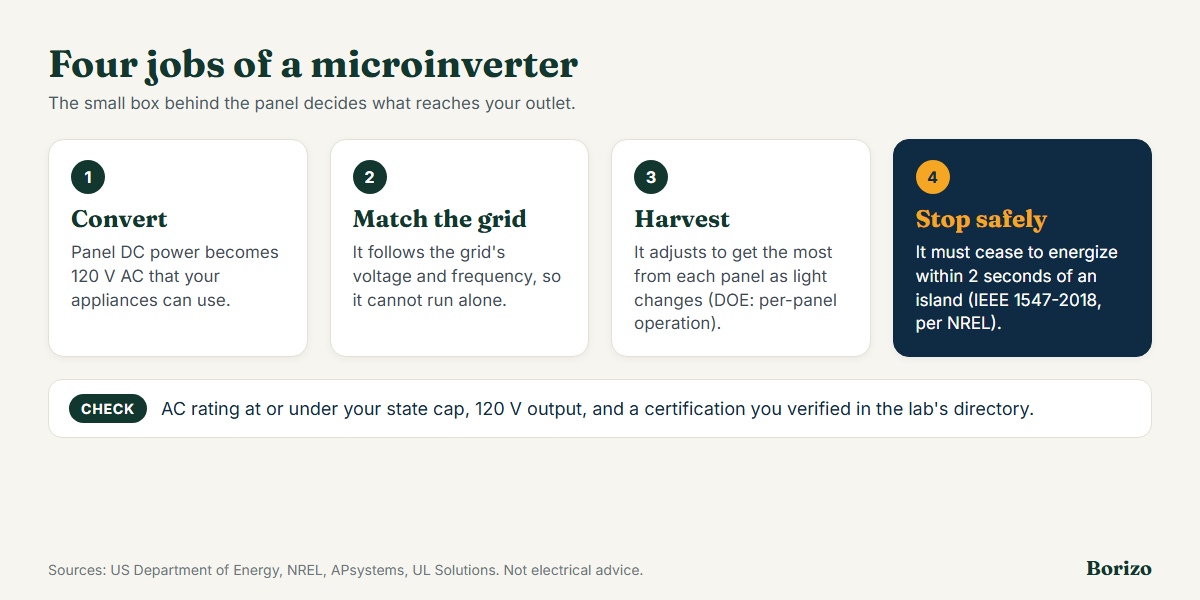
- Four jobs: convert DC to AC, match the grid, get the most from each panel, and stop when the grid fails.
- The AC rating is the number that counts for state caps, not the panels’ DC watts.
- Microinverters handle panels independently, which helps when one panel is shaded, according to the Department of Energy.
- Inverters are replaced more often than panels. DOE expects inverters to need replacing at least once in a 25-year array lifetime.
- Check the certification yourself. Some inverter-only listings we saw said nothing about UL or ETL, and two said they were not UL 1741 certified.
What a microinverter does
1. It converts DC to AC
Solar panels make direct current (DC). Your home runs on alternating current (AC). The Department of Energy describes inverters as the devices that turn the DC from solar modules into the AC used for local transmission and most household appliances. In a plug-in kit that happens in a small box, usually mounted behind a panel, with a cable and plug on the AC side.
2. It matches the grid
A grid-tied inverter does not make its own power system. It follows the grid’s voltage and frequency and pushes current in step with it. That is why a kit does nothing on its own in a blackout; see plug-in solar in a power outage. DOE notes that smart inverters can also communicate with the utility to help balance supply and demand, though plug-in kits rarely rely on that.
3. It gets the most from each panel
The power a panel can deliver changes with light and temperature, and the inverter adjusts its operating point to harvest as much as it can. APsystems, for example, says its EZ1 takes one or two panels and tracks each one independently. DOE says microinverters, which attach to each module, allow independent operation of each panel, which helps when some modules are shaded. See how shade affects balcony solar for why that matters on a balcony.
4. It stops when the grid fails
NREL’s primer on the IEEE 1547-2018 standard says an inverter must cease to energize and trip within 2 seconds after an island forms. APsystems says the EZ1’s built-in anti-islanding protection shuts it down during an outage and that it restarts only after the grid has been stable for five minutes.
Microinverter vs string inverter
| Microinverter (plug-in kits) | String inverter | |
|---|---|---|
| Where it sits | At or near each panel or pair of panels | One unit for a whole group of panels, usually near the electrical panel |
| Shade on one panel | Panels operate independently, so a shaded one need not drag down the others (DOE) | One inverter handles all modules, so shade has more effect on the group |
| Cost and servicing | More units to buy | DOE says a single inverter is generally less expensive and easier to cool and service |
| Typical use | Small balcony and plug-in kits | Rooftop systems wired by a contractor |
| Output | Plugs into 120 V | Wired into the panel |
Reading the ratings
| Spec | What it means | Why it matters |
|---|---|---|
| AC output (W) | The most power the inverter can send to the outlet | State caps count AC output, for example 1,200 W in most states with a plug-in law. See the wattage limit guide |
| Max DC input (W) | How much panel power it accepts | Panels larger than the AC rating are clipped, which wastes the extra |
| Number of panel inputs | How many panels it connects and tracks | APsystems lists one or two panels for the EZ1 and says two units can be paired for up to 1,800 W, above most state caps |
| Voltage and plug | 120 V output with a plug for a standard outlet | Some inverters we saw on Amazon are rated for 240 V and “ONLY support 240V” per their listing, which does not suit a 120 V outlet |
| Certification | UL 3700 and UL 1741, or NRTL listing | State laws require certification, and a seller’s claim is not proof |
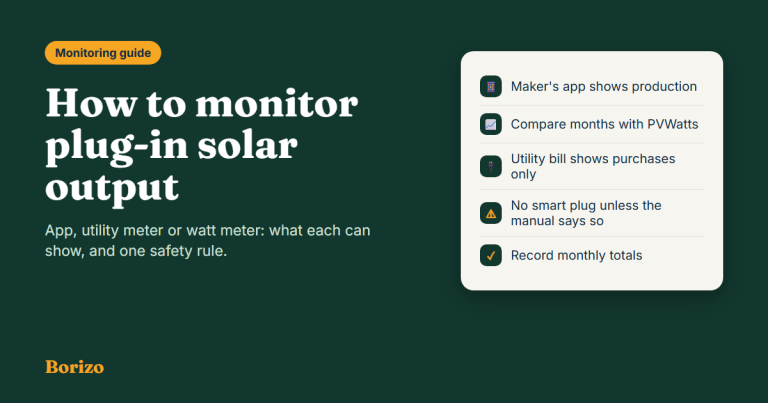
| Monitoring | Wi-Fi or Bluetooth app | Shows output; often needed to register the warranty. See how to monitor your output |
| Warranty and support | Years covered, who handles claims | Inverters fail more often than panels, so this matters |
Certification: where the safety case sits
The inverter is where anti-islanding, power quality and shut-off behavior live, so the certification attaches mainly to it. State plug-in laws require UL 3700, a comparable standard, or listing by a nationally recognized testing laboratory, and APsystems says its EZ1 is certified to UL 3700 by CSA and meets UL 1741 SB requirements. UL Solutions says UL 3700 is the basis for UL certification of plug-in PV products and tells readers to look up listings in its Product iQ database. Our UL 3700 guide explains the difference between “certified,” “compliant” and “listed.”
In our October 2026 read of Amazon.com listings, some inverter-only products showed no certification wording at all, one said “CSA Listed” but was rated 240 V, and two said the inverter “is not UL1741 certified.” We are not calling any seller dishonest: we are saying a listing line is not a certificate. Check the model number in the lab’s directory.
How long does a microinverter last?
DOE says it is expected that inverters will need to be replaced at least once during a 25-year array lifetime. We have not verified the lifespan of any plug-in microinverter, so read the warranty terms, keep your proof of purchase and register the product if the maker requires it. If you plan to keep the kit a long time, ask whether replacement microinverters will be sold separately.
What to check before you buy
- AC output at or under your state’s cap, and a spec sheet that states it.
- 120 V output and a plug suited to a standard outlet.
- A certification you have confirmed in the lab’s directory.
- Number of panel inputs, and whether panels are tracked independently.
- Monitoring and warranty terms, including who supports it in the US.
- Cable length and weatherproofing for where it will sit.
Then compare complete kits in the best plug-in solar kits, and read what plug-in solar is if you are new.
Frequently asked questions
Do I need a microinverter for plug-in solar?
Yes, some kind of grid-tied inverter is needed to turn the panels’ DC into AC and to meet the safety rules. Most plug-in kits use microinverters, which are built into the kit.
Can I buy just a microinverter and add my own panels?
Some are sold separately, but state laws require a certified device, and mixing parts can affect certification and your warranty. Check the maker’s instructions and your state’s rules, and ask an electrician if you are unsure.
Where does the microinverter go?
Usually on the mount behind a panel, with a cable to the panel and an AC cable to the outlet. Follow the manual for where to place it and how to protect it from weather.
Does a bigger inverter mean more power?
Only up to your state’s cap and what your panels and circuit can supply. A larger AC rating can exceed the legal limit.
Sources
- US Department of Energy, Solar Photovoltaic System Design Basics (DC to AC; independent operation of each panel with microinverters; inverter replacement within a 25-year lifetime).
- NREL, A Primer on the Unintentional Islanding Protection Requirements in IEEE 1547-2018 (cease to energize and trip within 2 seconds).
- UL Solutions, “Question Corner,” IAEI Magazine, July 1, 2026 (UL 3700 scope; Product iQ listings).
- APsystems, EZ1 for consumers (one or two panels tracked independently, anti-islanding shutdown, five-minute restart, UL 3700 and UL 1741 SB, pairing up to 1,800 W), read October 26, 2026.
- Amazon.com listings for inverter-only products, read October 26, 2026 (certification wording and voltage ratings as shown in the listings).
- State laws: State Laws hub.

Borizo is an independent guide to plug-in and balcony solar in the US. We track state laws, check certification claims against official sources, and compare kits using published specifications. Laws change often, so every state page shows a “last updated” date and links to its sources. We earn a commission when you buy through our Amazon links, at no extra cost to you. Our content is for information only and is not legal or electrical advice.