What Appliances Can Plug-in Solar Run?
A plug-in solar kit of about 400 to 1,200 watts can run small, everyday loads during the day, such as lights, a laptop, a phone charger, a Wi-Fi router, a TV and a fan. It can help with a refrigerator while the sun is up. It cannot run a whole home at once, and it cannot carry big heating, cooling or cooking appliances on its own. Think of it as a way to offset part of your daytime electricity, not a replacement for the grid. The wattages here are typical nameplate figures, not results from hands-on testing, so check the label on your own appliance and the output rating of your kit.
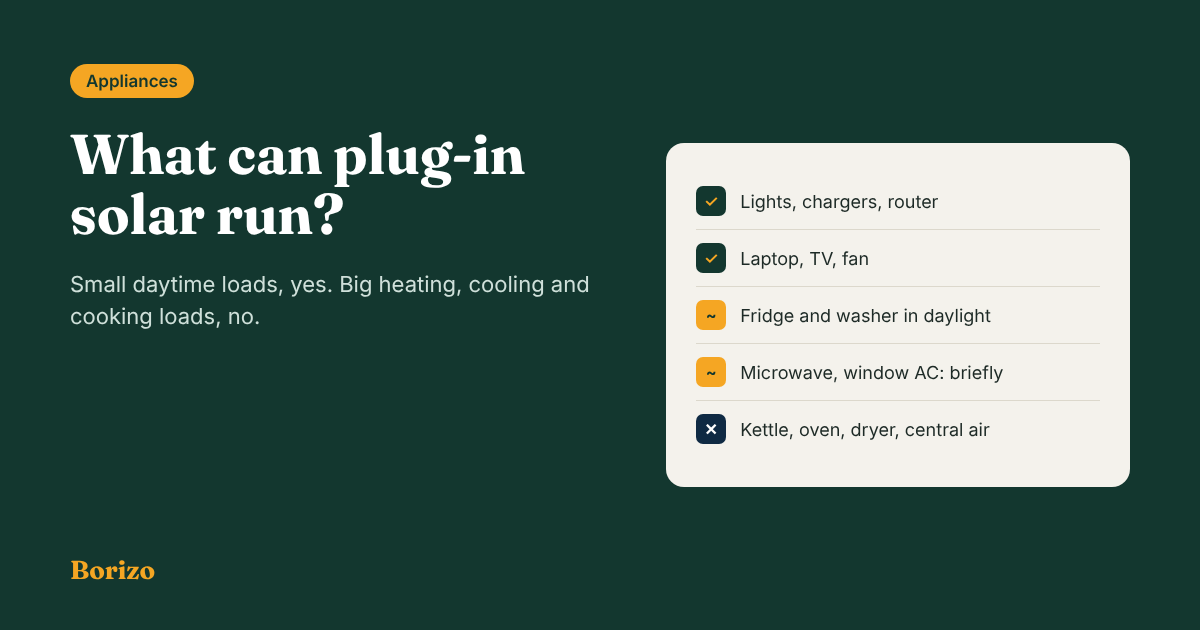
Anything under a few hundred watts that runs in daylight is a good fit: lights, chargers, laptops, routers, TVs, fans and a fridge’s daytime running. Appliances near 1,000 watts, like a microwave or a small window AC, work only briefly or partly. Kettles, ovens, dryers, space heaters and central air are beyond a kit on its own; the grid still covers them as usual.
- Solar power goes to whatever is running right now. The grid supplies the rest, so nothing switches off when the sun fades.
- The 1,200 W rating is a ceiling. Real output is lower in the morning, the evening, clouds and shade.
- Add the watts. Compare what is running with what the kit is making at that hour, not its maximum.
- No sun, no solar. At night or in an outage, a plain grid-tied kit makes nothing.
How plug-in solar works with your appliances
Plug-in solar connects to your home through a standard 120-volt outlet instead of being wired into the panel. A typical kit has one or two panels, a microinverter and a cable. The panels make direct current, and the microinverter converts it to the alternating current your outlets use. Our guide to how balcony solar works walks through the path.
The power the kit makes is used first by whatever is running at that moment. If your home is using 600 watts and the kit is making 500, about 500 watts come from solar and the rest from the grid. If your home is using only 100 watts while the kit makes 500, the extra is not stored unless you have a battery. Solar helps most when your daytime use lines up with daylight.
Most kits also shut off when grid power is lost, so a basic kit without a battery will not keep appliances running in an outage. See does plug-in solar work during a power outage.
How much power does a plug-in kit make?
A 1,200-watt rating (the usual US limit, see our wattage limit guide) is a maximum, not a constant. Output is highest near midday on a clear day, lower in the morning and evening, and much lower on cloudy days or in winter. Shade from a railing, tree or nearby building cuts it further.
For scale, a well-placed 1-kilowatt system in much of the US makes roughly 1,100 to 1,500 kWh a year, depending on location, tilt and shade. You can model your own address with the PVWatts Calculator. A 1.2 kW kit in that range makes roughly 3.5 to 5 kWh on an average day, more in summer and less in winter. That is useful but small next to whole-home use: the EIA says the average US household uses about 10,500 kWh a year, roughly 29 kWh a day. Our guide to average home electricity use works out the share.
What appliances can plug-in solar run?
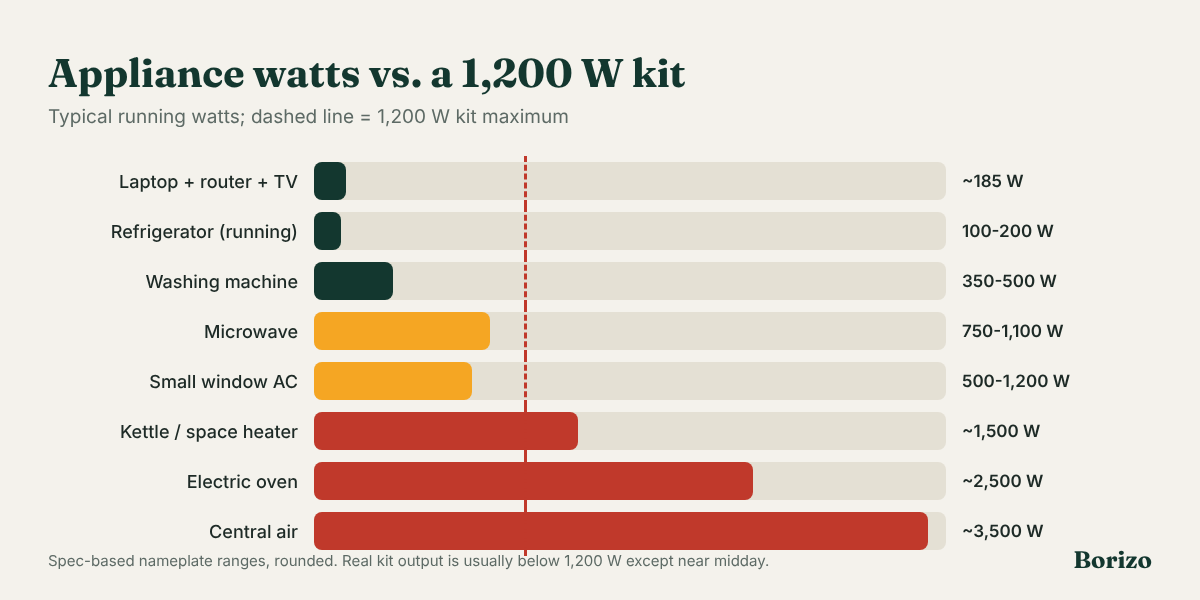
The table uses typical running watts from appliance specifications, rounded for planning. Fridges, freezers and air conditioners also draw a short burst of extra power when their compressor starts.
| Appliance | Typical running watts | Fit with a 1,200 W kit |
|---|---|---|
| LED light bulb | About 10 | Easy |
| Phone charger | About 5 to 10 | Easy |
| Wi-Fi router | About 10 | Easy |
| Laptop | 50 to 65 | Easy |
| Ceiling or tower fan | 55 to 75 | Easy |
| LED TV | 80 to 120 | Easy |
| Refrigerator, while running | 100 to 200 | In daylight, with care |
| Washing machine, wash cycle | 350 to 500 | Sometimes, in daylight |
| Microwave | 750 to 1,100 | Briefly, alone |
| Coffee maker | 900 to 1,200 | Briefly, alone |
| Small window AC | 500 to 1,200 | Partly, at the limit |
| Electric kettle or space heater | About 1,500 | No, over 1,200 W |
| Electric oven | About 2,500 | No |
| Central air conditioner | About 3,500 | No |
| Electric clothes dryer | 1,800 to 5,000 | No |
Appliances it can run easily
Low-wattage, steady loads are the best fit. Lights, chargers, a router, a laptop, a fan and a modern LED TV all draw well under a typical kit’s output, even together. A daytime home office is a good example: a laptop at 65 watts, a monitor at 30, a router at 10 and two LED bulbs at 10 each add up to about 125 watts, leaving plenty of headroom on a sunny day. Our home office guide does the full math.
Small kitchen helpers can fit one at a time, such as a blender at about 400 watts. Add the watts, and keep the total under what the kit is actually making at that moment.
Appliances it can run sometimes, with care
A refrigerator is the appliance most people ask about first. A modern fridge typically draws 100 to 200 watts while its compressor runs, which fits easily within a kit’s output. But it also needs power at night, when panels make nothing. Plug-in solar can offset part of its daytime energy, not run it around the clock. See plug-in solar for a refrigerator.
A washing machine on its wash cycle, at about 350 to 500 watts, can fit on a sunny day if other large loads are off. A coffee maker, microwave or toaster oven sits near the top of a 1,200 W kit. They can run for short periods only if they are the main load. A 1,000 W coffee maker plus a 1,000 W microwave is 2,000 watts, well above what the kit can supply, so the grid covers the difference.
Window air conditioners need extra caution. A small unit may draw 500 to 1,200 watts while running and more as it starts, so a kit covers only part of it, and only in sun. Our air conditioner guide has the details.
Appliances it cannot run on its own
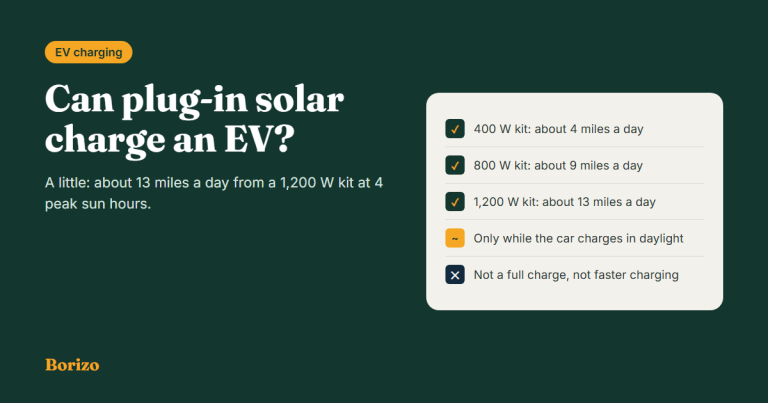
Large heating and cooking appliances are out of reach. Kettles and space heaters at about 1,500 watts, electric ovens at about 2,500, dryers at 1,800 to 5,000, central air at about 3,500 and electric water heaters at 4,500 or more all exceed a 1,200 W kit. They still work in a home with plug-in solar, because the grid supplies the difference, but solar alone will not carry them. Electric vehicle charging is also not practical with a basic kit, since even slow home charging usually draws more than 1,200 watts for hours.
Adding up watts: a simple daytime example
Start with the kit’s likely output at that hour, not its nameplate. On a clear midday, an 800 W kit might make close to 700 watts and a 1,200 W kit close to 1,000. On a cloudy morning, both could be far lower.
Here is a realistic midday mix for a 1,200 W kit: a fridge running at 150 watts, a laptop at 65, a TV at 100, a router at 10 and four LED bulbs at 10 each. The total is 365 watts, which fits easily. Add a washing machine at 450 watts and the total rises to 815, which still fits on a sunny midday with less margin. Add a 1,000 W microwave on top and the total jumps to 1,815 watts. Solar is still helping, but the grid is doing most of the work.
After sunset, panels without a battery make no power, so evening cooking, laundry and TV come from the grid.
What about cloudy days, winter and batteries?
Clouds reduce output but do not always stop it; panels make some power in diffuse light, often a fraction of their clear-day output. Winter brings shorter days and lower sun, so daily energy falls even on clear days. A kit that makes 5 kWh on a long summer day might make only 1 to 2 kWh on a short, cloudy winter day. See plug-in solar in winter and cloudy days.
A battery changes timing, not total energy. Daytime solar can be stored for evening lights, chargers or a TV, but a battery does not turn a 1,200 W kit into a whole-home power source. A battery with 1 kWh of usable energy could run a 100 W TV for about 10 hours before losses, or a 1,000 W appliance for about an hour. Our guide to plug-in solar with a battery explains when it pays.
Common mistakes
- Confusing watts with watt-hours. Watts measure power at a moment; watt-hours measure energy over time. Multiply watts by hours used, then divide by 1,000 for kWh.
- Assuming the kit always makes its maximum. Morning, evening, clouds, shade, angle and heat all lower real output.
- Running several large appliances at once. A kettle, microwave and toaster together are far beyond what solar can cover.
- Ignoring startup surges. Motors in fridges, freezers and air conditioners briefly draw more when they start.
- Expecting backup in an outage. Most basic kits shut off when the grid goes down.
- Buying before checking state, lease and building rules. Plug-in solar is not treated the same everywhere in the US.
Is plug-in solar legal where you live?
In the US, plug-in solar is generally limited to about 1,200 watts and is clearly allowed only in some states. Utah’s 2025 law, H.B. 340, for example, defines a portable solar device of up to 1,200 watts that connects through a standard 120-volt outlet. Other states differ on limits, notice rules and effective dates, and the picture is still changing. Check your state on our state laws hub, plus your utility and any lease or HOA rules. Look for a kit certified by a nationally recognized testing laboratory with anti-islanding protection, which shuts it off when grid power is lost.
Frequently asked questions
Can plug-in solar run a refrigerator?
It can help run a fridge during the day, because a modern refrigerator typically draws 100 to 200 watts while running. It cannot run one around the clock on solar alone, because panels make no power at night.
Can plug-in solar run a TV and a laptop at the same time?
Yes, in most cases. A laptop at 50 to 65 watts and an LED TV at 80 to 120 watts add up to roughly 130 to 185 watts, well within the daytime output of an 800 W or 1,200 W kit.
Can plug-in solar run an air conditioner?
A small window unit can be partly covered on a sunny day, but a 1,200 W kit is not a reliable match, especially counting the startup surge. Central air at about 3,500 watts is well beyond it. In a grid-connected home, the grid covers the shortfall.
Does plug-in solar work at night?
No, not without stored energy. Panels need sunlight. With a battery, stored daytime energy can run small loads in the evening, depending on the battery’s usable capacity and output rating.
Can renters use plug-in solar?
Often, because kits are small and movable and need no roof. In practice it depends on your state law, lease, building rules and a safe sunny spot. Get permission in writing before you buy.
Sources
- US Energy Information Administration, Electricity use in homes (average household about 10,500 kWh a year), read October 27, 2026.
- PVWatts Calculator, pvwatts.nlr.gov (output estimates by address).
- Virginia Cooperative Extension, Estimating Appliance and Home Electronic Energy Use (watts x hours / 1,000 = kWh; typical appliance wattages).
- Utah Legislature, H.B. 340 Solar Power Amendments, enrolled text (1,200 W portable solar device, 120 V outlet).
- Appliance wattages in the table are typical nameplate ranges, rounded for planning; check the label on your own appliance.

Borizo is an independent guide to plug-in and balcony solar in the US. We track state laws, check certification claims against official sources, and compare kits using published specifications. Laws change often, so every state page shows a “last updated” date and links to its sources. We earn a commission when you buy through our Amazon links, at no extra cost to you. Our content is for information only and is not legal or electrical advice.